Unpopular Opinion - Reflections on a culture of nice in ficdom
AO3 has ‘comments’ and ff.net has ‘reviews’. They serve the same surface function but this distinction is powerful in its consequences, especially once bulk fandoms started posting more on ao3 and less on ff.net.
Everyone is terrified to give criticism on AO3 lest they be called a monster or a bully. And the reasons to discourage it are grounded in empathy and a culture of positivity that on the surface, seems like it can’t be argued with. Who can dispute the idea that “if you can’t say something nice to you shouldn’t say anything at all”? FWIW, I think this is part of a bigger system of fear-based cultural trends in fandom social platforms as a whole, but I’ll contain my opinion to AO3 for a moment.
Here’s the truth: getting negative feedback of any kind is hard. It stays with you. It sucks. Sometimes it’s not about your story at all, it’s just harassment about fandom drama. Or sometimes it is about your story and it’s just really mean. And if you’re an active fan or prolific writer, you’ll see more of the grossness bc people like to target someone who stands out. Sometimes it’s not huge or evil it’s just something that didn’t work for the reader and they’re letting you know.
Here’s another truth: when you develop a group culture where all critical/negative feedback is treated like an insult or attack, no matter how mild, you eventually eliminate the spaces for people to provide useful, informative, or sincere criticism. Instead of a space where it’s understood that this is a working community and everyone is here to grow and be better, it’s just about the author posting their art and closing their eyes to any type of response that isn’t reassuring.
In years past on ff.net, in fandoms like BtVs, anime, Harry Potter, AtLA… I would give detailed feedback on chapters, the things I loved, the things that confused me, the things I thought didn’t make sense, the typos they might have missed, where I thought it was true to characters or not. I also received a lot of reviews to this effect. These could be a page long. It was common. If I read a fic that had parts that didn’t sit well with me, I said so, very openly, in a review. I also got messages that did the same.
Because it wasn’t a comment, it was a review. And that difference is huge.
So what’s upshot? From the conversations I’ve had and read, many authors prefer the AO3 culture. They don’t want to be reviewed, they want only supportive comments. And emotionally, I get that. I really do. I’ve been writing since 2001 in over 20 fandoms and I’ve received pretty much any kind of good or bad response that one can get for a story.
But doing it this way, we have lost something. We’ve lost a community that fosters writing and, by extension, internet communication, in a way that teaches you to accept the slings and arrows of public discourse gracefully. We’ve lost a culture that trains you to realize that you can get a flaming horrendous response to art that you posted and it’s not the end of the world. You don’t have to quit fandom and you don’t have to cry for an hour over it. You learn to treat it like noise and you learn to pull the critical value from it that you can. Having a culture that fosters criticism doesn’t just make you hardened against petty bullshit, but it also means someone can feel comfortable saying “I didn’t dig this part of the story and here’s why” and they’ll know it’s not about you and you know it’s not about you, so it doesn’t feel like your heart is getting carved out. There’s a space for talking about the work as a work.
I know that I’m a pretty good writer. I’m not the most consistent or the most creative or the most impactful, and I definitely don’t have the artistic discipline to write a novel sized story. There’s things I need to learn and ways I can improve. But I’m pretty fair at putting a sentence together. While most of that is from practice, I think no small amount is that I learned to write at a point in online fandom culture where I got all forms of feedback, not just approval. I whined a lot at the time, but the criticisms (and my responses to them) shaped me as much as the approvals.
It made me a stronger writer, and even more importantly, it gave me the tools to know when to let something affect me and when to let it slide down my back. It taught me to draw a line between my emotional self and internet drama.
That is a line that is badly, badly needed in fandom right now. We need the ability to talk about things without giving and taking personal offense. We need to respect that there are things we don’t like out there but still cannot and should not change, because our right to exist freely depends on theirs.
By eliminating any small negativities of any kind from our fanfic writing experience (in the name of protection and politeness), writers are growing up weaker. Their writing is weaker, their ability to handle criticism is weaker, their ability to give criticism is basically non-existent, and the subsequent drive toward conformity means everything is a lot more vanilla. There’s less weirdness, less wildness, less original characters and less of anything that isn’t default pleasant or familiar.
I can’t change this, I know that. Many people don’t think these problems I’m describing are happening at all bc it doesn’t match their fandom experience. They wouldn’t change it at all, to them it’s progress. At different times in the past I’ve contributed to the same stuff I’m now calling a problem. It’s taken a while (years) to accept that the community has shifted and that I’m part of that. Because it seemed to make sense and there’s some very moving discussions about keeping things positive to protect the author’s delicate self.
I’m not delicate though. And spending my formative teen fanfic years in a world where feedback was open is one of the reasons why. It made me a better writer and a tougher writer. And I know, from personal conversations, that I’m not at all alone in citing this.
End of the day, this is just reflection. I too conform to the culture of stifling-nice on AO3 comments bc I know that if I did start leaving critical feedback (even wrapped in a nice compliment sandwich), many writers would not know how to react to it. To them, I’d be an interfering bullying jerk who didn’t stay in my lane of being a passive, blindly supportive consumer. And that… well that state of affairs is a real pity, I think. It’s also a pity because fear of saying the wrong thing or an insufficient thing is one of the most commonly cited reasons that people say they don’t leave comments. I’d rather have more comments and accept some critical ones in the mix than to be living in the feedback drought that that is so prevalent. So yeah, I’m sorry this has happened and I’m sorry I contributed to it. As much as I love AO3, and will continue to support it, champion it, part of me also resents that they led us to this.
I think in the dream of making things kinder, we’ve fundamentally made fandom weaker, inside and out. And that weakness leads to people who, when they are faced with challenges, act out of fear, not out of reflection or respect.
Good intentions, y'all. Good intentions. We treated each other like babies, and now we’re vulnerable like them.
I don’t know how much of it is AO3 and how much of it is that the early culture of AO3 was influenced strongly by parts of fandom that didn’t really have a huge public review culture. We come from similar eras and had overlap in fandoms and flists, but you were a lot more active on ff.net than I ever was–I deleted my account when the NC-17 ban hit–and than a lot of the other people I knew in fandom were, including a lot of the early AO3 users.
I seldom saw critical reviews left publicly in the non-ff.net places where I posted stories and seldom got them myself. (Even with mailing lists, it wasn’t something that happened a lot.) The understanding was that crit wasn’t something to be attached to the permanent home of the story, but rather something handled either one-on-one or off in the reviewer’s own space, and that culture and those mores carried over to AO3.
I, personally, have always hated the idea of public critical reviews attached to my actual content–back when I used to post things on LJ where it was posted as a clearly-stated draft with changes that would come, I did invite critique, but public critique was never as useful to me as was having a strong stable of beta readers. (My biggest critique of that kind of critique was that it almost always was about sections I already knew were the weakest, didn’t actually give me anything to go on as to how to fix that, and was therefore like a beta, but without the useful stuff, and there where I could see it and grow more and more neurotic about it, because writing with an anxiety disorder is SO MUCH FUN, OMG.)
What I’d like to see more of is something I had early on, and that’s workshopping communities where you’ve got a certain amount of trust in your reviewer built into the whole deal: you know their strengths, both as a writer and a reviewer, and you know their weaknesses, and you can take that into account when taking their feedback into account. Which may be close to what you had in your communities on ff.net, back in the day.
How to get those started up again? Hell if I know. Maybe there are Discords, but my fandoms these days are so small that I’d basically need to force-feed everyone my canon, brainwash them into actually liking it, and then convincing them they really want to read thousands of words of pointless character study, so it’s all been sort of a theoretical desire on my part.
(Side note: my main reason for seldom leaving comments is a sheepish “I’m usually reading on my phone and it’s a pain in the ass and I always MEAN to do it when I’m back at a keyboard and then, well, I don’t.” and I think a lot of people, if they are actually being honest with themselves, are in that same lazy mobile boat.)
There are absolutely no circumstances in which I would consider unsolicited feedback from strangers, however kindly phrased, helpful. As Neil Gaiman said,
“When people tell you something’s wrong or doesn’t work for them, they are almost always right. When they tell you exactly what they think is wrong and how to fix it, they are almost always wrong.” Unless you’re talking about SPAG, it is very unlikely that I would take that feedback under advisement.
It’s not because I’m thin-skinned. When I send things off for beta, my betas are unsparing and mean, and I welcome that. It helps me improve as a writer. But here’s the thing: I have a level of trust with and respect for my betas (who are usually friends in my writer circles) that you just can’t build without time. We understand each other, we know our strengths and weaknesses, and can work around those.
If there are fanfic writers’ groups out there (I mean, there must be, but idk where to find them), I think that is much more useful than putting your work out in public for critique.
I don’t know what the fuck fanfic communities OP was in, but I’ve been in fandom for 18 years spanning all manner of private archives, forums, Geocities, ff.net, LJ, Mediaminer, Dreamwidth, and AO3, and literally never, never have I ever seen any culture other than “concrit is welcome only when the writer requests it.”
Sure, we had badfic communities, rants and essays aplenty on our personal journals, parody fics, lots of general tutorials hoping to educate writers (Minotaur’s Slash Guide, anyone?), but it was always considered extremely rude to leave the concrit in the comments of the story itself if the writer had not explicitly asked for it.
I picked this up from pretty much the beginning, at age 12, and it made sense to me even then. Fanfiction is a fun hobby. For fun. Do we all want to improve? Sure. And because we do, we ask for help - from people we think can help us. To be perfectly blunt, the vast majority of the unsolicited “advice” I’ve received over the years from people who ignored the cultural norm (which, again, I observed to be consistent across multiple websites and platforms) was worthless anyway, as it came from people who were either worse writers than me or had conflated their own personal aesthetic preferences with valid concrit. No thanks. This isn’t my professional job with professional standards and professional editors. For starters: professional editors have actual credentials and experience. I’m just laughing at the idea that all Rando Internet Readers would have the same guaranteed level of value to add to my work.
Tl;dr I’ve never once encountered a fanfic community where unsolicited criticism was considered normal.
I think OP is more right than they are wrong.
That said I don’t think their fandom experience is at all typical. I definitely never got a page long detailed review on ff.net.
The trouble is that, even once we exclude the troll/flame reviews from consideration, as is only fitting, most reviews are just not interesting, or helpful. Most reviews are, at the end of the day, either “I liked this” or “I didn’t like this”, which, even if I’m desperate for critique is just not helpful. There’s nothing to take from that.
But the other trouble with what the follow up posters are saying is that while I’m glad that they have access to a robust beta community, most people don’t. I’ve been in fandom for years, I have never had a regular beta reader, I have no idea where I would go about finding one, or how. I have never seen any explanation of how this works. Literally never.
I started off writing original fiction and later got into fanfic, and… the attitude that constructive criticism is mean and unhelpful is completely foreign to me. In original fiction the goal is (generally) ultimately to sell your work, and for it to be ready for that, multiple people have to pretty ruthlessly seek out any of the sort of obvious mistakes that might lead to “lol don’t buy this thing.”
Endlessly nice comments on my fic flatter me but they also kind of feel fake. There’s NOTHING in all 10,000 words of this thing that confused you or felt unrealistic? Seriously no fooling?
Because I’d like to think I’m that awesome…
… but I’m pretty sure no one is.
Fandom writers are strangely against criticism unless it comes from, basically, one vector, that being betas. The idea that you can take criticism of one work and apply it to another doesn’t seem to occur to most of them. I understand that it’s an unpaid hobby, but not wanting to improve at all, or only in limited ways, puzzles me.
That, yes.
I think it’s really unfair to say that because someone doesn’t want unsolicited concrit they don’t want to improve. It’s just that there is a time and a place for concrit, and it’s not in the comments section of a fic. If I want concrit I’ll ask my writing group, or my beta readers. And I’ll receive it at a time and a place where I’m expecting it. When I go into my AO3 comments I’m expecting to get praise. Getting negative feedback instead harshes my mood, basically.
I am slowly going through this thread because I understand and have been on both sides of the issue. I honed most of my writing skills through an online writing workshop in the late 90s-early 2000s. I got and gave mounds of critique and learned as much from critiquing others as from receiving feedback on my own writing. (That workshop is still around, the Online Writing Workshop for Science Fiction, Fantasy and Horror, if you’re interested.)
BUT. That was a writing workshop. AO3 is not a workshop. People are not posting multiple drafts hoping to improve and revise. Trust me, even people posting WIPs as they write them are giving you the most polished version of each chapter they can. When they say, “Here is my very best effort. I hope you like it,” they don’t need to hear about what’s wrong with it, especially not in a public place where everyone else can see the criticism. Think of the works on AO3 as finished products, and save your criticism for other environments.
(BTW if you look into your local Nanowrimo region, you might be surprised to find plenty of other fic writers writing and meeting year-round, so that might be a resource for beta help. My local region in a small city area is very active and full of people writing fic as well as original fiction.)
I find this whole thread really interesting – thanks to all contributors for sharing their thoughts and insights into fandom history.
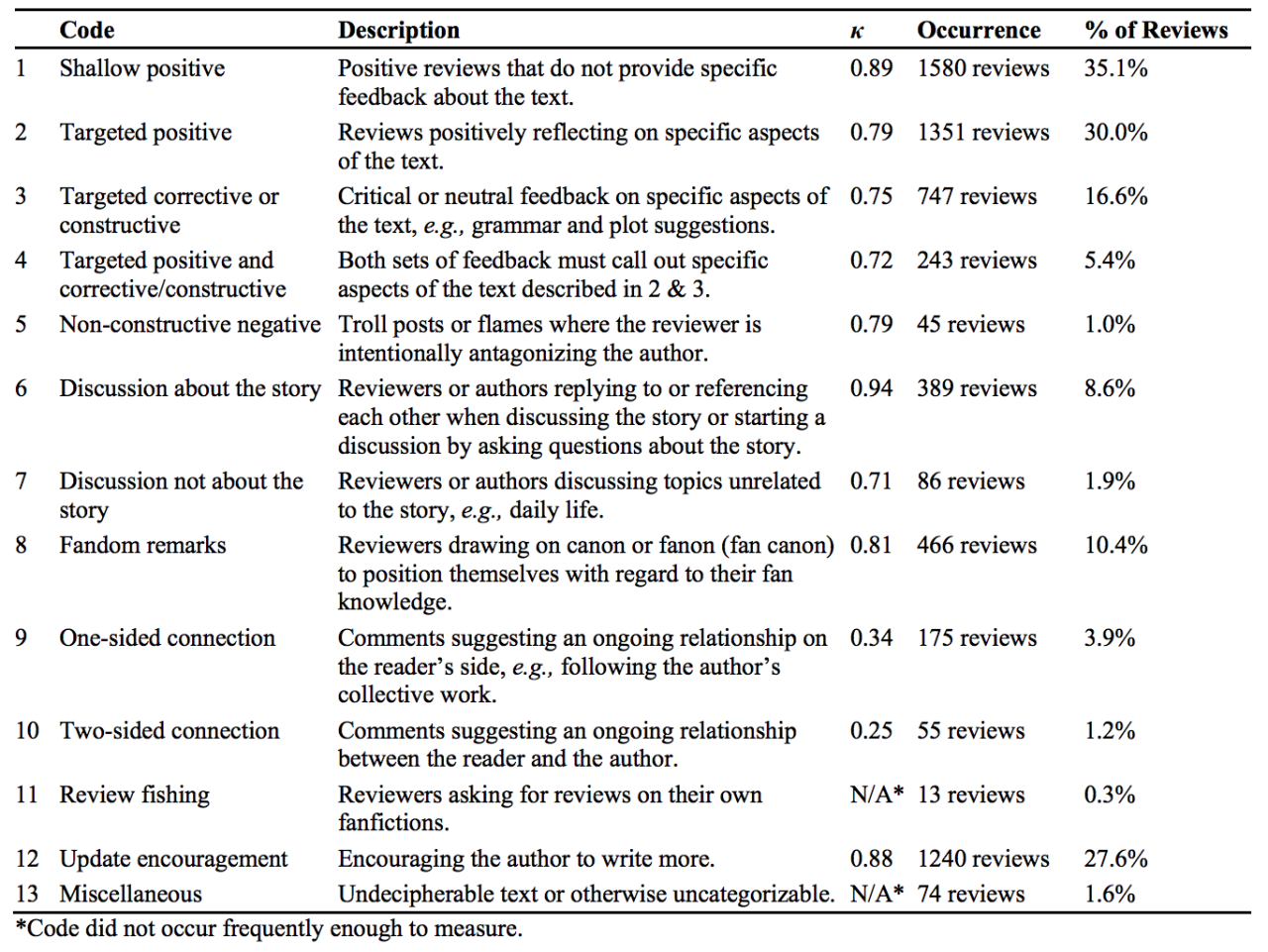
Some academic researchers have started studying the types of feedback on FFN and other sites. There’s a bunch more work to be done there to fully explore when/what kinds of feedback are helpful, but I’ll be interested to follow this and related research. Here’s the breakdown they give of FFN review categories in a 2017 paper, taken from a sample of stories in Harry Potter, Doctor Who, and My Little Pony fandoms:
They found about 22% of FFN comments contain some targeted “corrective of constructive” feedback, with or without additional positive feedback. From my quick skim, their sample of stories doesn’t seem to be fully random, but tiered based on popularity, and also these fandoms are not necessarily representative FFN as a whole. But still, if this data is at all generalizable, the OP is not wrong about their being a bunch of concrit there.
More broadly, on the usefulness of concrit: My experience is that betas are way more helpful than criticism in comments. I’ve occasionally explicitly solicited concrit on AO3, but I’ve rarely gotten anything useful on that front. And I have to admit that I tend to fixate on and angst about unsolicited critiques (whether accurate or not) more than is warranted (while positive feedback can make my week, and be something I return to reread when I’m feeling down). So even if it wasn’t the predominant culture on AO3, I would always hesitate to give anything other than encouraging feedback to writers who haven’t asked for it – especially as many of them are young, inexperienced, and/or just doing this for fun.
On Wattpad, there seems to be a different culture re posting drafts – I’ve observed that lots of authors there are revising their works after posting. Maybe some of the inline comments that they get along the way are concrit to help with that process – but it seems like people mostly leave positive comments there, in my limited experience.
However, while I agree that in theory betas are the most useful, I also agree with @dendritic-trees that finding betas and writing groups can be hard. I think it’s probably easier over on LJ/DW because there are smaller communities where it’s easier to build up relationships, and where challenges sometimes seem to involve organized beta matchmaking. But for some fandoms/pairings, it’s hard to find that kind of thing. And depending on how you “do” fandom (e.g., how cross-fandom you are, and how much you enjoy interacting with other fans), you may have a harder time finding betas than others. Here are a few things that have worked for me, but may not work for other folks:
Leave thoughtful comments on the fic of writers I like. If they respond, eventually offer to beta for them. Then ask if they’ll reciprocate. (This is how I built up a few friendships when I was totally new to fandom.)
Participate in a fic exchange on LJ/DW (like Holmestice) where they required people to have betas, and therefore a bunch of people are volunteering their services as betas.
Bid on beta services in fandom auctions (e.g., FTH).
Strike up fandom friendships – online and/or at cons – and do some co-writing with these people (at the con or in IRC). Opportunities for concrit or longer term writing groups/beta relationships can arise there.
Ask on Tumblr if anyone was willing to do a beta trade – though this first required my having a decent number of followers.
Just flat out ask random people who said they liked my early works if they’d be interested in betaing something new. I probably wouldn’t still do that now, because that seems to be a bit outside norms and might make people feel obligated. But I don’t mind other people asking me for help – as long as they don’t mind me saying no.
Ask people I know who aren’t in fandom but write (or at least read a lot and think critically about it) if they’re willing to trade giving feedback. Some of these folks I met via Nanowrimo (in person or on the foums), which @missdaviswrites mentioned above.
Not all of these have lead to ongoing/long term beta relationships. But usually I’ve gotten something useful out of it! Almost always moreso than anything I’ve gotten from comments.
Super interesting discussion here!
I agree that LJ did not have much of a concrit culture, but it did have a commenting culture. AO3 is designed so that readers can get into long threaded discussions with each other in the comments, or a reader and the author can have a conversation. The functionality is there. For the most part, people don’t use it.
I like obscure fandoms, and I post a lot of one-off fics or vids. I’m not going to get meaty criticism because I’m not posting that much serial stuff with a plot that anybody would think warranted it. What I’d like to see is more people who love obscure thing X chatting about it in the comments.
I would also like to see more people using AO3′s bookmark feature to leave reviews and recs with details. I want some other way for reviewers to discuss with each other, but I don’t want that in fic comments. I’d rather see something more like a fic recs community. The best content of that kind comes when the conversation can be about trends and fanon in general and include more than one fanwork.
I’ve become a better writer by being in fandom, but my fanworks are all done in a rush and posted as fast as I can. I don’t generally use betas because that would add enough time to my process that I would post nothing. (This also informs my opinions about mandatory tagging and warning, as it happens. I’ll often add lots of detail later, but I need the option to mark ‘danger’ and then hit post without giving it any more thought than that. Whether that’s “mean” or “unfair” or whatever, being asked to do more does genuinely decrease my output, and I’ve seen the same thing play out over and over on high-warnings and low-warnings kinkmemes.)
However, every work I make or consume contributes something to the next thing I make. There are more ways to improve than by revising the same work. Whether concrit or observation or trial and error help an individual artist depends more on their personality than on fandom culture.
There are fic-writing discords. Metamorprose springs to mind.