I just dozed off and had a half-waking nightmare where fandom’s post-Tumblr migration was to a walled garden controlled by Disney.
On waking, that is clearly ridiculous because Disney doesn’t own all the copyrights yet, and there are still enough media companies out there that Disney running a platform full of fanfiction for other companies’ properties would be the ninth ring of Licensing Hell. But whatever. Maybe it’s a different behemoth. Maybe Amazon acquires Wattpad, uses its stranglehold over the media-distribution market to extract licensing agreements from most major industry groups, and uses the built-in massive userbase to actually make Kindle Worlds a thing this time.
It makes me wonder what fandom in the year 2017–or 18, or 19–would do if Verizon/Yahoo shut Tumblr down and the media companies were standing there with open arms: “Come post your fic and art to our sites, chat in our forums, get a shot at publishing the next EU novel or at writing an episode of your favorite show. The licensing terms aren’t bad. We will love you, recognize you and validate you. And, you know, we’re modern-day companies–you can post all the gay stuff you want. Just don’t taint our brands with anything actually immoral.” The catch being, of course, that any fanwork outside the walled garden gets pursued with the full wrath of MPAA lawyers’ interpretation of copyright law.
I wonder if today’s fandom would still reject that devil’s bargain.
I think we all know, or suspect, what today’s fandom would do if Strikethrough happened again.
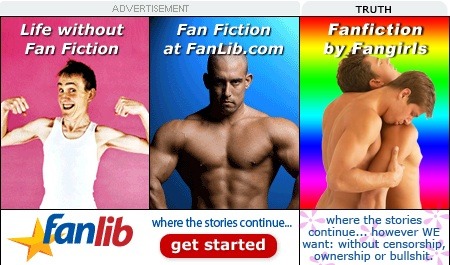
Fanlib tried this. “Post on our site; we have contests and your script could be used on The L Word!” Of course, to enter the contest, you have to give up all rights to your fic and it could be used by anyone who paid Fanlib for it.
Also, they seemed to have some odd ideas about how to advertise a fanfic site:
It lasted less than a year. Commercial promo companies have no idea what appeals to fandom, and even less awareness of how to make it profitable. Every few years, yet another company decides, “oh hey, there’s this ‘fanfic’ thing, and this ‘fanart’ thing, and people are spending THOUSANDS OF HOURS MAKING STUFF that other people want to see, and they’re doing it FOR FREE, and I bet there’s the chance for MONEY in there somewhere.”
They can’t figure out if they want to charge the creators for hosting it or charge the readers for access or get paid by media companies to be curators, but they’re so very sure that there’s MONEY to be made, because money-on-the-internet is all about appeals to eyeballs, and fandom has all these eyeballs waiting for the next chapter, the next sketch, the next fascinating headcanon post.
So they start a site and say FANFIC WELCOME HERE plz don’t break any IP laws and no, we don’t have any statements on how we’ll interpret those when the pressure hits. Also, we’re not going to discuss what kinds of content are or aren’t allowed or what our ratings system actually means.
And they say MONEY WILL COME and don’t say who it’ll come to or how. And they last between six months and two years (that being how long it takes the domain registration to flop) and vanish, and a few years later… a new “entrepreneur” notices fandom and says, “oh hey, here’s all these people making stuff for free! There must be a MONEY option in here somewhere!”
Just remember: if it’s trying to make money, and you’re not paying, you’re not the customer: you’re the product. That’s not always bad - Dreamwidth is a for-profit company, but their customers need a broad array of other posters to interact with; free members are are providing content that paid members want to read, and DW knows what ratio of free-to-paid works for them; free members are an important and valued part of their business plan.
For any place that hosts your content - figure out who’s paying to host it, and what restrictions they want on your content, because that’s going to be what’s important to the owners.