Case Study: An Archive For Fiction of ‘Literary Merit’
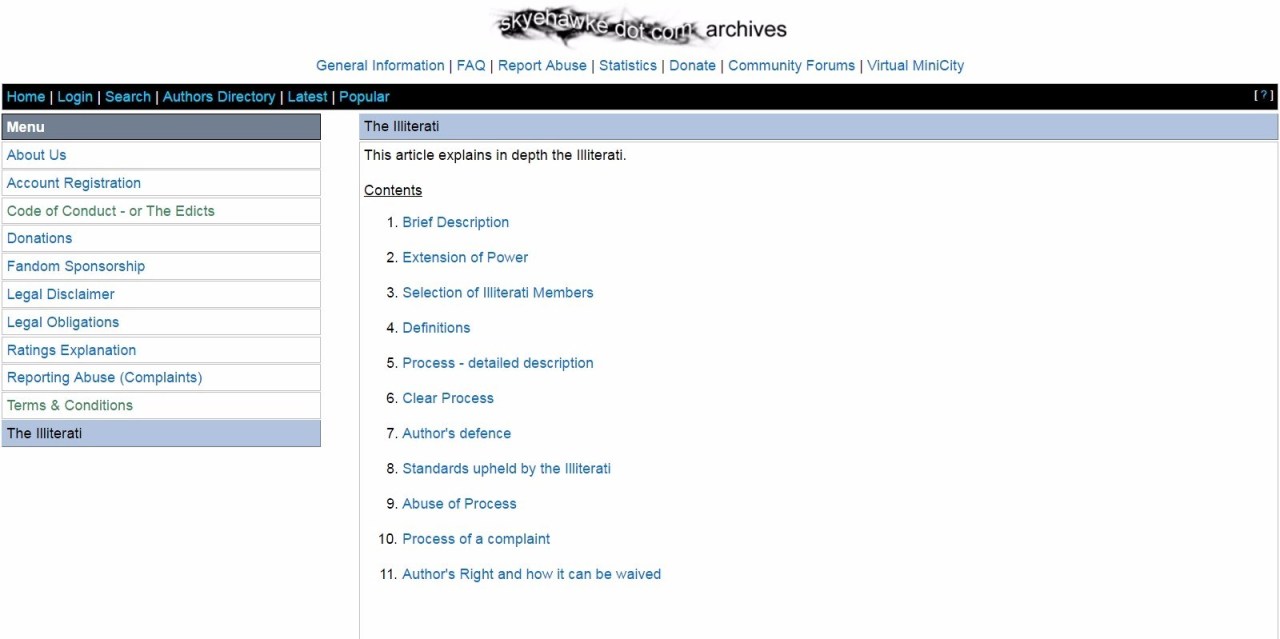
Fascinating read about a multi-fandom archive based in Australia called skyehawke. In 2005, Australia passed stricter child exploitation laws and the archive revised their terms of service to allow people to report fanfic for removal. They created a reviewboard called the “Illiterati” which invited authors to defend their work to avoid deletion. Muddying the waters was the fact that the Illiterati were tasked not only with reviewing underage fanfiction, but were intended to scrutinize a wider range of objectionable text, including non-con fanfiction involving adults and other types of banned fiction that was written for sexual titillation. There was much confusion. More about the archive here.
Some of the solutions that the archive adopted in 2005 may be similar to the current debate as to whether AO3 should start reviewing and removing fiction based on content
Banned fiction and nonfiction was defined as text that was:
- inflammatory
- prejudiced
- bigoted
- exploitative
Especially (though not restricted to) where it is or can be justly and reasonably seen to intentionally sexually titillate (while having no ulterior motive beyond sexual titillation) in situations of sexual violence or indecency as defined by this Terms & Conditions (see below).”
They explained why they chose these things.:
“…..If we used racism and sexism rather than ‘bigotry’ in the "Terms and Conditions” and somebody posted a story that revolved around how old people were stupid and their religion was “tehbestever!” and everybody should convert or “burnineternaltorment!11!” (as some of you might remember from the infamous “Harry Potter Discovers God” posting at fanfiction.net) we’d be unable to bring up formal complaints against that story because it didn’t fall under racism or sexism - yet the intent behind what we were trying to say (i.e. no prejudice or bigotry) would still be there. Rather than handle the vast amounts of arguing, we use a broad term. However, because we wanted to make it very clear we explicitly state that 'exploitative’ does include underage ('chan’) stories that are 'indecent’ and 'sexually violent’. (Now those phrases have been explained to utter death, refer to the clarifications link above for exactly how they apply please for information).“
The restrictions were lifted if:
"These restrictions are exempted where artistic (or literary) merit and/or educational and/or scientific purpose exists. ”
which then led them to this explanation
“And of course: "What do you mean by literary effort? What’s the exact definition? How can we tell? What about the fact that we’re being judged - why should we be judged?”
First, literary is an open definition - it changes from story to story, fandom to fandom. Pratchett has been 'accused of literature’. The Bronte sisters’ works were not literature until after they died. I read a college literary novel while I was in America called “Push” which revolved around the life of a girl who was raped as a child by her father.
“Literary” means the Illiterati are looking for a storyline, a plot line, character development (check out the later Laurell K Hamilton’s Anita Blake books if you want to know how character development can intersect with smut), themes, metaphors, similes - something - in the questionable circumstances that have placed your story before them.
“Effort” means that you TRYING counts even if somebody (probably the complainer) thinks you failed. It also means that the Illiterati are going to be looking at YOU to tell them you tried.
So YES, saying “But I was saying THIS how can you think I meant THAT” is a valid defence.
The Illiterati does have the power to make a decision that doesn’t involve removing your story - for example, they could ask you to put an author’s note explaining what you intended at the end of the story. YES an author’s note - that’s all, so that the people complaining understand what you’re trying to say. That way they stop flaming you - and we stop having to deal with their exclamation marked emails.
The last thing anybody wants is to delete or remove a story - but it might happen, which is why we’ve built this entire process where you can defend yourself and talk it out and come to an agreement.
“Judging” - somebody has to judge. It was either the administration team OR a group of people unaffiliated with the administration (also, unlikely to be really stressed, tired and likely to take the fastest solution if it meant they could get back to doing something else like getting the archive back up).“
In this post the archive went into some detail as to what stories could be challenged.
An excerpt:
”- if you write non-consenting porn between adults , this will only apply to you if it can be seen as a rape fantasy. What makes up a rape fantasy? This is the job of the Illiterati to figure out. BUT these are the guidelines that they’ll follow:
- the entire thing is about rape and how turned on everybody is by the fact that it’s rape
- it encourages you to go out there and rape somebody because it’s so fun and healthy
NOTE: stories that intend to disturb you BECAUSE it’s a rape are free and clear. How do we tell the difference between stories intending to disturb you because it’s a rape and stories that are out to turn you on because it’s a rape? That’s the job of the Illiterati.“
In the end, only a few stories were challenged, with some authors choosing to delete their fiction if they felt they might run afoul of the new TOS. After ten years, the archive is still operational.
Greater detail can be found on Fanlore, the fan run wiki about the history of media fandom.