honestly I don’t even care why ao3 was created, if you defend their policy of not deleting horrible works, or are otherwise completely uncritical/forgiving of their mistakes because “but they’re by fans for fans”, you’re a piece of shit
horrible tropes and abuse have always been a part of fandom and fanworks, but it’s super gross that a bunch of fandom elders (who are most likely at least in their thirties) continue the tradition of citing “don’t like don’t read” as a good enough excuse to write child porn, abuse, rape, sexual slavery, etc. AND they collect thousands of dollars each year to fund this through donations
like. they are literally putting money into abusive content being published on their site. where people of any age, even pre-teens, can access it. for example, I could never report people posting alec/women stuff despite it being homophobic, because it doesn’t violate their terms. I can’t report pretty much anything, because as long as you’re not plagiarizing, it’s all good
yeah, ao3 is great as a concept, but allowing abusive, homophobic, racist, etc. material to be published on your site because “fuck the pc police/moral crusaders” is appalling and fuck ao3 tbh. not to mention they’ve had really disgusting people as members on their board, so it’s pretty obvious what kind of people are in charge of this site
actually you know what i didn’t get to say what i was going to say before because i had to rush off but now i’m just gonna say this – this post is garbage. if little sally doesn’t understand how road signs work, the appropriate question to ask isn’t “how can we make the highway safer for 8-year-olds,” it’s “hOLY FUCK WHY IS LITTLE SALLY DRIVING A CAR?!” when work is tagged appropriately, marked nsfw/inappropriate for those under 18, and warned for everything that requires a warning, the creator’s side of the contract has been fulfilled. period. this is why parental controls and safe search exist. it’s not my job as a hobbyist purveyor of casual filth to prevent someone else’s child from accidentally reading what i’ve written. it’s not my job to parent anyone else’s children. it’s not ao3′s job to convert a twelve-lane highway into a go-kart track for those plastic fisher-price cars you pedal with your feet because hypothetical children might read something they shouldn’t have access to in the first place.
and for that matter, if the argument is “kids will lie about their age to look at that stuff anyway” – yeah, sure, of course they will. funnily enough, i got into harry potter fandom young – started reading fanfic when i was around 10 and 11. you know what i did when i saw things that were tagged in a manner that disturbed me? I DIDN’T READ THEM. I WAS CAPABLE, AS A CHILD, OF CONTROLLING MY OWN MEDIA CONSUMPTION EXPERIENCE. and then i got a little older and turned 13 and read wuthering heights and david sedaris and augusten burroughs and a confederacy of dunces, and then i turned 15 and read lolita and anais nin, and you know what? i. could. handle. it. by. then. yeah, i was a precocious kid (my favorite book at 13 was a fucking confederacy of dunces, for god’s sake), but i was not permanently damaged by anything i read. funnily enough, i was permanently damaged by my ABUSERS, not the literature i read, and sure as hell not by the fanfic.
despite all of my issues with moral wank and purity culture, historically, fandom is a remarkably safe space for younger people to read things that toe the boundaries of what they can find in the YA section at their library, and to try creating things that toe those boundaries as well. it’s not a perfect space by any means, but it served that purpose for me. i can’t say enough good things about what it did for me as a teen who was not allowed to date and whose school stressed abstinence-only sex ed which taught us that masturbation was immoral and condoms would give you cancer. if your argument is “ao3 and content creators have a responsibility to the community” – yes. and we fulfill it by TAGGING THINGS CORRECTLY. if the argument is “but kids will read tagged things anyway” – sure. some will. but as someone who did, i can tell you, kids aren’t fucking stupid. they can differentiate between fiction and reality, and for that matter, they can differentiate between things they want to read and things they don’t.
i am not anyone else’s parent. neither is OP.
s t o p.
“if little sally doesn’t understand how road signs work, the appropriate question to ask isn’t “how can we make the highway safer for 8-year-olds,” it’s “hOLY FUCK WHY IS LITTLE SALLY DRIVING A CAR?!”
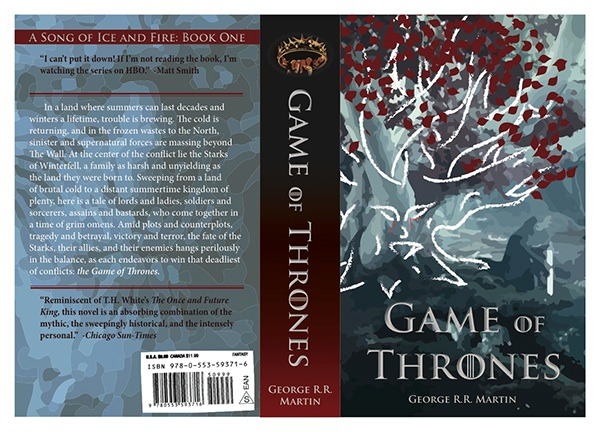
This is the full cover for Game of Thrones (well, one version). The text consists of:
Front Cover - Story Title, Author’s Name
Spine - Story Title, Author’s Name
Back Cover - Quote (”I can’t put it down! If I’m not reading the book, I’m watching the series on HBO.” - Matt Smith), blurb (”In a land where summers can last decades and winders a lifetime, trouble is brewing. The cold is returning, and in the frozen wastes to the North, sinister and supernatural forces are massing beyond The Wall. At the center of the conflict lie the Starks of Winterfell, a family as harsh and unyielding as the land they were born to. Sweeping from a land of brutal cold to a distant summertime kingdom of epicurean plenty, here is a tale of lords and ladies, soldiers and sorcerers, assassins and bastards, who come together in a time of grim omens.Amid plots and counterplots, tragedy and betrayal, victory and terror, the fate of the Starks, their allies, and their enemies hangs perilously in the balance, as each endeavours to win that deadliest of conflicts:the Game of Thrones.”) and another quote (”Reminiscent of T.H. White’s The Once and Future King, this novel is an absorbing combination of the mythic, the sweepingly historical, and the intensely personal.” - Chicago Sun-Times).
Notice what’s not anywhere on that book?
Warnings.
There are no warnings for rape, incest, violence, abuse, slurs, character deaths, rape, nothing. A twelve-year-old kid who likes fantastical stories can and probably has picked this up at a local library, sat down in one of the library chairs or even signed out with it, and gotten to reading.
I know, because once upon a time that kid was me. Not with Game of Thrones, but most assuredly with comparable stuff.
We put adult-oriented television on after nine pm. There are definitely kids who stay up later than that. We put ratings on our movies. I’ve seen toddlers in R-rated films. We make laws to try and keep kids safe, and actual, real-life horrific stuff still happens to them. That’s life.
Fanfiction at least, as mentioned, warns people what they’re getting into. Generally, way better than any other media does, in fact.And that might even be part of why people get so up-in-arms about it. When you go into a book store, you just see glossy covers and titles and generally innocuous quotes. People can happily walk among the stacks without ever knowing how many of those books contain stories that would actually offend the hell out of them.
When you browse through fanfiction, though, you get warnings. And anyone just casually looking at AO3′s archives will see those warnings first, long lists of them, and they might think to themselves that fanfiction is uncommonly depraved.
It isn’t.
I promise you that AO3′s archive is not more racist, sexist, homophobic, or otherwise rife with questionable content than your local library. But you do have better odds of being warned about what you’re getting into there.
I almost never reblog anything having to do with politics
here, but I will make an exception because it’s important to talk about
censorship, especially given the persistence of “anti”
“discourse” on Tumblr and the call to regulate and control content on
AO3. Free speech – especially free speech at the margins of any given society –
is absolutely necessary for liberty and equality. Words like “liberty”
and “equality” are frustratingly abstract, so let me offer a concrete
example of the real effects of censorship with a brief bit of background.
Throughout the 1970s, female intellectuals in the United
States staged a vigorous critique against sexist and violent imagery in their media
and culture, and in 1979 a New York based organization called Women Against
Pornography started to gain traction. Partially because of the outreach efforts
of this organization, in 1983 two law professors named Andrea Dworkin and
Catharine MacKinnon drafted an antipornography law that ended up being passed
by the Minneapolis (a large city in the Midwestern state of Minnesota) City
Council. The twin problems with this law were that it was both hopelessly vague
regarding the nature of “pornography” and extremely specific
regarding its focus on denying the depiction of women’s pleasure. Dworkin and
MacKinnon wrote extensively and published prolifically, and in the next few years
versions of their law were enacted elsewhere, including Los Angeles county and
the state of Massachusetts. Although Dworkin and MacKinnon identified as feminists, local and national
feminist groups wanted nothing to do with them, and their support came from
conservative Christian interest groups, the same people who were also
campaigning to take sex education out of American schools.
In the United States, the Supreme Court eventually struck
these laws down as being unconstitutional as a result of court cases filed
largely by lesbian and gay rights organizations. Canada was even more
conservative than America during the 1980s, however, and the Meese Pornography
Commission that informed and influenced the Canadian Supreme Court’s deliberations
on antipornography laws was utterly dominated by right-wing opponents of
women’s rights. According to the court’s eventual decision in 1992, such laws
were upheld, and the first “pornographers” targeted by police were feminist
and lesbian bookstores (remember that, since these laws only targeted depictions
of women’s pleasure, gay dudes were
largely off the hook). Ironically, because Andrea Dworkin’s 1989 book Pornography contained samples of the
sort of imagery she argued should be banned by law, the actual passage of such
laws resulted her own book being banned in Canada.
Let’s return to the conversation at hand – protecting the
children.
A good case study of how censorship denies resources to
children on the margins, such as children with “queer” genders and
sexualities and children who experience abuse, is the reception of Bryan Talbot’s
1995 graphic novel The Tale of One Bad Rat, which chronicles a young woman’s flight
from home after being abused by a male relative, her struggles with living as a
homeless minor, and the uneasy peace she is finally able to make with her
trauma. According to Talbot, he could have written the story of a homeless girl
finding a home without the depiction of abuse, but, as he says, “the issue
was far too important to marginalize.”
Due to the inclusion of this
depiction, however, the book has been successfully removed from schools,
libraries, and bookstores in Canada, with challengers citing local and national
antipornography laws. The graphic novel is nothing that any sane person would
consider “pornography,” and it was expressly intended to serve as a
source of strength and comfort. Because it was challenged so relentlessly, however, multiple writers and artists from across
the Commonwealth (including, most famously, Neil Gaiman) were continually called on to help defend
it in the ten years after its release. The situation
concerning banned and blacklisted books in Canada has recently gotten better,
but throughout the 1990s and 2000s multiple people were charged, fined, and literally
imprisoned on account of the comics they owned, imported, or ordered for their
libraries.
TL;DR: Fiction and art
can be extremely powerful tools with far-ranging effects, but censorship never
hurts people who are already in a position of power. The victims of censorship
have historically been the young, the queer, the poor, racial and ethnic minorities, and
other people on the margins. Demanding that AO3 remove works with
“problematic” content is a slippery slope, and I promise that fandom,
as a collective community, does not want to go down that road.