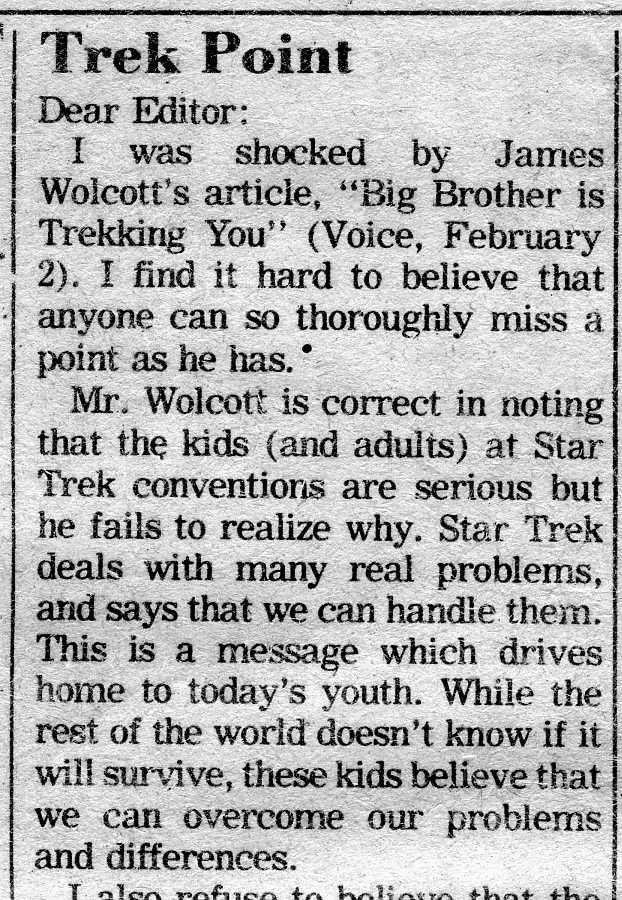
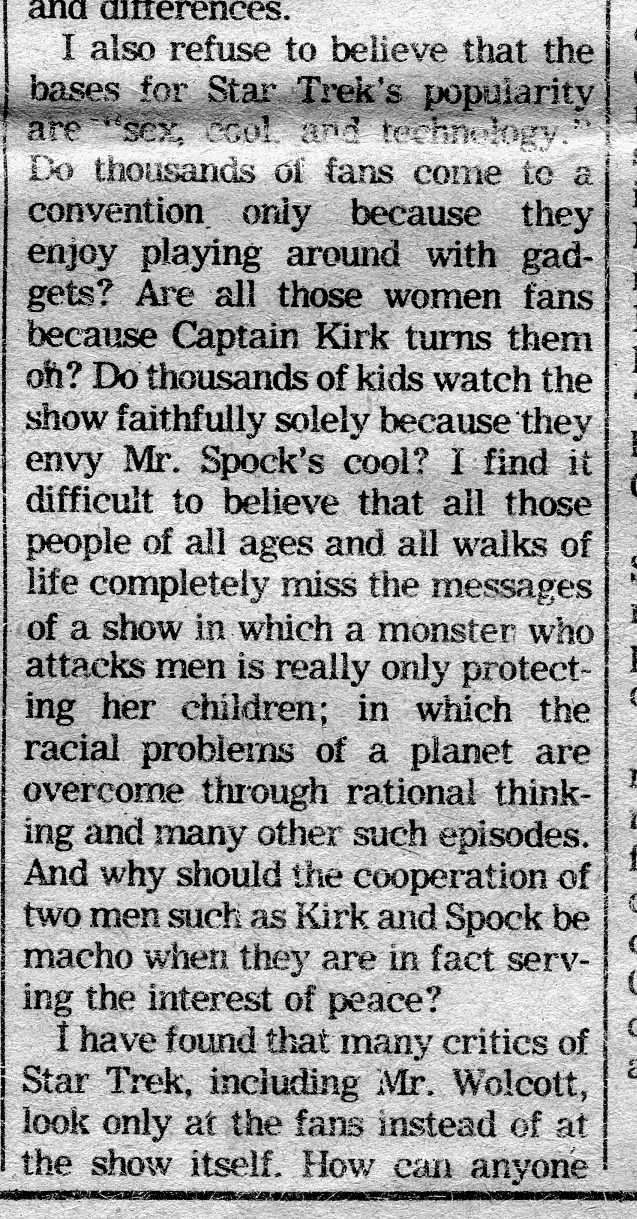
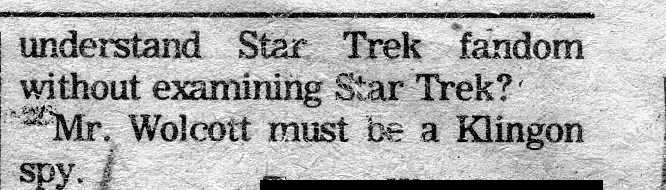
In honor of Star Trek’s 50th anniversary and ST Mission NY starting tomorrow, I present my own tiny contribution to early Star Trek history. In the Feb. 2, 1976, Village Voice, James Wolcott (who went on to become a famous media and culture critic writing for Vanity Fair) used a ST con I’d attended as an opportunity for a scathing (and sexist) critique of fandom. He wrote stuff like:
The emergence of fandom is breathlessly told in a paperback entitled Star Trek Lives! written by Jacqueline Lichtenberg, Sondra Marshak, and Joan Winston. As we shall see, these women have their libidinal thermostats turned up pretty high, hence their prose squeaks and squeals like the rusty springs in a newlywed’s bed, yet the style of their enthusiasm gives much insight into the Trek fans’ mentality. What one comes to understand is that aside from the show’s superb production values, respectable acting, and intelligent writing, the real basis of Star Trek’s popularity is sex, cool, and technology.
and
What’s underlying Star Trek’s appeal, what lies beneath the surface of vulgar merchandise and optimism-effect cant, is an inchoate surging of power–technological and sexual–which Trek fans are trying to tap into.
Even at 14, I knew that basically what he was saying was, Yeah, Star Trek is pretty good for TV, but these overheated, embarrassingly uncool fans – especially the female ones – don’t really get it. Fandom is just a combination of hormones and adolescent maladjustment.
These were the days when fandom wasn’t an accepted phenomenon affectionately seen as adorkable. It was considered truly shameful and nerdy in the worst possible way. And female Trekkies, like Beatlemaniacs before them, were worst of all: desperate, sexually frustrated, emotional, and out of control.
So I took it upon myself to pen a response, and the Voice published it. I’m still pretty proud of this. Today, it would have been an ephemeral post online, one of thousands, but because back then responding meant writing, typing, mailing, waiting, and hoping for publication, I was (I think) the only response to Wolcott’s hatchet job.