Read the full article: https://www.facebook.com/aconitumnapellusstartrek/posts/1639905769606874
“tl;dr - Star Trek TOS Pocket Books currently have no female authors. This needs changing……….all of the current TOS Star Trek novels are written by men. Every. Single. One. Obviously men have a place in Star Trek. Obviously men have a place in science fiction. But women have a hell of a place in Star Trek too. Women were instrumental in keeping it on our screens and so instrumental in the early novels and fan fiction. …..
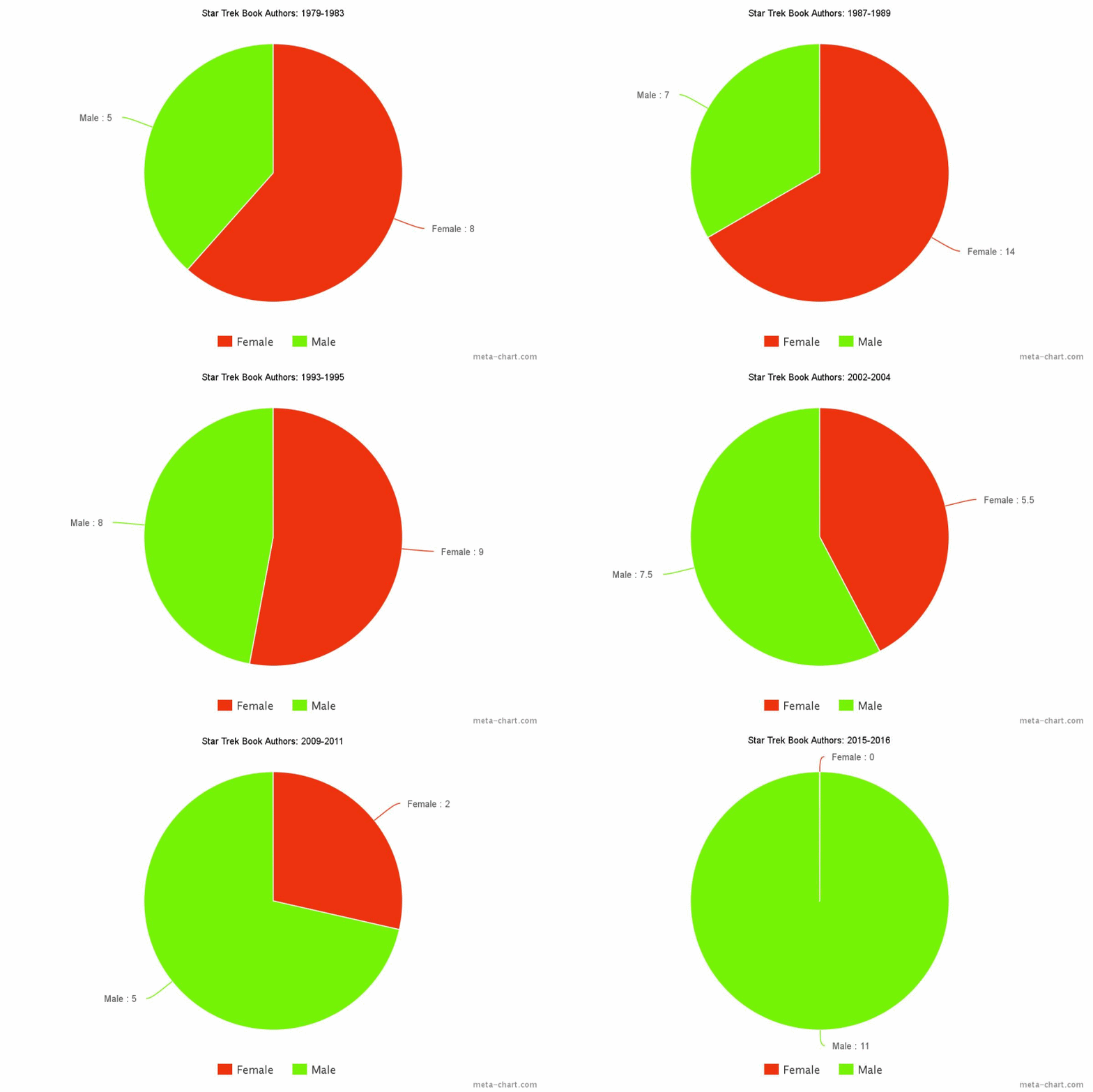
The gif above is the result of my research on the TOS Pocket Books novels published between 1979 and 2016 (of course the 2016 ones are as yet unpublished.) Each frame shows the ratio of authors identified with male pronouns on the internet (in green) to authors identified with female pronouns on the internet (in red)…..
So, what does this gif show? An astonishing slide towards a completely male authors……
……They’re ignoring female writers, and they’re ignoring female readers, too. This needs highlighting, it needs discussing, and it needs changing.”
isn’t the story that fannish women abandoned the Pocket Books gig when they realized it was a pretty rum deal?? not enough money/creative credit, and you can’t do good fic work under the creative constraints placed on profic writers.
Tell me more about this!
urk, I don’t really have sources to hand, this is more in the line of old remembered hearsay … let’s see what I can pull up …
the fanlore page on tie-ins links to some documentation on drama w/Pocket Books in the 80s; I don’t believe that as a rule the payout was very good? And there’s the case of Della Van Hise’s slashy-as-hell book Killing Time, which was re-issued with the queer toned down (though even bowdlerised it’s still delish); K/S was (explicitly?) disallowed, and of course tie-ins are also really hampered by the need for a reset at the close. This article in TWC mentions the editors at Pocket wanting to avoid authors “tainted” by fanfic, so it doesn’t sound like crossover success was much encouraged.
I feel like the vibe I got irt tie-ins as a young fan at the turn of the millennium was that they were fine, but not necessarily a venue for fen to count on for either creative or financial success.
There’s still def. an issue with women’s work being unpaid; but I think it’s the old struggle that was discussed by cupidsbow, among others, back in 2007. Our independence from monetization here in fanspace gives us freedoms undreamed-of by the market - but we don’t get paid, and can’t claim our work in professional contexts.
You see, that raises even more questions. I was talking earlier about how I’d heard a couple of female Star Trek authors discussing how badly they were treated by the publishers. I haven’t read similar from male authors, although there may be complaints out there. Are women treated more badly by the publishers? Are they less willing to put up with it? What’s going on here?
Do the publishers perceive less of a female audience willing to hand over money? Are women going more to fan fiction than pro novels? Is it a vicious circle or something that’s deliberately being pushed? We could ask similar questions about fan fiction. Why is fan fiction so overwhelmingly dominated by women?
The steep decline in women authors across all Trek books started around the time S&S stopped doing open pitches for Trek novels in the late 90s. Since that time one needs an agent to pitch an idea - agents and agencies (and gatekeepers in general) in the publishing business are pretty misogynistic, which means fewer women authors being able to pitch Trek book ideas. That’s my theory anyway!
Honestly, after reading the guidelines about what is and isn’t acceptable material to submit as a novel, I’m surprised anyone is publishing any Trek books. Here’s the official list.
DOs and DON'Ts
There are a number of plots that we would specifically like to avoid:
- Any story primarily about a guest star or non-Star Trek regular. This means no stories about other crews, ships, or guest characters that become the focus of the story. The novels should always “star” Kirk, Picard, Sisko et al. Paramount Pictures feels very strongly that Star Trek stories should primarily be about the Star Trek characters, who must be the major problem solvers in any Star Trek novel.
- Death of an established crewmember or character, or any other permanent change in the Star Trek characters, settings, or universe, such as introducing offspring or close relations of the characters other than those already in existence. Also no childhood or current sweethearts, although you can create temporary love interests. As with all series, the status quo must be restored at the end.
- Any plot that hinges on or describes in detail sexual relations of any kind, especially between humans and aliens. We are not interested in books that suggest anything other than friendship among any of the Enterprise crewmembers.
- No mixing of casts is allowed, which means no plots that mix the characters from one series with another. While we do intend to occasionally cross over between series this will always be handled very carefully in-house.
- Traveling in time to change history or learn something, rescue someone, etc. Also, we are currently overstocked on alternate universe storylines.
- For Deep Space Nine and Voyager, the books should stay current with the programs. Next Generation should, for the moment, be set between the end of the series and Star Trek: Generations, the first movie with the Next Generation cast.
- No stories that turn out to have been a dream, a hoax, or a virtual reality sequence. We are also avoiding novels that start out with an action-packed opening that turns out to be taking place on the holodeck.
- No “test” stories, i.e. stories where the Enterprise is tested by god-like beings studying humanity or judging our worth.
- Avoid trying to definitively map out a character’s history beyond what has already been done in the movies or television episodes. When we do biographical books, we work very closely with Paramount and the writer. As a general rule, the best chance for a Star Trek submission by a first-time Star Trek writer is to submit a “traditional” Star Trek mission story that follows the Problem on Planet/Problem on Ship (or Station) formula. If you’ve been reading the novels, you know that we do take some chances and publish books that push the boundaries somewhat, but be advised that we approach these stories very carefully, working closely with experienced Star Trek writers and Paramount Pictures.
- Do not introduce any levels of technology beyond what has been established in the television shows.
As you can see, a lot of these rules are pretty arbitrary at times and fairly stifling to creativity (not to mention that #3 is blatantly aimed at discouraging shippers). And frankly, it really shows as most of the more recent books are often fairly dull in comparison to some of the stuff published in the 70′s (”Child of Two Worlds” is probably the first exception in a long while where I actually enjoyed a Trek book published after 2000).
Maybe I’m just being optimistically naive, but perhaps the female Trek writers felt that these rules were just too constricting and would rather publish their writing in zines or online where they were free to use their imaginations without restraint. I think it is a stylistic tendency that a lot of female Trek writers (at least the ones I tend to read) tend to focus their stories on new possibilities, “what if?” scenarios, and/or complex emotional journeys, and this list tends to discourage nearly all such writings. A lot of male writers (at least nowadays) may be content with writing yet another story about Capt. So-and-So fighting a space battle/avoiding galactic war/saving a planet and so have less problems working around the guidelines.
I know personally, I had an idea for a fic/possible book, but there is no way in hell it would ever get published under such guidelines since it already breaks about five rules.
Forwarding to the FB fan crowd.