Temba, his arms wide...
A while back I did a series of posts about how technology has shaped – and continues to shape – our fandom culture: here, here and here. The short version: We do not use technology, technology uses us. And I am not alone in blogging about this.
I came across two interesting posts discussing fandom’s migration to newer platforms and think they both fit into my belief that fandom needs to recognize the larger social and technological forces shaping our community .
First up, a fan discusses how twitter hinders fan communication: “The mix of locked and public accounts, trying to follow multi-branching conversations when sometimes you can’t see what half the people are saying, and of course the character limit are all huge obstacles to good fandom discussion.”
Next up: a fan argues that Tumblr benefits both visual and text based fan whereas LJ mainly benefited text base fans (as a text based fan I can say that – for me – Tumblr does not work as a method of discussing with other text based fans. As always, YMMV)
“LJ was text based, so text-based content creation was king, and tumblr is image based, so image-based content gets more attention this way, but the main difference, in my view, is that LJ only had text, which resulted in written content dominating to the point of near total exclusion of nonwriters… I suspect the people singing LJ’s praises didn’t experience how isolating it could be if you didn’t produce the kind of content favored by the platform at the time. Meanwhile the relationships I’ve made on tumblr as a result of a major form of fandom interaction finally shifting to something I’m capable of doing are just as longlasting as the relationships made between writers on LJ, and I bristle a bit at the implication that they’re not.”
My thought: when we use platforms designed by commercial entities for their own purposes, we end up absorbing some of their cultural DNA – this is not necessarily a bad thing and has been going on since the early days of Fandom Dodos (fanzines and mimeo machines oh my!) through the early days of UseNet and bulletin boards across mailing lists and into today. But until we own the platforms; until we design them to meet our needs, we are influenced by these commercial forces in ways we often fail to examine or understand. And because we fail to understand how external forces are shaping and reshaping us, we tend to lose sight that we, as a community, do have agency. We also run the risk of losing the ability to both talk about ourselves and to ourselves in ways that bring us together.
Which is why AO3 (Archive of our Own) speaks to me on so many levels. “We own the servers” is not just a slogan – it is philosophical world view that peers into our future and says: “Oh shit, that’s one big tidal wave coming down on us. Let’s build a boat. And if we get wet, we’ll get wet together.“
And which is why I wish that we had better tools to communicate with our fellow fans – ones that did not encourage us to limit and self-segregate us or force us into creating artificial divisions. I am a text based fan – but I am also a vidder and can communicate visually. I like having more privacy controls – but I may, or may not use them, understanding that with every “locked” tweet or post I am locking myself away. I like to blog about fandom – but also about art and music and politics and social change and kittens. I love it when people tag their posts (easier to find what I want when I want it), but I don’t object to tagless posts. I see myself as a media fan while also acknowledging that many fans who are part of my community do not identify themselves that way.
In conclusion:
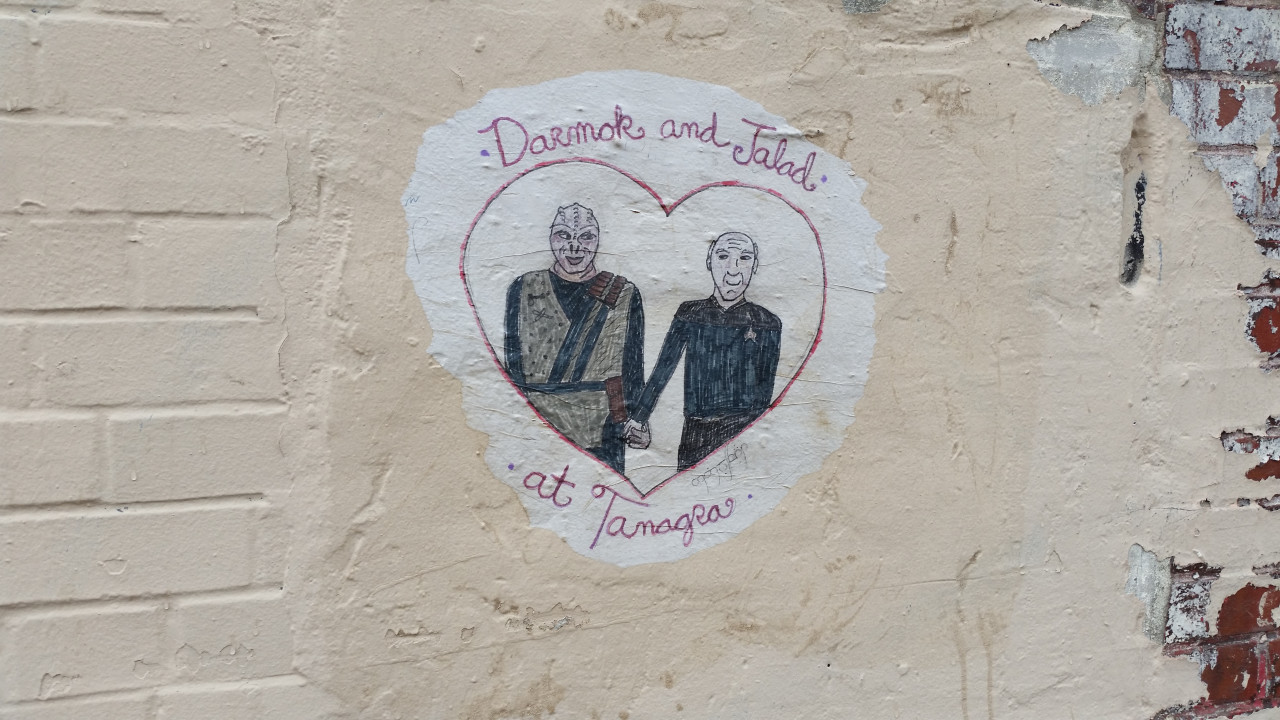
Source. According to one person, the graffiti may be found at New Third World Lounge in Philadelphia. I’d love to know the artist.