I don't know if you've seen it, but there is a small t'pura fandom in here - as in t'pring and uhura! And I don't know if it's a new thing or if someone had already thought of it in the past, but the art and fic about the pair are absolutely adorable. They are absolutely my favourite after spirk 😍
Yes, I have seen some t’pura art here and there! This is a modern pairing; or at least, if anyone shipped them in the 70s, I was not aware of it.
T’Pring, when we saw her at all, was vilified in those days for having dumped Spock and named Kirk rather than Stonn as her champion. No one thought about her possibly limited choices for escape from the marriage, or explored her character except as a stock villain. I’m delighted to see her getting some love these days – both from the fans and from Uhura ;-)
Oh goodness, I have so many stories it’s hard to know what to say here. But I get this question a lot, so I need to just start writing down memories as they come to me or I will never get a post out about this.
Jimmy Doohan (Scotty) gave the best bear hugs in the world. He was not just a cast member but a real Star Trek fan himself. He loved the show, he loved Scotty, he loved the fans. He was a regular con fixture in the ‘70s, and you must remember that back then there were lots of conventions that had maybe 70 or 80 people in attendance. He didn’t care about audience size ; if you invited him, and he was able to come, he came.
Back then everything happened in one hotel. The con would take over the ballroom and a couple of side rooms, and there was always a welcome suite that acted as organization central. The actors stayed in the same hotel as the guests. It was mostly very amateurish, just a handful of dedicated fans getting a smallish group of people together. Jimmy, George Takei (Sulu), De Kelley (Bones), and Walter Koenig (Chekov), could all be counted on to stick around and be pretty accessible all weekend.
George would always make an announcement that if anyone wanted to go running with him, to meet him in the hotel lobby (or wherever) at a set time. Then a group would get together early in the morning and go for a run. He was a pretty hardcore runner, though, so I think most people who went couldn’t keep up with him.
De always brought his wife Carolyn (I can only think of one time I saw him without her, and he apologized all weekend that she couldn’t make it). They were the sweetest couple, really warm to the fans and, what was especially nice, warm to each other. It was obvious they were best friends. And they’d been married close to 30 years by the time they were coming to those early cons.
De took a warm interest in fan work and read a lot of fanzines. He sought out authors and artists and would give in-person feedback on your work, always very encouraging, but also quite thoughtful. You could tell he’d read your work and thought about it. He had an ever-increasing set of humorous poems that he wrote for the fans, and he would read these at conventions. Reading his poetry to us was such a set feature that regular con-goers would recite some of his older work in chorus with him. It was very interactive and fun, and he would get so tickled that people liked his poems. It was the most charming thing you can imagine to see him get so pleased at the audience’s response to his writing that he would do that bouncy thing on his toes.
Walter always seemed kind of serious to me, but he was a great conversationalist. He was extremely well-read and could be counted on as a great person talk books with.
Nichelle Nichols (Uhura) was the goddess she was then, is now and always shall be. She didn’t hang around the way most of the guys from the cast did, and anyway I was a little in awe of and shy with her, so I never took much opportunity to talk to her.
I did see Leonard at numerous conventions over the years, but he was a
special case, because by the time cons really got going, he had become
so popular that it was just not possible for him to hang out the way the
others did. In earlier days I’d had a chance to interact with him
through his fan club, but I’ll write another post about that.
Mark Leonard, the original Sarek, was an occasional guest. He seemed very laid-back and approachable. Soft-spoken. It was wonderful to see him laugh.
JImmy was the one cast member I spent considerable time with, though
only ever in the context of a Star Trek gathering. We first met at the
beginning of the 70s when I was on a committee trying to get Star Trek
back on the air, and were just very friendly after that. My oldest
child has very fond memories of him.
The last time I saw him
was perhaps a week after The Search for Spock had hit the theaters, in the summer
of ‘84. He and his wife Wende were in St. Louis for a convention, and a
small group of us went to dinner and then for drinks until some small
hour of the morning. He was extremely warm, exceedingly funny, a great raconteur, and
some of my fondest memories of those convention days are of drinking
with Jimmy (and usually Wende) and a small group of friends in the after
hours.
He always claimed that the character Scotty was 99% Jimmy and 1%
accent (or something along those lines). I can attest he had Scotty’s
love of a good drink, but he was both funnier and more irascible than
Scotty ever was, in my opinion.
How did you personally react to Spock’s death in Wrath of Khan and not knowing that he was coming back, before Search for Spock was released ? LLAP :-)
I went through a serious grieving period, like losing a very close friend with whom my life had been entwined for 15 years. It was rough!
This is one time I am glad I wasn’t born then. I don’t know how I would have coped.
Word got out well in advance that Spock was going to die in the film. There was a sizable organized movement in fandom to boycott the movie as a result.
Paramount backpedaled then, and dropped hints that all was not as it seemed and maybe he wouldn’t “really” die.
That is why the line was placed at the beginning of the film, when Jim sees Spock immediately after the Kobiashi Maru: “Aren’t you dead?”
That line was written straight to the fans. So we didn’t know if that was it – if that was what was meant by maybe he wouldn’t really die.
The emotional memory is burnt like a scar, and I can remember like it was yesterday the feeling in the pit of my stomach – dared I to hope? – when Jim spoke those words. I spent the rest of the movie leaning forward in my seat, praying to the universe “Please let that be it. Please let that be Spock’s ‘death.’ Please, please, please.”
But the moment Spock got that look on the bridge, then stood up and walked down to engineering, I knew. Everyone knew. I remember people starting to cry in the theater as soon as he went into the reactor chamber.
As for me, I spent the rest of the weekend lying on my bed staring at the ceiling. I can so clearly remember how worried my husband was, and him sitting beside me asking, “Are you going to be ok?” And me: “Of course I’m not going to be ok! SPOCK IS DEAD!!” And then crying. It was just awful.
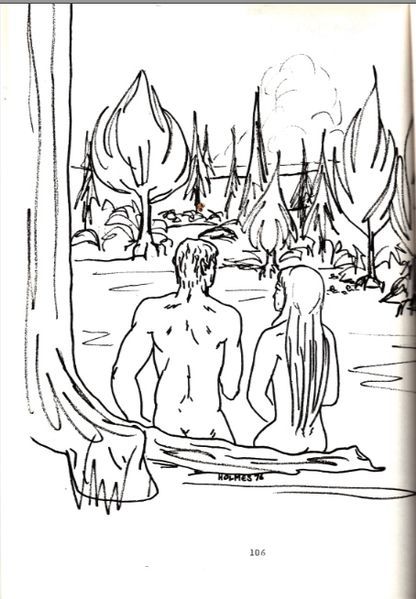
I have to re-post this fan art from Jean Lorrah’s fanzine novel, Night of the Twin Moons, because that peek at Sarek’s butt makes me so happy.
If you like mature Star Trek fan fiction, this is a zine well worth reading. You won’t soon forget the scene where Amanda schools Sarek on being a better lover.
She makes him hold onto the rungs of the brass headboard (which she brought with her from earth) and keep his hands there, to show him what it’s like to have a sexually dominant partner who leaves you frustrated in bed. He gets so frustrated he bends the brass with his bare hands – but he doesn’t move!
Re blogging to answer questions here and in my messages about where to find NTM. I’m guessing it would be one of the easier fanzines from that era (late 70s) to find copies of now, because it was so popular that Jean did 4 or 5 print runs.
If you do find an old copy for purchase, be aware that there are 4 zines in the series: Night of the Twin Moons, Full Moon Rising, NTM Collected 1 & NTM Collected 2 (the last 2 being collections of stories from the NTM universe, most of which had been printed in other zines).
I will be donating my copies to a collection when i pass on, but in the meantime, I will ask Jean if she still holds the copyright on these and if they can be posted on line. If she gives permission, I will see about getting my copy scanned and uploaded.
We didn’t call it ‘cosplay’ back then, but yes, I did. Once. Then I got banned from ever doing it again.
#remember when cons starting posting rules that you actually had to wear clothing to be in the costume competition? #who says green paint isn’t a costume? #dammit, it was the 70s lighten up #George thought it was hilarious and laughed so hard we got in trouble for noise #that quote that circulated for a few years “I’m not giving you my phone number I just want you to carry me around on a platter”? #ok so maybe that came from that evening #or maybe that was just a rumor who can say #hotel security did carry me around on a sheet of plywood though #because there was a sign asking people not to walk naked from the pool through the lobby #did I mention it was the 70s? #ok no naked walking in the lobby #so I didn’t walk #I might have just outed myself because this was a wee bit infamous for a time #I probably should not be posting this #but honestly we were adults having fun and it was actually very innocent #just a little naked #and don’t forget that damn green paint #my kids are going to have a fit when they hear I posted this #lighten up kids it was the 70s
Did you know that Uhura’s first name, Nyota – never mentioned in TOS – was also a fanwriter contribution? Zines as early as the 70′s were calling her “Penda Uhura,” then in the early 80′s “Nyota Uhura” began circulating, and got picked up by the licensed published novels. We first heard her name in a cannon source when Abrams used for “Nyota” for the reboot.
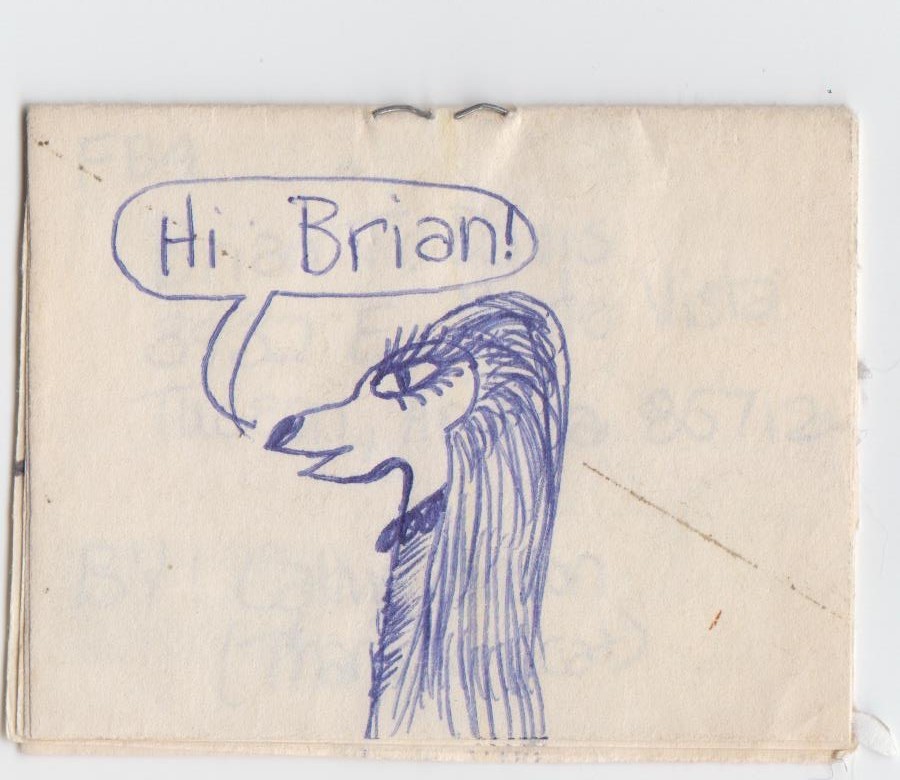
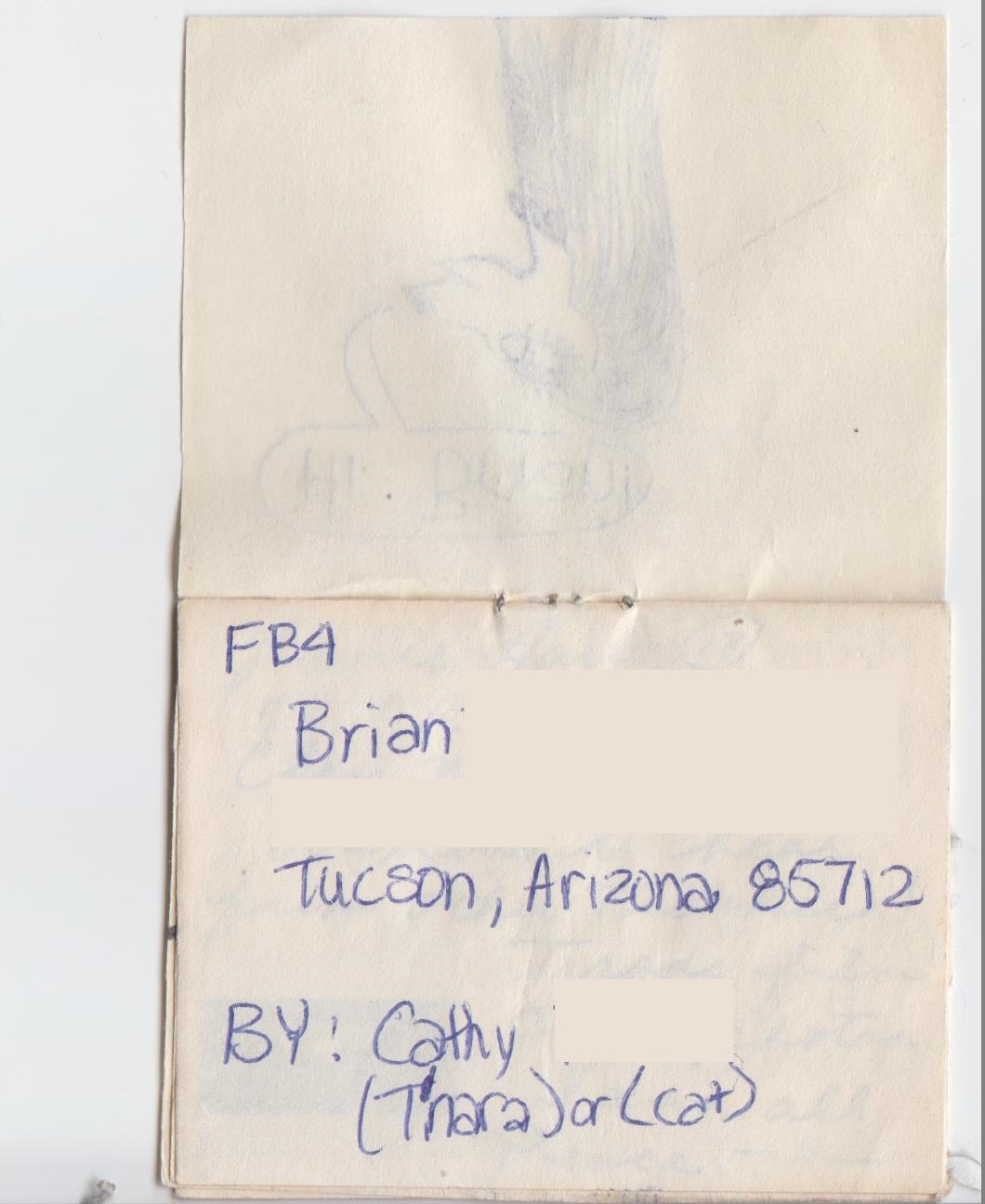
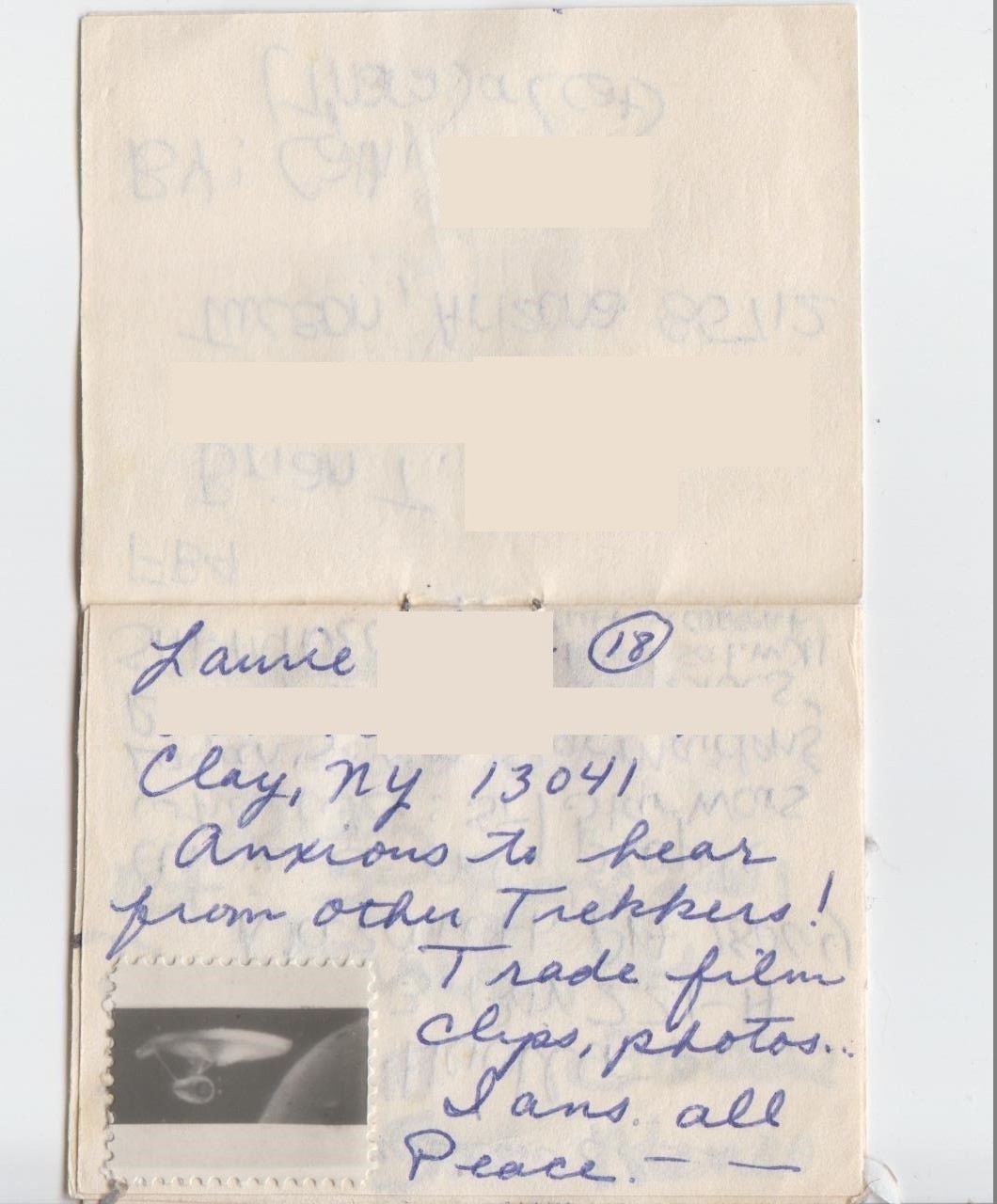
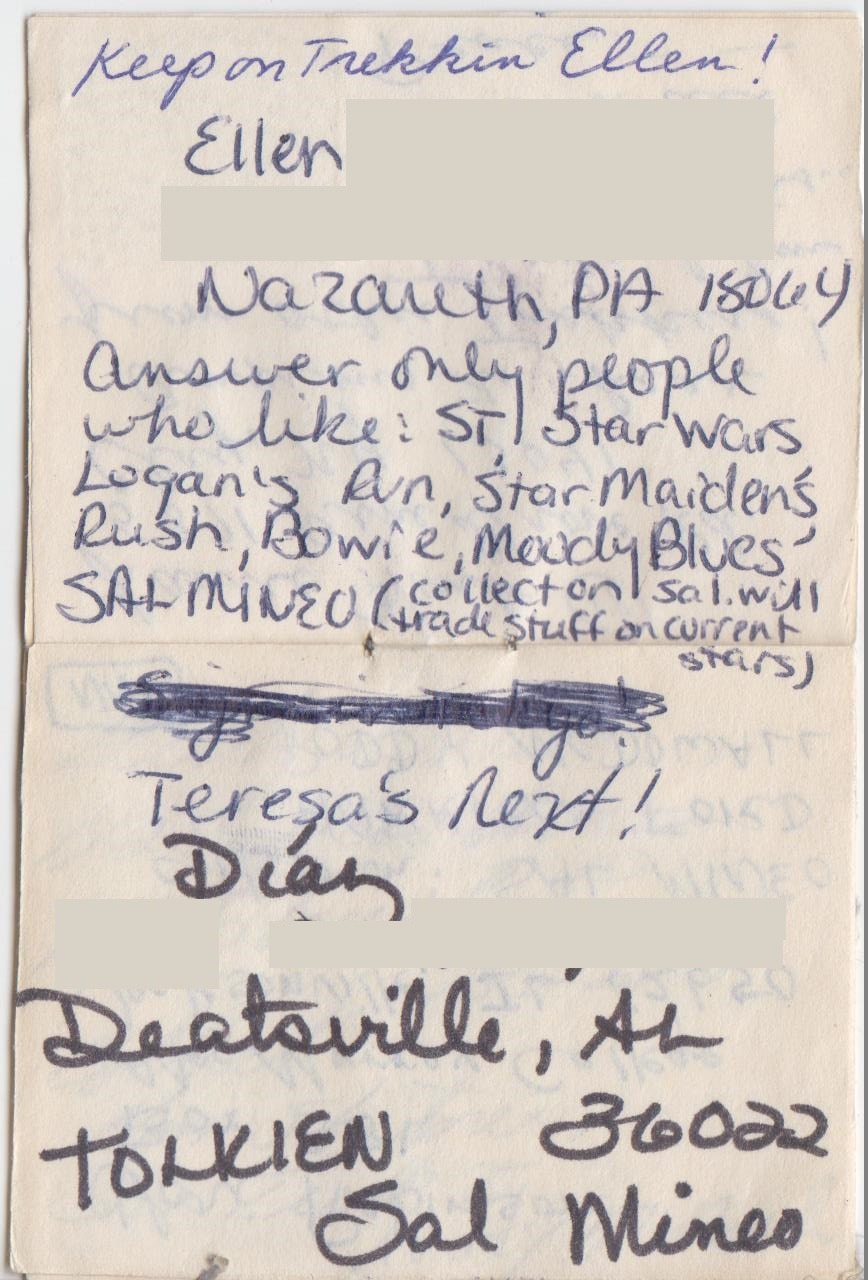
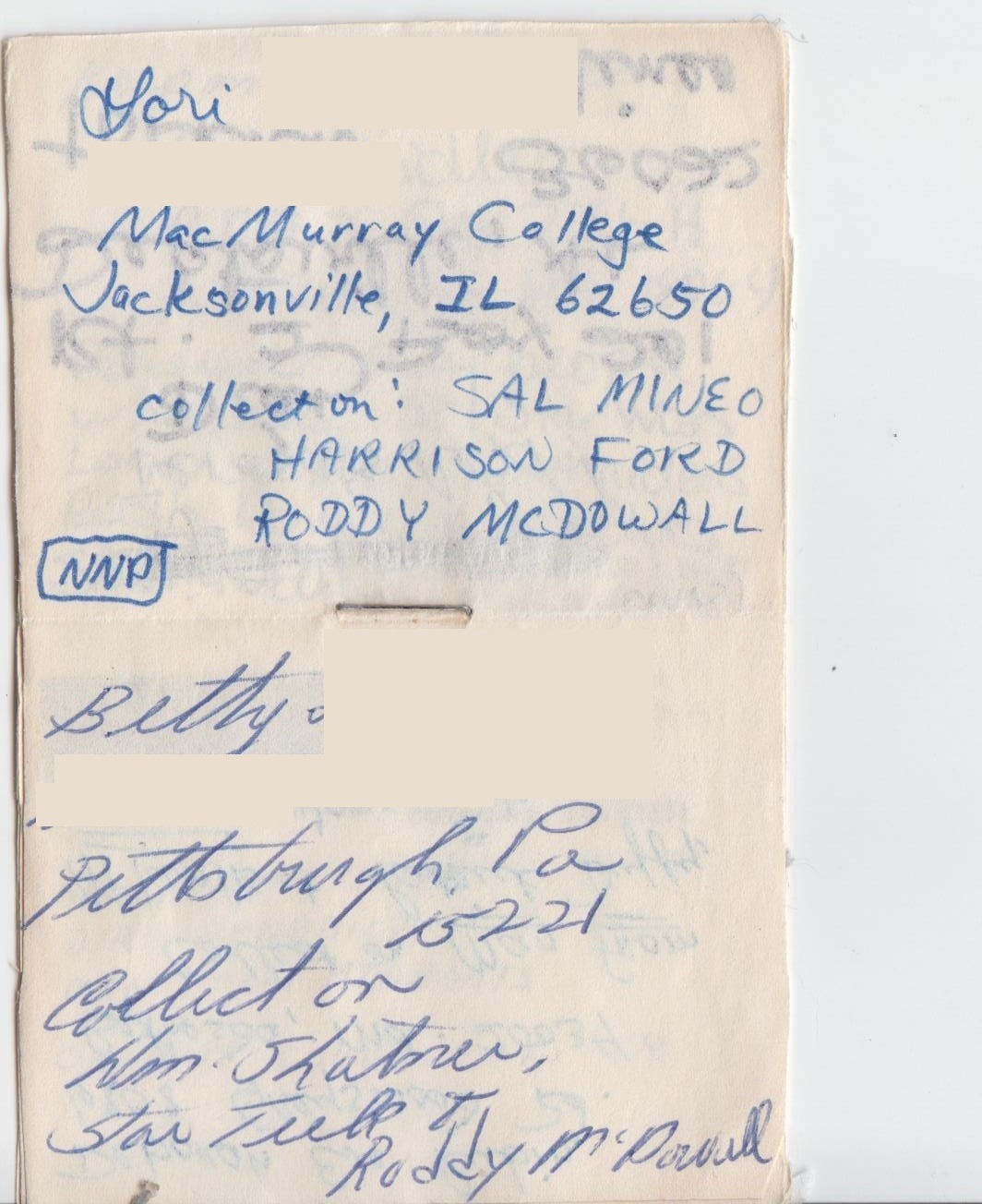
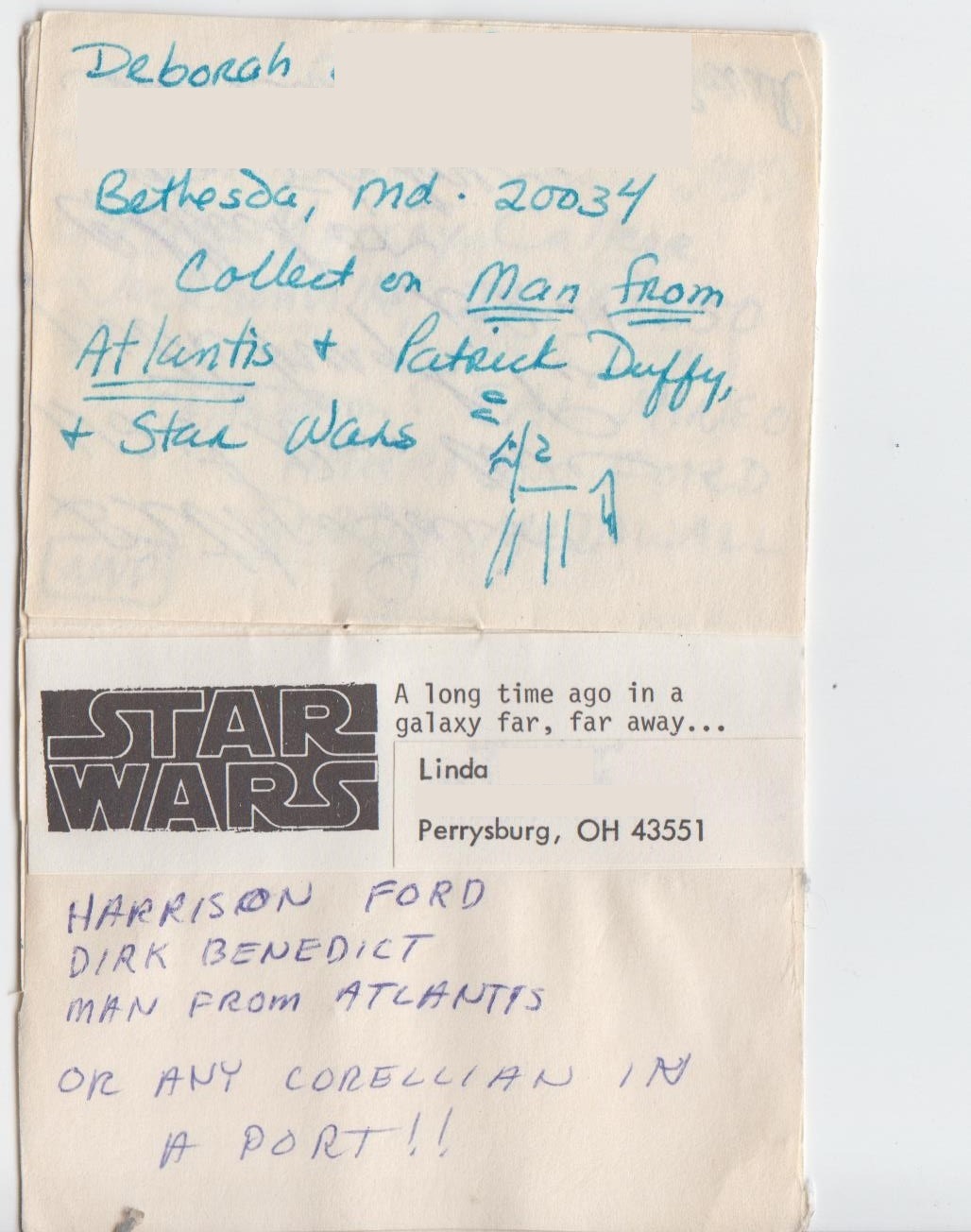
“"Friend Books" were used by pre-teens and teens in the 1970s and 1980s as a way of finding other like-minded fans in the pre-Internet era. Unlike the dreaded “slam books” which began circulating in the US in the 1940s, these books were not used to bully,[1][2][3] but as a means of connecting with other fans.
Some “friend books” were sized small enough to fit into an international envelope (2-3 inches), and consisted of no more than a few pages. The covers were often pages cut from magazines or advertisements and were stapled or taped into a booklet shape. Many were multi-fandom, but some focused on single fandoms like Star Wars.
Fans would write their name and address, and list their interests. The book would then passed along to the next fan. When the booklet was filled it was to be returned by mail to the original fan. Often times questions were asked (ex: Who is your favorite Star Wars character?)
I’ve noticed a current sub-genre of fan art & fan fiction depicting Jim and Spock (and sometimes other crew members) meeting for the first time as children.
This trope goes way back. The first “child Spock & Kirk” story I can find is in “Eridani Triad” in June 1970.
“How I Spent My Summer Vacation” is about James Timothy Kirk’s summer visit to San Francisco, where he met a Vulcan boy named Spock, whose ambassador father was stationed at the Embassy there.
In which he sits upon a suburban sofa and eats cake.
I know I write terribly long posts, so I’m going to try to keep this brief.
In 1966 I was the secretary of a women’s science fiction writing club. We were all deeply into Star Trek from the very first episode, so within a few weeks of it coming on air I called Desilu and asked to interview one of the show writers. I ended up in a phone conversation with Gene Roddenberry about (my primary interest) Spock, his character, his backstory, the planet Vulcan, etc. The interview became an article that got passed around to other science fiction clubs and was printed in our local university newspaper.
I mailed the article to Leonard and before long, he wrote the club back saying thanks for getting the word out about Mr. Spock. We had morphed into a “Fans of Vulcan” club, and sent out little speculative essays and short fiction about Spock & Vulcan (which were entirely speculative; we were in the first season and had not yet seen Amok Time or Journey to Babel).
The following summer, Leonard was touring around to publicize Star Trek (which was always on the cusp of cancellation crisis) and making paid personal appearances. Back then he went out of his way to thank the fan organizations that supported him, and he would write or even stop by if he could, just to express his gratitude. Thus, when he was in our town for a paid appearance, he agreed to stop by our Fans of Vulcan club afterward to say hello.
To picture the scene: we were 9 suburban, middle class ladies (at 27, I was the youngest), in our skirts and our big bouffant hair. We had prepared cake and coffee, set out the china, and freshened our lipstick by ten minutes before he was to arrive.
He drove himself to the house, knocked on the door, and when we opened it he said, “Hi, I’m Leonard Nimoy” —as if we would not recognize him in that Spock cut!
He told us we were going to get to see an episode taking place on Vulcan when the second season started, and that caused a buzz that didn’t die down until after we’d seen Amok Time. (I guess the buzz never died down, but at the time it was extremely exciting news that we were going to see Spock’s home planet.)
We talked about if Star Trek would manage to stay on the air; we talked about the science in the science fiction on the show (warp drive? transporters?), we talked about the space program that everyone hoped would lead to a moon landing within a few years. He had brought a stack of b&w photos of Spock, which he personalized and signed for each of us. After maybe 45 minutes he shook hands all around, thanked us, and left.
It’s only in hindsight that any of us knew just what a fortunate moment that was, to have been present before Star Trek was popular or Spock was a cultural icon. At the time, the “phenomenon” of Star Trek was all in the future, and we had no idea!
If the Bronte sisters were alive today, would they be writing fanfic? (Answer: Definitely yes.) – @fangirlamanda (x)
Let me expand on that answer with this excerpt from the Brontë page on @otw-fanlore wiki (x):
They were huge fans of Arthur Wellesley, First Duke of Wellington, who had defeated Napoleon at Waterloo, and invented long, elaborate sagas of his further adventures along with his two sons, Arthur and Charles. There were action-adventure, supernatural fantasy, mystery and comedic stories, with an increasing focus on romance and erotic melodrama over the years.
So there you have it. The Bronte sisters totally wrote smutty RPF.
Oh goodness, I have so many stories it’s hard to know what to say here. But I get this question a lot, so I need to just start writing down memories as they come to me or I will never get a post out about this.
Jimmy Doohan (Scotty) gave the best bear hugs in the world. He was not just a cast member but a real Star Trek fan himself. He loved the show, he loved Scotty, he loved the fans. He was a regular con fixture in the ‘70s, and you must remember that back then there were lots of conventions that had maybe 70 or 80 people in attendance. He didn’t care about audience size ; if you invited him, and he was able to come, he came.
Back then everything happened in one hotel. The con would take over the ballroom and a couple of side rooms, and there was always a welcome suite that acted as organization central. The actors stayed in the same hotel as the guests. It was mostly very amateurish, just a handful of dedicated fans getting a smallish group of people together. Jimmy, George Takei (Sulu), De Kelley (Bones), and Walter Koenig (Chekov), could all be counted on to stick around and be pretty accessible all weekend.
George would always make an announcement that if anyone wanted to go running with him, to meet him in the hotel lobby (or wherever) at a set time. Then a group would get together early in the morning and go for a run. He was a pretty hardcore runner, though, so I think most people who went couldn’t keep up with him.
De always brought his wife Carolyn (I can only think of one time I saw him without her, and he apologized all weekend that she couldn’t make it). They were the sweetest couple, really warm to the fans and, what was especially nice, warm to each other. It was obvious they were best friends. And they’d been married close to 30 years by the time they were coming to those early cons.
De took a warm interest in fan work and read a lot of fanzines. He sought out authors and artists and would give in-person feedback on your work, always very encouraging, but also quite thoughtful. You could tell he’d read your work and thought about it. He had an ever-increasing set of humorous poems that he wrote for the fans, and he would read these at conventions. Reading his poetry to us was such a set feature that regular con-goers would recite some of his older work in chorus with him. It was very interactive and fun, and he would get so tickled that people liked his poems. It was the most charming thing you can imagine to see him get so pleased at the audience’s response to his writing that he would do that bouncy thing on his toes.
Walter always seemed kind of serious to me, but he was a great conversationalist. He was extremely well-read and could be counted on as a great person talk books with.
Nichelle Nichols (Uhura) was the goddess she was then, is now and always shall be. She didn’t hang around the way most of the guys from the cast did, and anyway I was a little in awe of and shy with her, so I never took much opportunity to talk to her.
I did see Leonard at numerous conventions over the years, but he was a
special case, because by the time cons really got going, he had become
so popular that it was just not possible for him to hang out the way the
others did. In earlier days I’d had a chance to interact with him
through his fan club, but I’ll write another post about that.
Mark Leonard, the original Sarek, was an occasional guest. He seemed very laid-back and approachable. Soft-spoken. It was wonderful to see him laugh.
JImmy was the one cast member I spent considerable time with, though
only ever in the context of a Star Trek gathering. We first met at the
beginning of the 70s when I was on a committee trying to get Star Trek
back on the air, and were just very friendly after that. My oldest
child has very fond memories of him.
The last time I saw him
was perhaps a week after The Search for Spock had hit the theaters, in the summer
of ‘84. He and his wife Wende were in St. Louis for a convention, and a
small group of us went to dinner and then for drinks until some small
hour of the morning. He was extremely warm, exceedingly funny, a great raconteur, and
some of my fondest memories of those convention days are of drinking
with Jimmy (and usually Wende) and a small group of friends in the after
hours.
He always claimed that the character Scotty was 99% Jimmy and 1%
accent (or something along those lines). I can attest he had Scotty’s
love of a good drink, but he was both funnier and more irascible than
Scotty ever was, in my opinion.
Question to DeForest Kelley: Do you read fan-written stories?
Response, “Some
of them I do. It’s impossible to read them all…. There’s some
very good writing, you know. Some of the stories are better
than the stories we did in the series.“
- conversation reported in fanzine Odyssey 7, 1983
The longest-running series in The CW’s history, Supernatural started out following brothers Sam and Dean Winchester as they road-tripped across the country in their 1967 Chevy Impala and hunted everything from ghosts to vampires. The show premiered on The WB in 2005 at a time when being a diehard fan meant simply tuning in to watch every week. Twitter didn’t exist, and success was measured almost exclusively by ratings. And although Supernatural has always been consistent in the viewer department, there was something else that made the series stand out. Year after year, as the stories got bigger and bolder – hunting monsters became stopping an apocalypse, defeating rogue angels became battling God’s sister – the show’s steady viewership evolved into a cult following and ultimately, a full-blown fandom. Cut to 2017, where being a diehard fan means tuning in, live-tweeting, and attending one of the more than 16 fan conventions held annually across the country. Heading into its 13th season, which premiered Oct. 12 at 8 p.m., Supernatural is leading the charge on what it means to be a “fandom” these days. Anyone can attend a convention, but when Supernatural showed up at this year’s San Diego Comic-Con, it kicked off its panel with the rock band Kansas performing the show’s unofficial theme song, “Carry on Wayward Son.” Anyone can live-tweet, but when Hurricane Harvey hit Houston – the first in a strong of devastating storms – the Supernatural stars took their characters’ mission to save people and make it a reality, starting a fund to help those who were impacted by the storms. Fans rallied behind the stars as they asked for donations on Twitter and together, the #SPNFamily helped raise more than $450,000 (and counting), proving that, when it comes to Supernatural, even fandom is a family business. “This particular fandom has become a real community, and people have found a home there,” star Misha Collins says.
“Supernatural: Two Winchesters and a dead angel spill secrets from beyond the grave (and the season 13 set).” Entertainment Weekly, October 20/27, 2017. [print] (via justanotheridijiton)
“15,000 issues of US underground and alternative press periodicals available
In in partnership with Reveal Digital have extended the early availability to UK HEIs of these, often rare, periodicals to the end of 2017. The publications feature material form many significant underground, alternative and radical presses.
Reveal Digital’s Independent Voices already comprises over 15,000 issues of 21st C US periodicals produced by feminists, dissident GIs, campus radicals and the New Left, Native Americans, anti-war activists, Black Power advocates, Hispanics, LGBTs, the extreme right-wing press and alternative literary magazines. This initiative is based on a “library crowdfunding” cost recovery-open access model to support digitisation of collections. We will now digitise similar UK publications.
(UK libraries will also be able to take part and access the US-based collections. Half the income from UK libraries will be used to digitize UK content)
“
I would love to know more about when you first started thinking that there was more than friendship between Kirk and Spock and when fans first started talking about it. Was it Amok Time that first gave you the idea?
I started thinking about it before Amok Time aired.
In the summer of ‘67, watching the reruns of the first season, I very clearly remember a growing sense of, “They really love each other.” I did not jump to “they are in a romantic/sexual relationship,” but I was increasingly aware that there was love and devotion between them. I wrote a speculative essay about their platonic love in our summer fan club newsletter, which I remember being well-received.
With the start of Season 2, our whole fan club (and often others) watched the show together, at the house of the one person we knew with a color TV. The show was on Friday nights, so we would start the weekends by piling into her living room and watching “in living color” for the first time. Afterwords we would stay and discuss.
When Amok Time aired, we definitely had a lot to talk about. I am pretty sure no one suggested that they were gay – that would have been quite a scandalous suggestion at that time; and I don’t think I thought it myself. But we did have quite a discussion about how much Jim was willing to sacrifice for Spock, Spock’s reaction to seeing Jim alive, and what did Spock mean by “having not so pleasing a thing after all as wanting…?”
Did Spock … want Jim?
Two camps formed: one believing that Spock was in love with Jim and was pining for him, the other believing no way! that’s ridiculous!
Single copies of “Spock pines for Jim” stories started appearing and being circulated hand-to-hand. Two other women and I were doing most of the writing in my circle of fan friends, and because distribution was so difficult, we started having Thursday night gatherings. Anyone could come and we would read the latest installments in our Spock-loves-Jim stories out loud to the group.
Sometime between the second and third season, my primary writing mentor – an established, published sci-fi writer who was much older than me – told me in private conversation that she thought their love was mutual, quite possibly physical, and that she thought their relationship was worth exploring in writing.
She and I each started working on long pieces exploring the Kirk/Spock relationship, and it was the first time I had seriously entertained the idea that their love was also physical. That was a very secret project. We only ever shared our work with each other for comment / revision, and never mentioned it to anyone else at the time.
The first time I realized that the K/S relationship – which was called “The Premise” in those days – was being explored by other writers and even artists was in the summer of ‘69. Star Trek had been cancelled and I went to another state to meet with a handful of people who were forming a fan network to try to get Star Trek back on air. While there, a fellow fan showed me a set of drawings, all very tame by today’s standards, that depicted a physical relationship between Jim and Spock. I remember how shocked I was — not by the subject matter, but by the fact that someone had dared depict it.
Slash stayed very much underground until late 1974, when the first published K/S story used very coded language to suggest a love relationship between them.
Before we can talk about the first printed K/S fiction, we need to talk about the first “adult” Star Trek fanzine to appear.
Prior to 1972, all printed fan material was for a general all-ages readership. Then “Grup” came on the scene in 1972 (you will recall that “grup” was the word for “grownups” in the episode Miri), specifically to publish adult stories and art. It was considered pornographic at the time, though the stories were not very explicit by today’s standards.
The first nsfw art was published in Grup: the first edition had a nude centerfold of Spock!
In the first instance of a practice that would become standard for writers and publishers of adult — and especially slash — publications, one of the two editors of Grup was known only by a (male) pseudonym. (With a few exceptions, none of us ever published under our real names.)
Grup was hugely popular, as you might imagine, but the editors did very small print runs, not even trying to meet demand. Everyone was scared in those days of exposure and of being prosecuted for producing pornography. Just mailing Grup through the US mail was breaking the law!
In 1974, in the 3rd edition of Grup, Diane Marchant published a story called “A Fragment Out of Time.” It was very short and very, very vague, describing two unnamed people making love. Although the characters weren’t identified, the story was accompanied by a drawing showing Spock saying to Jim,
“Impossible?… No, Jim. I warned you about messing with aliens … especially Vulcans.”
Whoa, Nelly!
Fandom would never be the same.
Back then we had something called letterzines, which were named and numbered just like regular zines, but existed as a way for fans to discuss things about Star Trek and fandom. They typically came out every month or two. They were like pre-internet discussion boards, and of course, were a much slower means of communicating. But the system worked! And they were very popular.
Letters poured into the letterzine The Halkan Council, questioning if the two characters depicted in the story were, in fact, Kirk and Spock. The author wrote an essay in Grup 4 confirming that yes, “Fragments” was about Kirk and Spock, and exploring (again in very subtle and somewhat coded language) the nature of the relationship between the characters.
And a huge, raging debate started in the letterzines all over fandom about The Premise that Marchant had proposed: that Kirk and Spock were in a romantic, sexual relationship with each other. (This was when that term came into general use. Before that, there was no public discussion of the K/S relationship, and so no general name for it.)
Two authors, Gerry Downes (whom I wrote a post about) and Leslie Fish, wrote into (I think it was) The Halkan Council, asking Marchant if they could borrow The Premise to develop in fanzines they were inspired to publish, thanks to Marchant breaking this new ground.
Gerry Downes then broke new ground herself by publishing the first K/S zine, Alternative: The Epilog to Orion, in 1976. She printed only a very few copies (there was a HUGE risk to circulating porn with gay characters), and distributed them mostly to trusted fan friends in other states. She encouraged the recipients to copy the zine, using Xerox machines which were just becoming fairly widely available in print shops, and to circulate and distribute those copies locally.
So my partner and I have an pinkie bet. I say that Vulcans kiss by touching fingertips and any further hand-contact in public is basically obscene. He doesn't even think fingertip touching is kissing. I looked for proof, but even in the TOS ep where Sarek and Amanda touch fingers, it is less than obvious that that's a kiss. Help!
Oh my gracious, sit your partner down to watch the scene between the Romulan Commander and Spock in The Enterprise Incident. And tell them to be prepared to lose that pinkie bet! :-)
Here’s some background on what has come (in fandom) to be called the ozh’esta (the finger kiss):
The first time we see the “Vulcan kiss” gesture it is in Journey to Babel (the episode you reference in your question), where it wasn’t actually written in the script. The actors playing Sarek and Amanda asked Leonard Nimoy about the body language and gestures used by Vulcans, in order to give their performance continuity with what had been developed in Star Trek so far. It was Leonard’s idea that hands and hand gestures are deeply significant to Vulcans, and between the three of them the actors worked out the now-familiar two-finger touch as the way a Vulcan would interact with his bond-mate.
Then fan writers – rabid as ever to develop the full backstory (and bedroom story) behind every thing given us on screen – took over. Essays and fanfiction quickly developed the fannon (fan-made cannon) that we are familiar with today: the gesture is the Vulcan equivalent of a human kiss; it’s a touch through which the telepathic bond crackles like lightening between a bonded pair; Vulcan hands are erogenous zones that one only fondles in private.
Gene Roddenberry was extremely aware of and respectful towards the development of fannon in the early years of Star Trek. He bought the fan zines that were in circulation at that time, he kept them in the production offices, and he insisted that the show writers read them and keep them in mind when writing new episodes. (These were golden years for being a fanfiction writer, needless to say. GOLDEN.)
As a result of Gene’s requirement to read fan fiction, show writer Dorothy Fontana was fully aware of the fannon about Vulcan sexuality when, during the 3rd season, she wrote The Enterprise Incident. During pre-production, the new producer on the show (the unfortunate Fred Freiberger) went and added a rather torrid love scene between the commander and Spock, very much against Dorothy’s wishes. Infamously, the scene called for (and this line is burned forever in my memory) Spock taking her in his arms and “raining kisses on every square inch above her shoulder.” (!!!!)
Well, Dorothy, god bless her, pitched a fit and refused to back down. Pointing out that the fans “know exactly how a Vulcan makes love,” she insisted that Spock and the Romulan commander be seen fondling each other’s hands rather than raining human kisses on faces and necks. Leonard found out about it and balked at playing the scene, and wrote his objections in a now-famous letter to the production heads. Dorothy and Leonard prevailed on this one, and if you go watch The Enterprise Incident you will see quite a racy (for Vulcans) scene play out between Spock and the Romulan commander – all expressed via the touching of hands.
I hope that helps. I’m trying to think where to point you for source material, since I’m writing this from memory. (For ten years we only had 79 episodes to obsess over. It shows.)
You could check These Are the Voyages by Marc Cushman and Bjo Trimble’s Star Trek Concordance (but be aware that there are some errors in it); most or all of these details are probably referenced in those books.
re blogging because I wrote this in the middle of the night
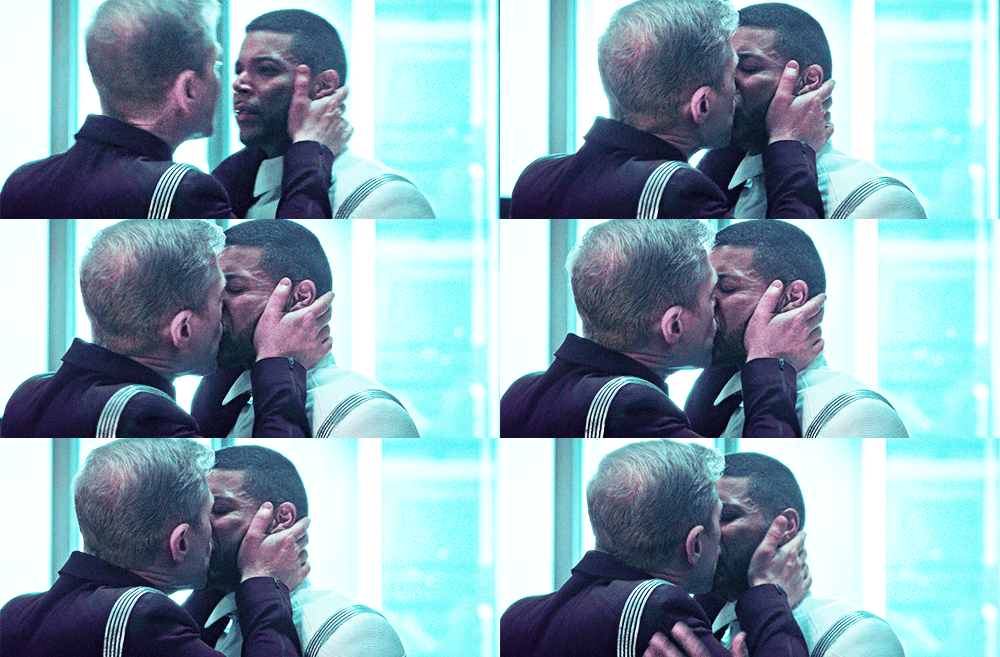
Ok guys, so here’s the deal. You don’t have to like this pairing, you don’t have to like the characters and you don’t have to like the show. But can we all please take a moment to acknowledge how important this scene is to Star Trek. Star Trek is over 50 years old. It’s always prided itself on championing great causes and the rights of everyone regardless of gender or race. It was the fandom that launched a thousand ships. It was the fandom that made it ok to ship. It is the fandom that has battled for this moment for years.
This fandom had multiple episodes scrapped because of networks being scared off by LGBTI story lines. Those networks, when it once did have a lesbian kiss, played it off as an ‘It’s ok because she used to be a man’.
This fandom where the writers and two of the actors were actually banned from having too many scenes together because their portrayals of their characters were not ‘family friendly’ according to the network heads.
And now, Star Trek has given us this. A strong relationship which is not being used as a punchline.
So please, whatever your feelings are for the characters themselves and Discovery as a series, lets just acknowledge how important this is for Star Trek.
It is one of my favorite movies. It’s absolutely part of Star Trek cannon!
I once read something somewhere that said: “Intelligence is knowing that Galaxy Quest isn’t a Star Trek movie. Wisdom is know it’s the best Star Trek movie”
In the 70′s, instead of “Live long and prosper,” the most common greeting and sign-off between Trekkers was “May the Great Bird of the Galaxy bless your planet.” The Great Bird being Gene Roddenberry, of course.
I still sign my emails that way to my fan friends from that era.
This very brief analysis of the history of German fan fiction, as well as the results of our cursory comparison of the exclusively German-language archive FanFiktion.de and the international Archive of Our Own, suggest that fandoms, fan practices, and fannish affections are complex and heterogeneous. Generalizing assumptions about an (imagined) unity in a specific fan fiction community are highly questionable. There is not, for example, a single Harry Potter fan fiction community but rather numerous ones that differ in their sets of rules, the socialization and education of their members, and the popularity of certain characters, pairings, tropes, or genres. In addition, political, historical, economic, and legal factors influence a national fan fiction history.
Cuntz-Leng, Vera, and Jacqueline Meintzinger. 2015. “A Brief History of Fan Fiction in Germany.” In “European Fans and European Fan Objects: Localization and Translation,” edited by Anne Kustritz, special issue, Transformative Works and Cultures, no. 19. (via fanhackers)
Years ago, I wanted to create Fanlore pages for each country to help highlight fan contributions, involvement, and practices. I also toyed with the idea of creating subsections by language within a specific fandom page. But that was shot down because it was felt that it would be two divisive. I am still fascinated with how fans in other countries do things the same as well as how they do things differently.And I would love to be able to go to one page to learn all about the fan creativity and contributions from Greece, Malaysia, or Kenya.
I was born in the -gasp- 70s. When people did things like line up for days to see Star Wars. And before that? Girls chased The Beatles for blocks. Star Trek blew the walls off. Before these here Internets, we had zines, my loves. (And if you don’t know what that is, go ahead and Google, I’m old and patient, I can wait). You think re-blogging on Tumblr is dedication to your ‘ship? Try an Exacto knife and a copy machine.
Nothing has changed. The desire for slash comes from the same place it always has–Cumberbatch and Freeman didn’t invent Johnlock, they existed long before anybody reading this drew breath.
A bit more recently, but when many of the current rulers of the fandom fief were still pre-puberty, a bunch of us cut our fan teeth on the years of URST between Mulder and Scully, or discovered that knife’s edge between lust and hate on Buffy. Do you honestly think you could have Supernatural without those shows? Do you think you’d be able to still be rolling on Harry Potter if the groundwork hadn’t been laid by Tolkien? Hell no.
What I am saying, my young friends, is that next time you decide to mouth off about how fandom should have an expiration date, you may perhaps want to give a though to how you woke up here. Much as it’s easy to believe everything you love was created from nothing, we are all in debt to those who came before us.