Shipping is one of Tumblr’s favorite hobbies, drawing hundreds of millions of engagements each year. On Tumblr, shipping exists in many forms: fan art, fan fiction, manipulated GIFs and videos, and roleplay, just to name a few. It’s a common practice no matter what fandom you’re in—from television shows and movies to K-pop and video games. On Tumblr, the most popular type is slash—ships comprised of two male characters. Out of the top 150, 95 (63%) were guy/guy love.
We grabbed the top 30 ships from 2013—2016. 2013—2015 were ranked by reblogs alone. 2016 and 2017 are ranked by their Trending Score. This includes volume of searches, original posts, and likes in addition to reblogs. We’ve sorted the source content behind each year’s top ships below.
2013
TV | 40%
Music | 40%
Anime | 10%
Celebrities | 6.67%
K-Pop | 3.33%
2013’s most reblogged ships were predominantly slash (76.67%). The remaining 23.33% were all heterosexual (het) ships—there were no femslash ships in the top 30 that year.
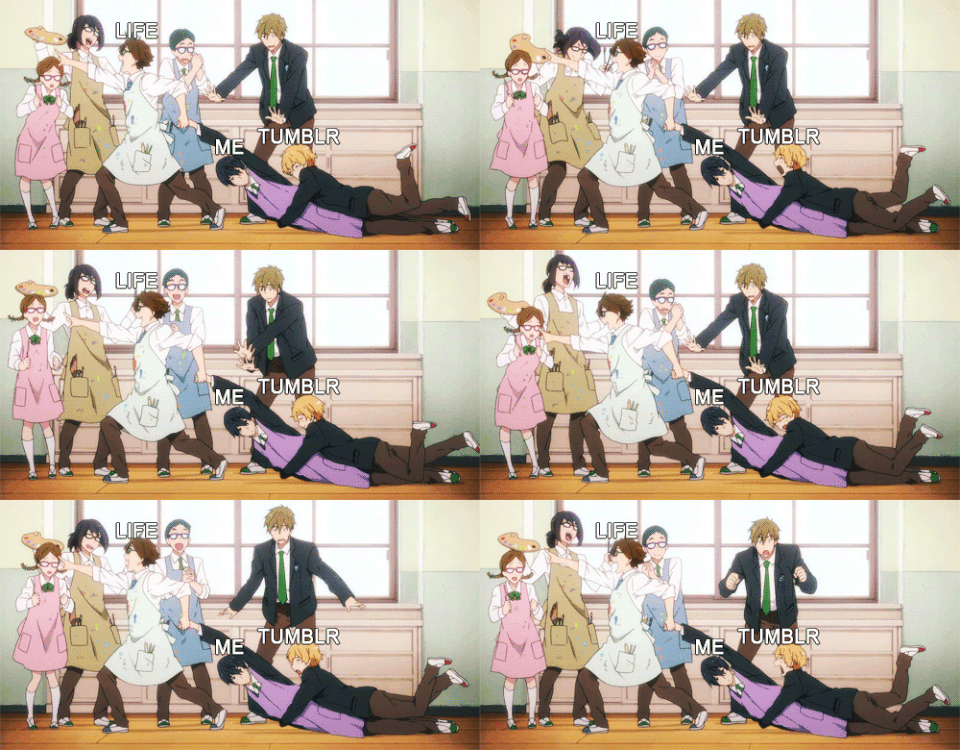
The most reblogged ship of the year was from an anime: MakoHaru (Nanase Haruka and Tachibana Makoto, Free! series).
2014
TV | 40%
Anime | 20%
Music | 13.33%
Celebrities | 10%
Movies | 10%
Web Celebrities | 6.67%
Though slash (66.67%) and het ships (26.67%) comprised most of the list in 2014, femslash ships (6.67%) made their debut.
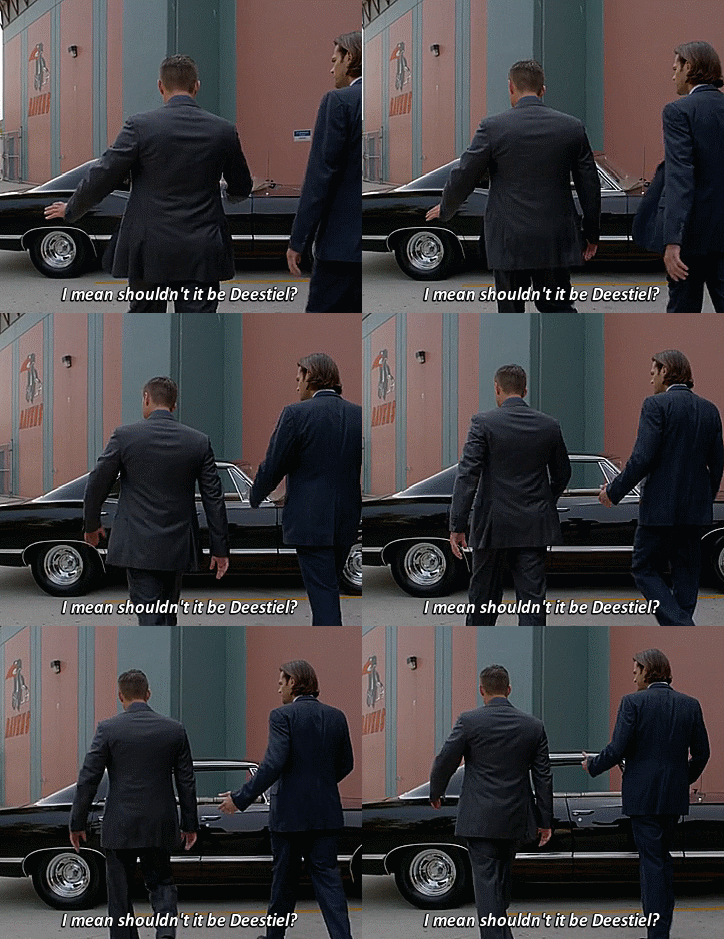
2014’s top ship was Destiel (Dean Winchester and Castiel, Supernatural). Though the ship is not canon (yet), the 200th episode “Fan Fiction” paid homage to it.
2015 was a big year for Larry shippers—Larry Stylinson (Louis Tomlinson and Harry Styles, One Direction) reached No. 1.
2016
TV | 50%
Movies | 20%
Anime | 13.33%
Web celebrities | 6.67%
Music | 3.33%
K-Pop | 3.33%
Video games | 3.33%
Slash ships began to take a dip (56.67%) in 2016, while het ships grew (36.67%) and femslash decreased (6.67%).
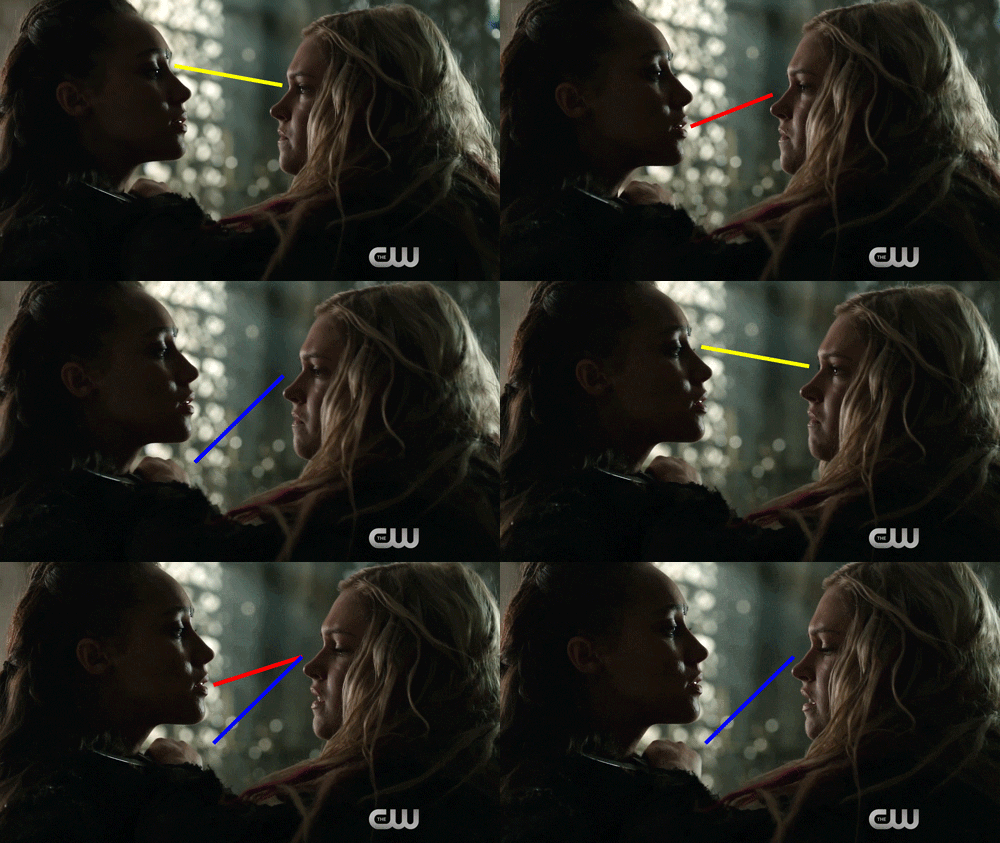
Despite femslash’s waning popularity, 2016 marked the first year a f/f ship not only cracked the top five, but hit #1. Clexa (Clarke Griffin and Commander Lexa, The 100) was embroiled in controversy when Commander Lexa was shot by a stray bullet and killed immediately after her and Clarke’s relationship was consummated. Her death launched a critical look at the “Bury Your Gays” trope by journalists and fans alike, and the argument that LGBTQ+ fans deserved better than the storylines given to them.
2017 (thus far)
TV | 50%
Anime | 13.33%
K-Pop | 13.33%
Music | 6.67%
Movies | 6.67%
Web celebrities | 6.67%
Video games | 6.67%
In the first half of 2017, slash has continued to hold over half the conversation (56.67%). Het ships and f/f ships are starting to equal out at 26.67% and 16.67%, respectively.
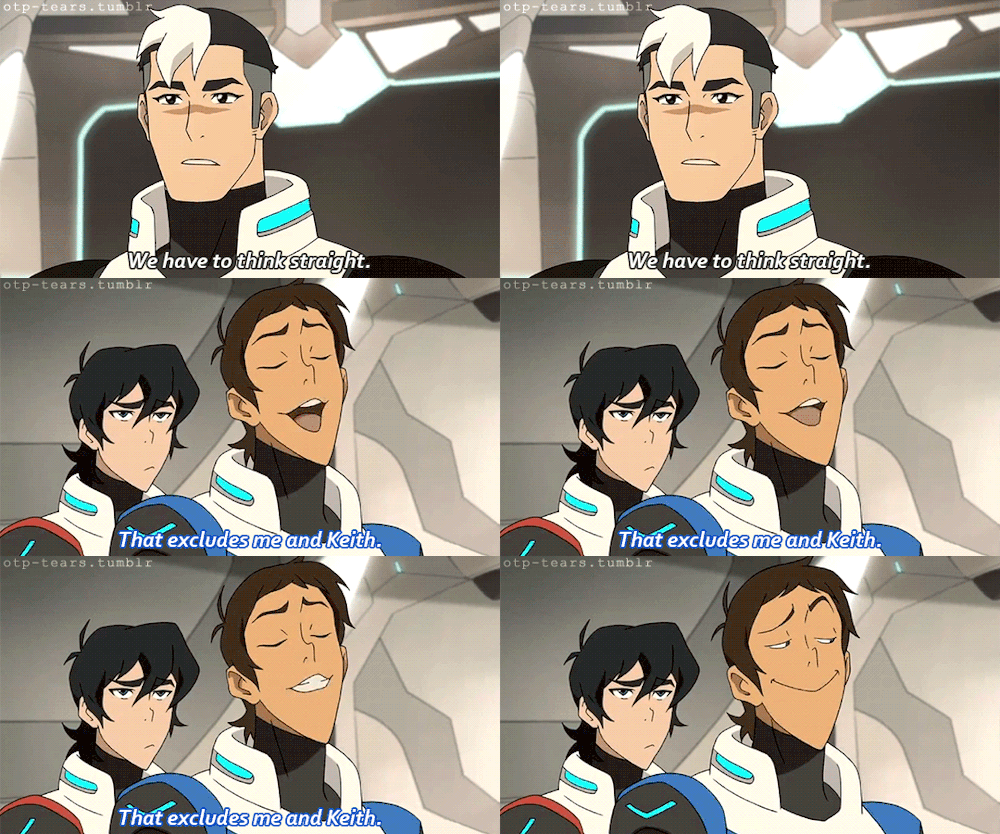
This year’s top ship so far? Klance (Keith and Lance, Voltron: Legendary Defender). Since we launched the weekly ship list on May 1st, Klance has been No. 1 seven times.
Further reading
Some great resources where you can learn even more about shipping and fandom:
Destination Toast (@destinationtoast) has spent the past few years working with fandom and fic data. You can find all of her research, along with reblogs of posts created by others in different fandoms, on her side blog, ToastyStats (@toastystats).
I find myself really yearning to explore and understand early XF fandom culture. I get little snippets of clues, I sometimes play with the waybackmachine, livejournal, and fanlore.org, I’ve heard crazy stories of people faking their deaths and lawsuit panic. How, even, certain fics caused absolute shockwaves in the fandom (looking at you, Iolokus). It’s incredibly interesting from a sociological perspective. Have any of you been here from the start? What are your experiences? What do you remember?
I was 13 when I got into it in season 1, so my memories are hazy to say the least. I remember that we were honestly dumb enough to believe Mulder and Scully would remain just friends.
I remember a bunch of “Luke, I am your father” jokes about The Smoking Man before he was Cancerman, but we were kidding.
I remember downloading the entire fic archive to multiple floppy discs before it was known as Gossamer and before I really understood what fic was. (Thanks for all the free porn, internet! 13-year-old me enjoyed it a lot.) FTP was just as annoying back then.
The Organization for Transformative Works was founded six years ago, because fans realized that owning the means of circulating and distributing fanworks—the servers, the interface, the code, the terms of service—would be essential to the long-term health of fan creativity, and so we created the nonprofit, donor-supported Archive of Our Own. Today, when I talk about the importance of fan writing, I don’t just mean fiction and nonfiction: I mean contracts and code. In the old days, fans self-published their fiction (and put it under copyright, asserting their ownership in their words), they distributed their own VHS cassettes and digital downloads, and they coded and built their own websites and created their own terms of service. Today, enormous commercial entities—YouTube, Amazon, LiveJournal, Wattpad, Tumblr—own much of this infrastructure.
This is a very mixed bag. On the one hand, these companies’ products and interfaces have made it infinitely easier for the average fan to connect with other fans and distribute fanworks. Now you only need a username and a password to get started, where before you needed access to server space, a knowledge of HTML, how to use FTP, and so on. However, there are also various dangers, including not only capricious or exploitative terms of service but simple market failure. None of the companies I just listed has anything like the track record of the average fandom or fannish institution; consider how much younger they are than Sherlock Holmes, Doctor Who, or even Supernatural fandom. In the best case, these companies may fail and become a disruptive force in relatively stable and long-term communities; in the worst case, they may exploit and betray their users.
In the past few years, the nature of the arguments I have been having as a fandom advocate has changed: In the past, I found myself arguing for the legitimacy of our works; now, I find myself arguing against their exploitation. The commercial ownership of the infrastructure means that money has now complicated fandom’s gift culture, and, like it or not, we now have to think about who should benefit. Here, too, there is a spectrum: Some grassroots creators don’t want to engage with the commercial world on any terms (and they should have the right not to); others feel that if someone is profiting from their works, it should be them, and it should be a fair compensation. If the relationship between fans and the commercial world is being renegotiated, we’re going to have to apply some of our creative energies to writing contracts as well as fanfiction, rather than let unfavorable or disrespectful terms of authorship be handed down to us by corporate owners.
In which my study about the design of AO3 not only gets into the big publication venue in my field, but also wins a major award. Fandom is amazing, and I want all the computing scholars to know it, too!
The link in this post is to my blog post about the paper, which is the TL;DR version. But here’s an even more TL;DR version, i.e., what I think is most interesting to fans about this work. (Disclaimer: I’ve been on the legal committee of OTW since 2009, but this work was entirely independent of them! I also didn’t screen potential study participants for any particular attitudes towards OTW or the archive.)
Why did you study AO3? My dissertation was largely about social norms about copyright in online creative communities. I interviewed a lot of fan creators over a few years, and when we talked about copyright norms around things like attribution, remixing remixes, etc., a lot of people mentioned specific AO3 design features. I’ve been following AO3 closely since it’s very beginnings, and I know that there’s something really unique and amazing about it: It’s a massively successful online platform built completely by the people who needed it, built to reflect their values and norms. And the majority of those builders have been women. It’s amazing! And I thought, there is probably something that designers can learn from this.
So for this study I (with the help of an undergraduate research assistant) interviewed a bunch of AO3 users, as well as people who worked on the development of the archive in the early days. And by the way: THANK YOU TUMBLR because I had so many volunteers that I had to turn people away. Trust me, this never happens. All my colleagues were super jealous. I was like, well, you guys really should study fans because they’re awesome.
What is feminist HCI? First, HCI is human-computer interaction, so welcome to my discipline! And feminist HCI is the idea that a lot of the central commitments of feminism - like empowerment, agency, equity, participation, identity, advocacy, social justice - are great things to integrate into interaction design. Imagine if all of these things were really important to the people building the technologies that you use!
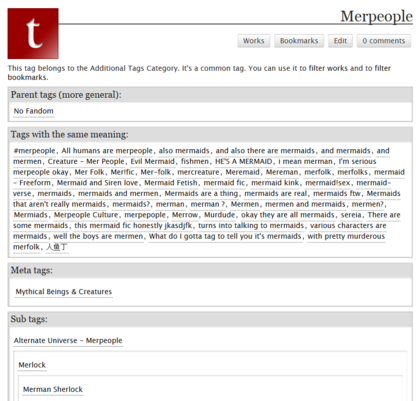
So how does this apply to AO3? Talking to folks about AO3 made it clear that a lot of the values that were baked into the design are the same values at the core of feminist HCI. For example, participation: this is the entire reason that AO3 exists, so that fans themselves have control over their own space. And accessibility, diversity, and inclusivity - there are so many little design decisions towards these things, an attempt to try to make sure that not only does everyone have the ability to use the site, but that everyone feels welcome. One of my favorite quotes: “If you think you’re a fan, then you’re a fan, and you’re welcome here.” And also, the tagging system at AO3 is pretty amazing - not only did most of the users I talked to speak at length about how this improves over other sites they’ve used, but also the user-created folksonomy means that the archive doesn’t make content judgments. You can use any tag you want, and this actually becomes a pretty powerful thing because even a system picking categories for you to choose from (e.g., gender or relationship options on social networking sites) is an exercise of power. And the way that AO3 handles identity and pseudonyms is pretty nuanced, too. It all adds up to many small things that users really seem to appreciate. (The image below is from the Tag Wranglers page on Fanlore - this is in my paper, so it’s probably the only CHI paper to have the phrase “mermaid!sex” in it.)
And what did you learn? Besides just presenting AO3 as a case study of feminist HCI as successful, there are also some useful lessons for designing to reconcile competing values. After all, fandom doesn’t always agree on priorities! This of course is a huge problem in lots of contexts - the idea that you can’t please everyone. And of course, not all of AO3′s design or policy choices have been popular over the years. But there are a few things that AO3 does to mitigate some of these value tensions. For example, fan history is important! It sucks when archives disappear (Geocities anyone???) and all those stories you loved are just gone forever. But control is also important! If you want to wipe your fannish identity off the face of the earth, you should be able to do that. So AO3 has orphaning, which lets you erase your name/identity/footprint from fics while not erasing the fic forever. Another example is the content warning system, which was a compromise between the desire to not cast judgment on content (”your kink is not my kink but I will defend it!”) as long as it’s legal, and the desire to protect people from stuff that they don’t want to see or is triggering. Of course, this solution isn’t perfect, and some of my interview participants talked about wanting a “tag blacklist" to help even more. But in short: AO3 does some cool and thoughtful design things that are interesting to people studying HCI.
So now what! Well, I’m a professor now, and I hope to keep studying these sorts of things. I’m interested in feminism and women in technology (remember the Barbie remix? Yeah that was me, I was Internet famous for about a day), in online communities and especially fandom, and in social norms. If you want to know if I do more studies of fans in the future, you can follow me here or on Twitter. Because can’t stop won’t stop writing!
Finally, thank you to everyone who participated, volunteered, or shared, because this kind of work isn’t possible without awesome people to talk to. And you can read the full paper at the link at the top of this post!
We’re welcoming @cfiesler to @fyeahcopyright as our newest blogger - and we hope you like her paper!
You know, when I was a teenager it absolutely pissed me off when people over the age of 18 referred to me as a child. My friends & I wanted to be taken seriously in communities so we never pulled the "just a child" excuse whenever shit went down. Now it seems that anyone a month under the age of 18 is like "uwu im just an innocent minor dont call me out or ill accuse you of being a pedo & child abuser." It's just so weird to me cuz my generation was the opposite. I wonder why it changed.
It changed because of the leverage of perceived victimhood, and the ability of social media to bring together the social outcasts of society that view themselves as such. When brought together, these people become a co-dependent group of enablers. Rather than going through the natural cycle of emotional maturity, they reinforce each other’s flaws, assuring each other that they don’t need to change. They don’t take the time to self-reflect, and miss out on valuable psychological growth
Eventually. when you have enough people like this, they feel emboldened to take their resentment out on others, particularly those that resemble the people who have mocked or rejected them in the past (hence the trend of blaming majority groups for their own social ineptitude). If they didn’t feel as though they had people to support and praise them for this, they wouldn’t do it. They also wouldn’t do it face-to-face: The internet allows them to take this passive-aggressive stance without real-world consequences.
They then discovered that certain issues in life can be used as an invulnerable shield, because there are taboos that elicit knee-jerk responses that people are afraid to question, lest they appear to support them. Thus continues the leverage of victimhood, except now it’s dragging serious topics down into the mud with it. In the process, these people can pretend to be “heroes” and receive praise for doing absolutely nothing. It’s a game of “Look at how good of a person I want you to think I am!”. Once they realized they could use this ploy to achieve the kind of popularity online that they never could in real life, all bets were off.
The full-scale attack on adulthood is likely due to being corrected by adults on their behavior, or others trying to hold them accountable for it. They don’t want that–they want to be childish and petty, because it makes them feel better about themselves to put down others. Adulthood in general terrifies them, because it means there will no longer be anyone to spoil them, or make excuses for them.
It’s like that one episode of “Chowder” where everyone pretended to be babies to get out of having to work. Except it backfires in that you will then be treated like a baby in everything else. It’s an incredibly unhealthy mindset that is, frankly, holding these people back socially, emotionally, and psychologically.
A large number of “innocent children” on Tumblr are 22 and in the process of graduating from college. There’s every reason to fear being an adult then. (Not that that excuses ridiculous bullying and trying to redefine 20-somethings as children.)
There are plenty of teenagers around who feel like we all did back in the day. We just don’t notice them because they’re busy pretending to be adults.
The biggest change I’ve seen from my teenage years till now is that back in the 90′s, you had to pretend to be 18 and you had to befriend people to find the good fic, especially the slash, because that was locked down tight. Then, like now, a lot of the good shit was by “old” people who had been writing longer. Now, you can read all of the old people’s fic on AO3 while screaming on tumblr that you hate anyone over [your age + 5]. Your favorite author isn’t going to notice that you’re an asshole who hates them, and they couldn’t block your ass on AO3 even if they did. In the 90′s, they’d just have kicked you off of their mailing list and changed the password on their archive.
There was plenty of bullying and nonsense back then too, but some of the specifically ageist behavior wasn’t seen because you had to be an adult to access fandom at all–or at least that was the assumption.
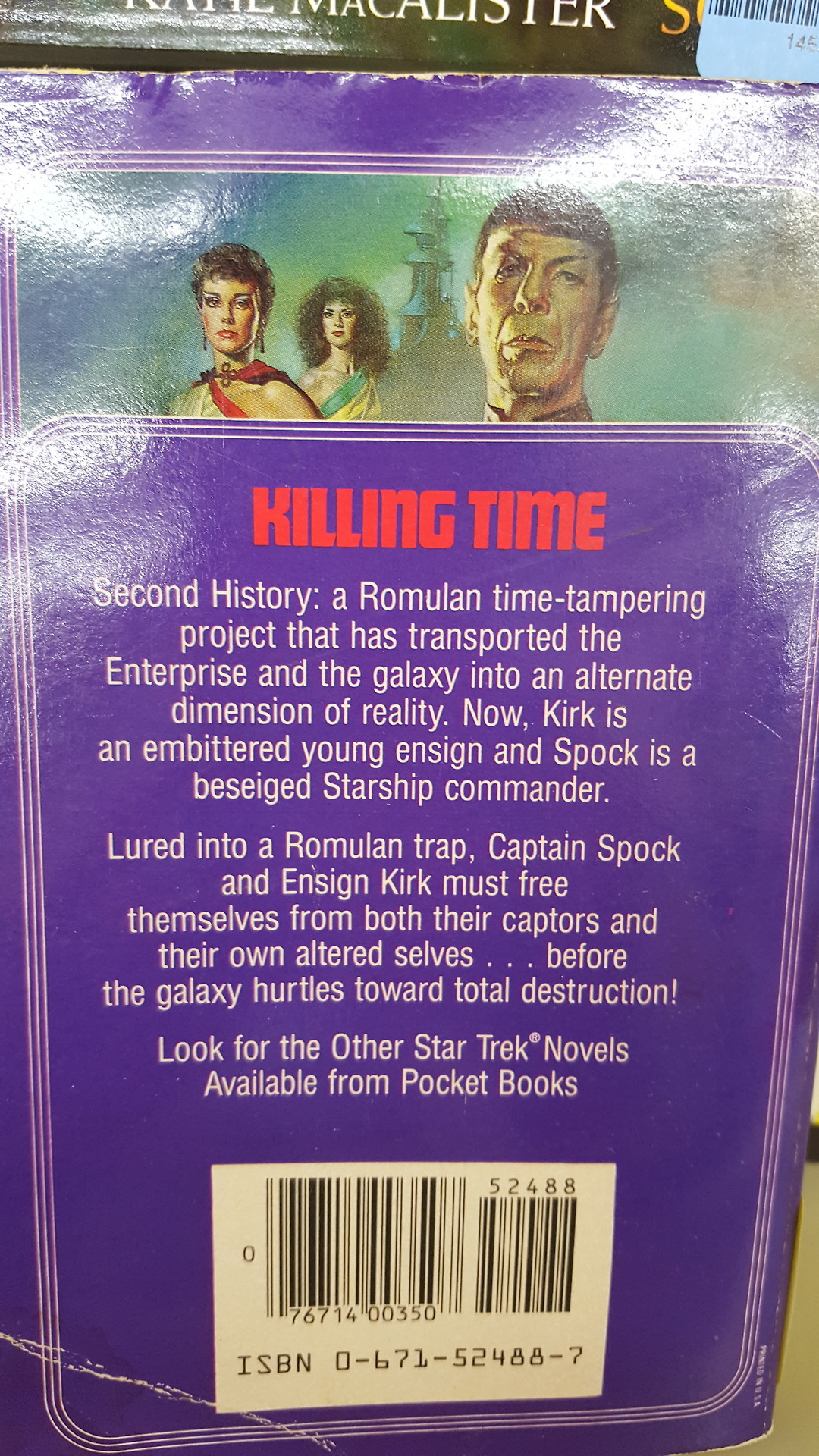
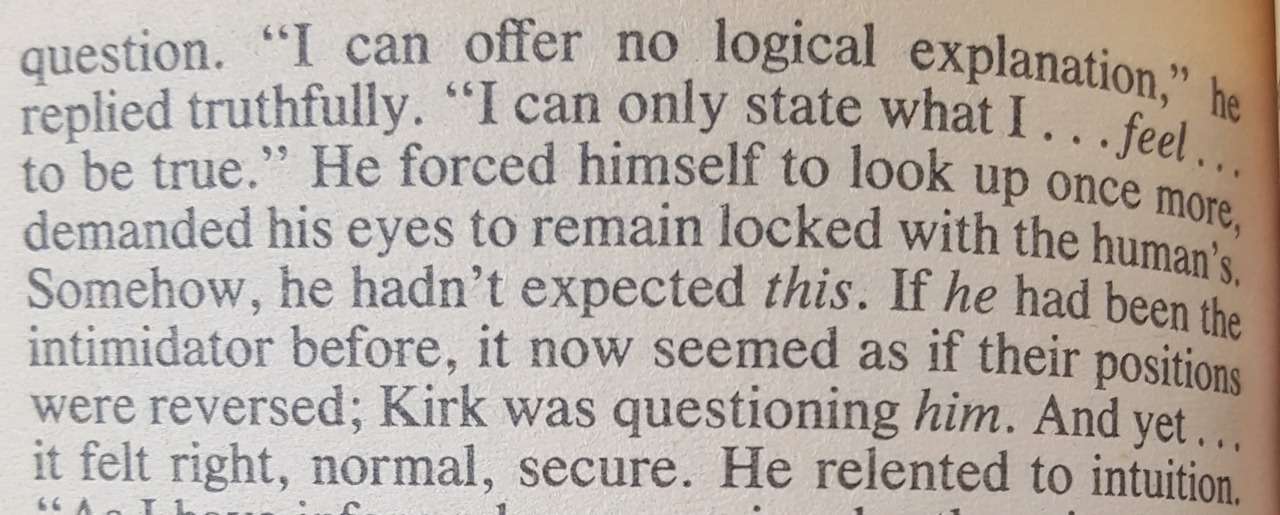
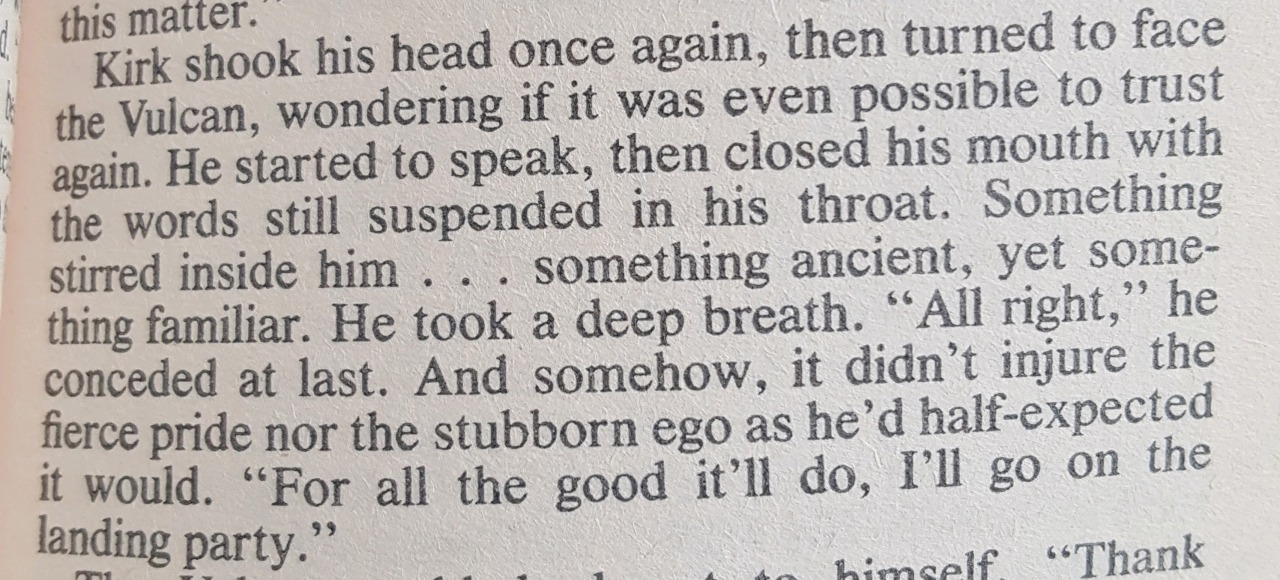
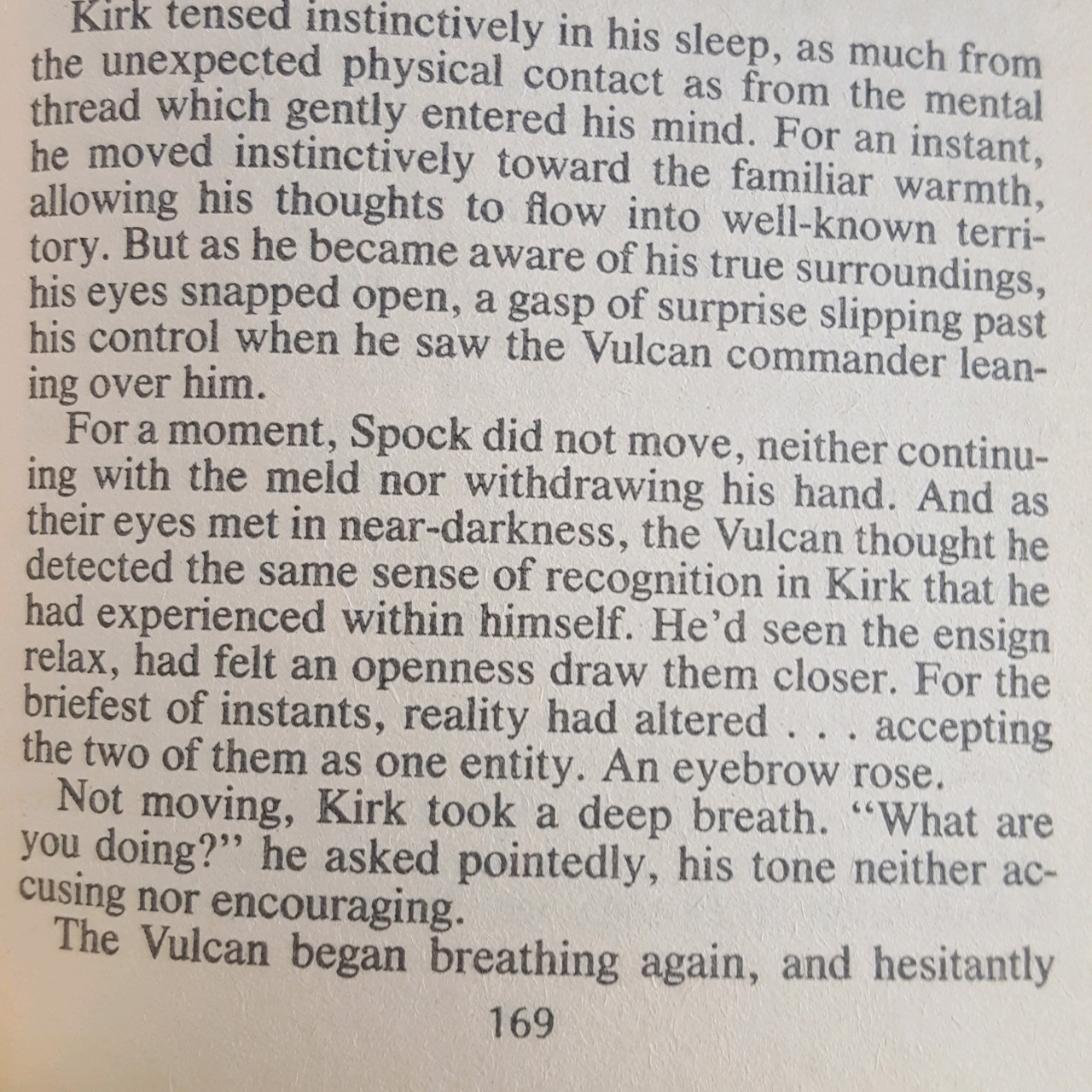
today at goodwill i found a kirk/spock au where kirk is a lowly redshirt
Okay no but this book.
Do you know how fucking long I hunted for a copy of the first edition of this book? I can’t remember the specifics, it’s been ages since I read it, but in the first edition it had some line that was basically confirming Kirk/Spock that was removed after the first printing.
oh my god are you telling me i found a piece of fandom history and i had no idea
I AM BACK AT GOODWILL AND IT’S STILL HERE AND IT’S A FIRST EDITION WITH GAY STUFF???? IT’S A DOLLAR?????? I’M
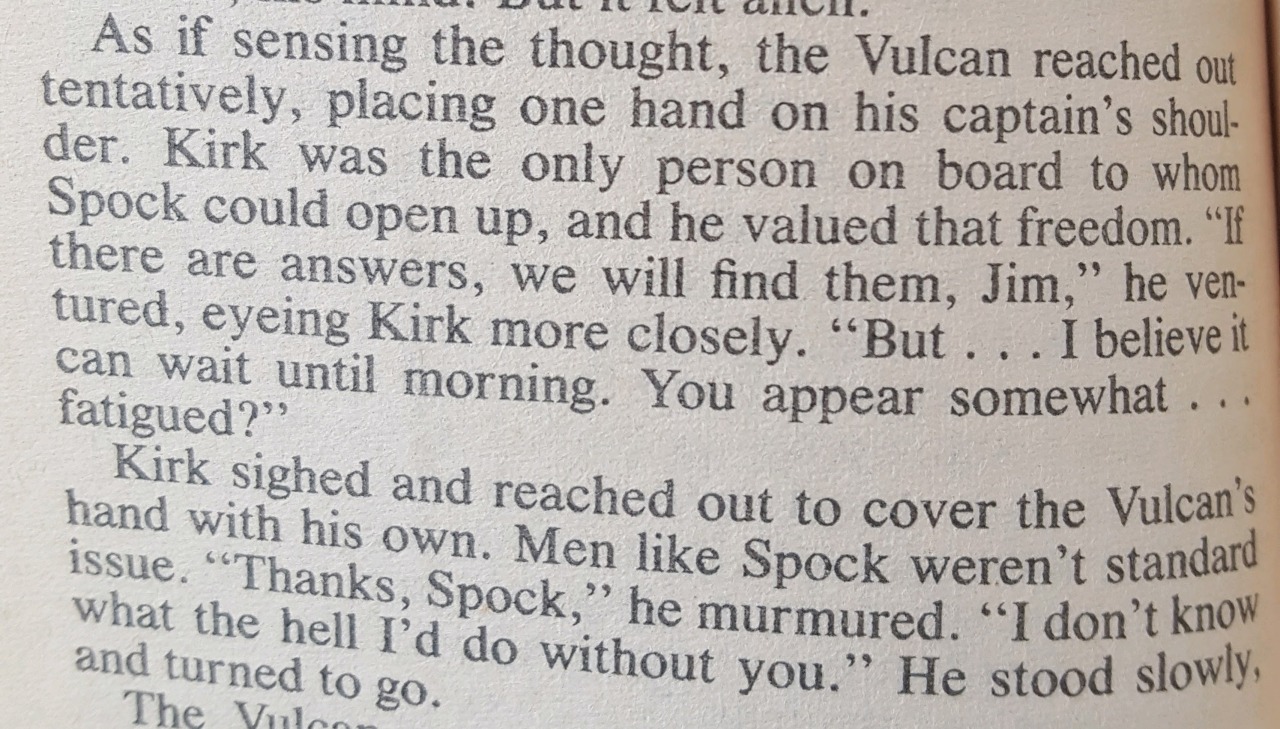
it starts out with wholesome hand-holding and boyfriends worrying about each other
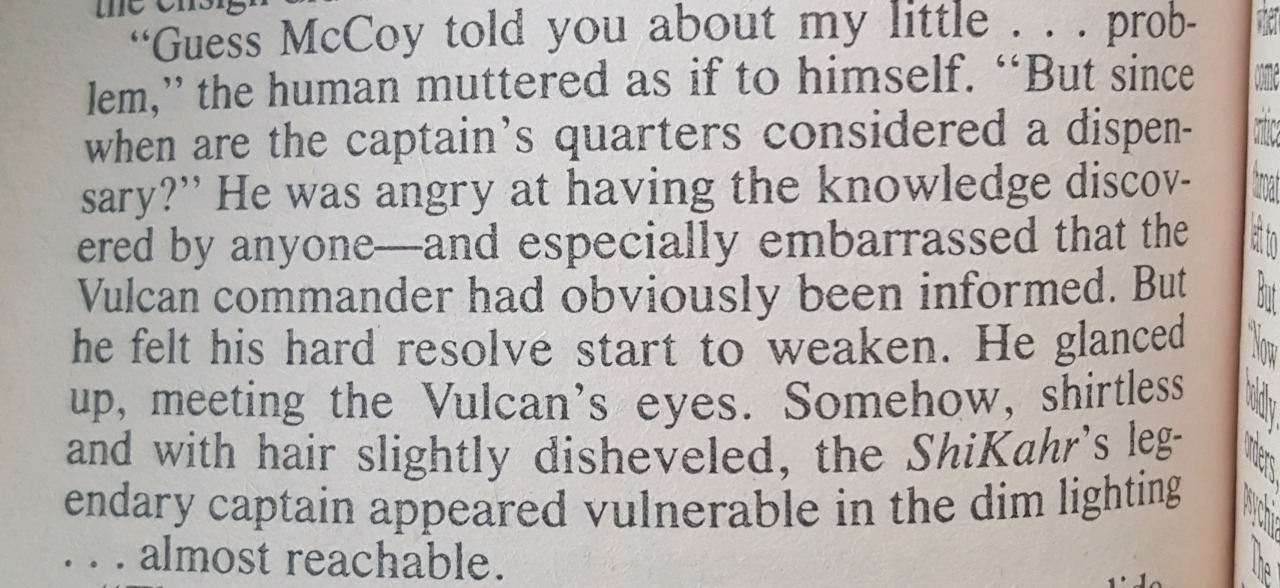
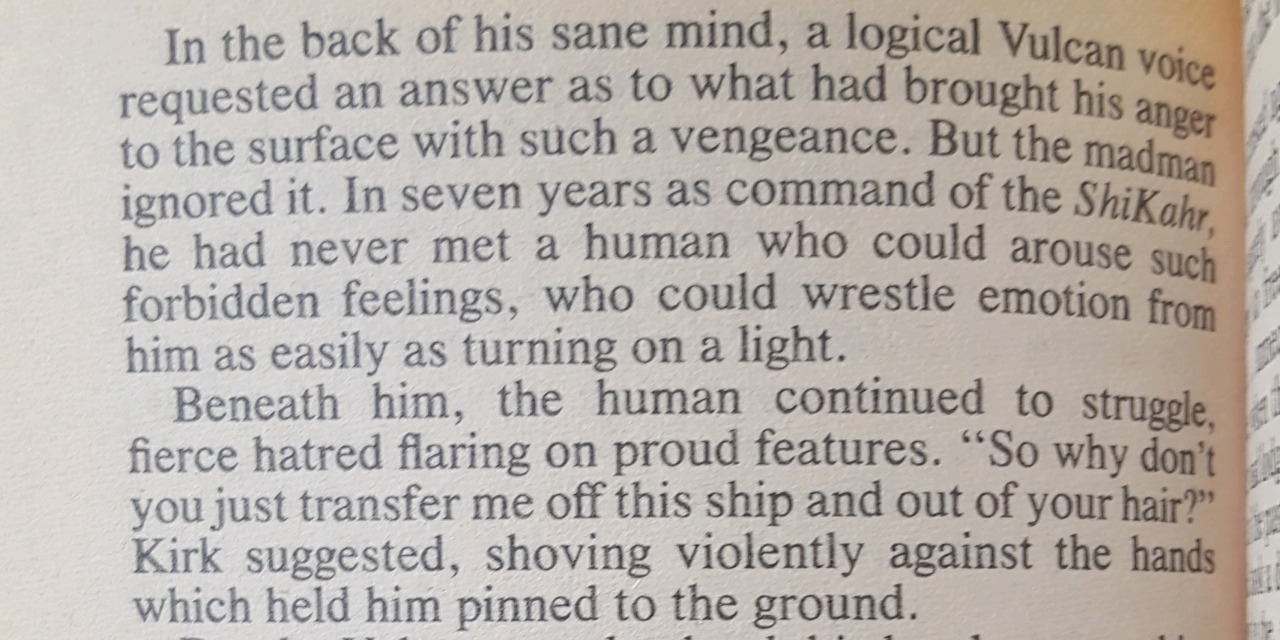
they’re in an au now and kirk is an angry ensign with a drug problem
“being the top felt weird and wrong”
SOMETHING STIRRED INSIDE HIM
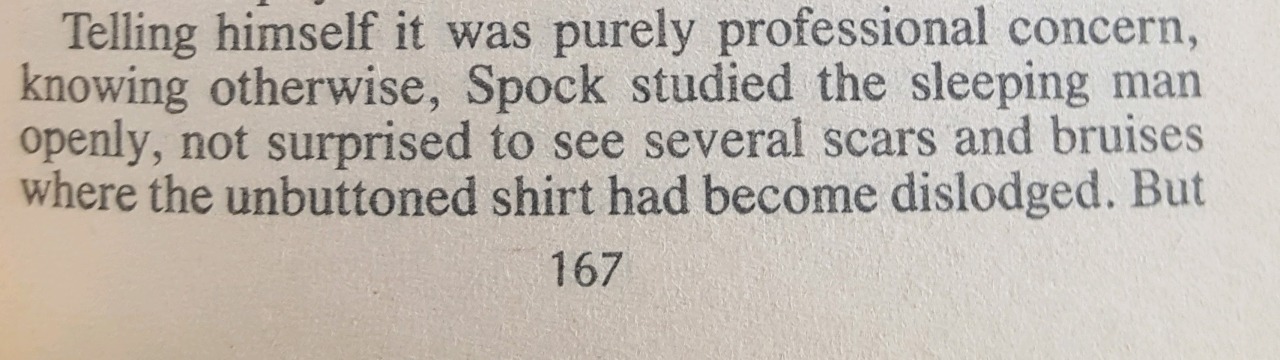
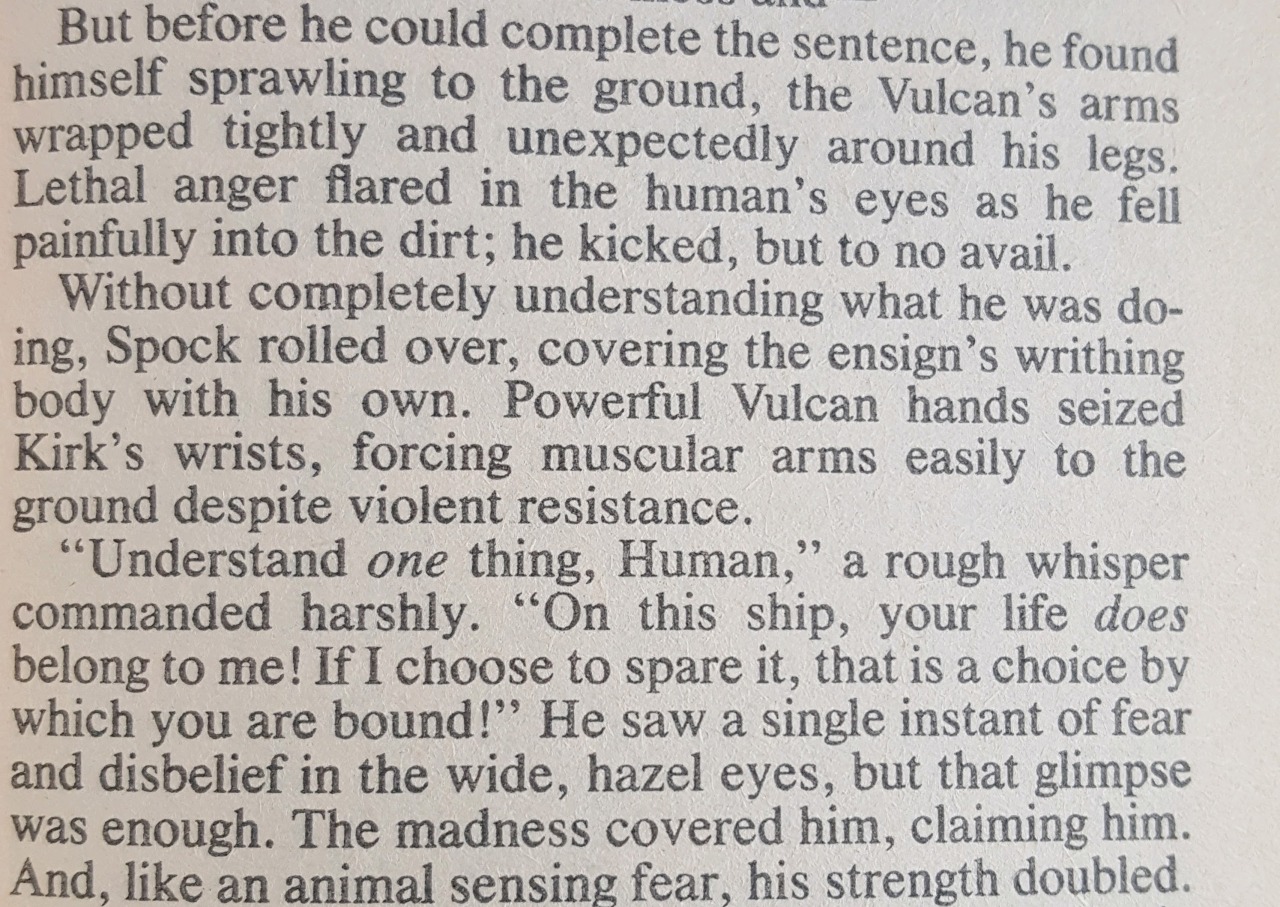
no matter the universe kirk can’t keep his shirt intact
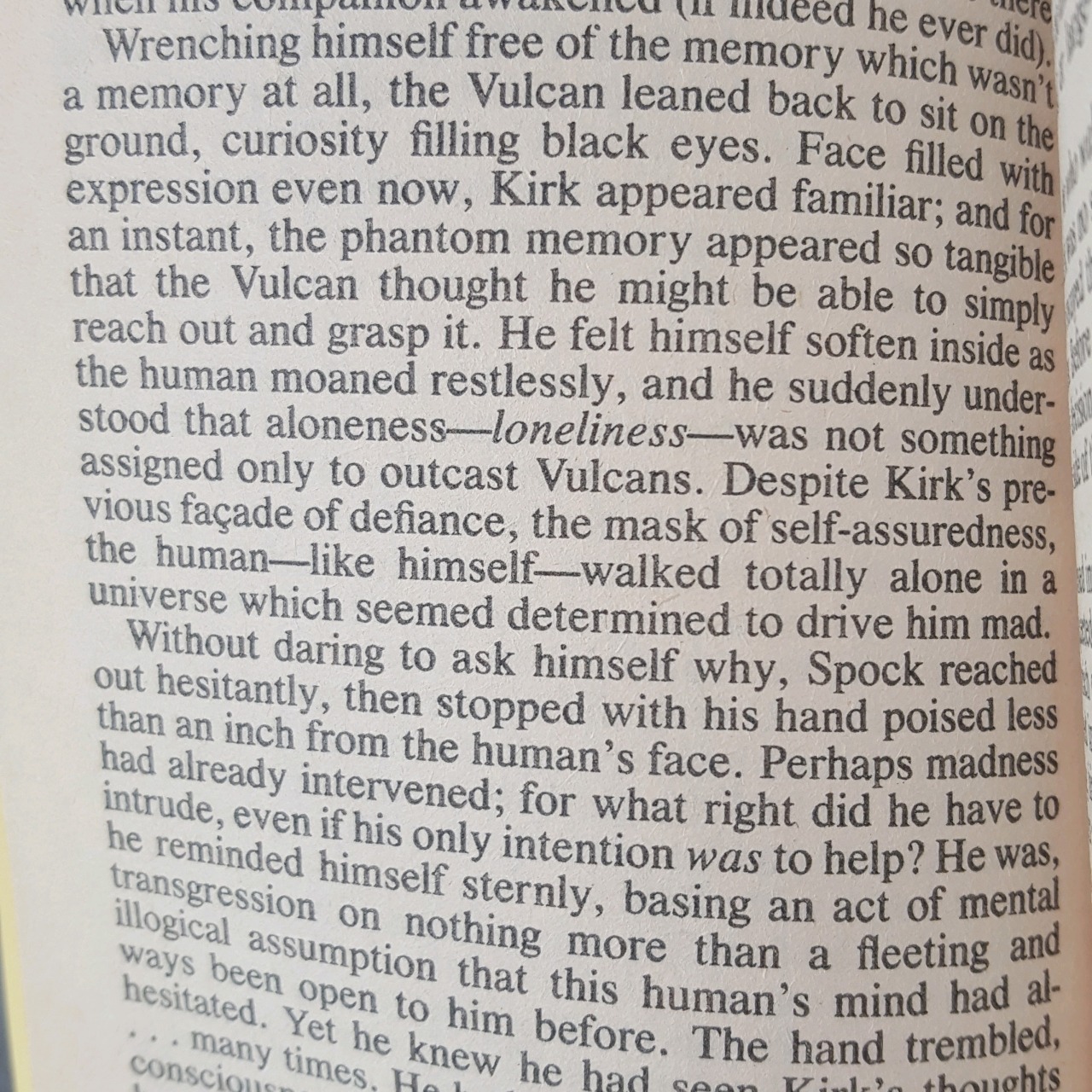
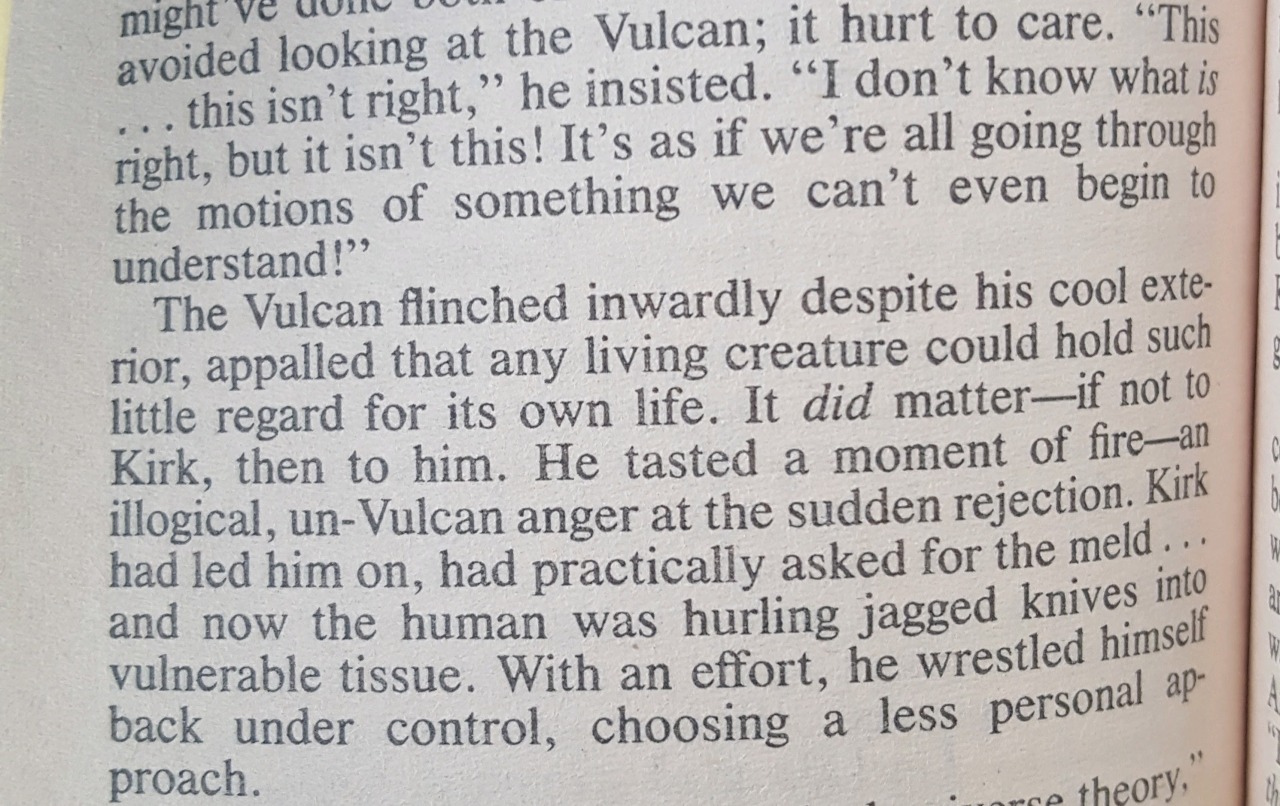
THIS IS WHERE SHIT GETS REAL Y’ALL I CAN’T
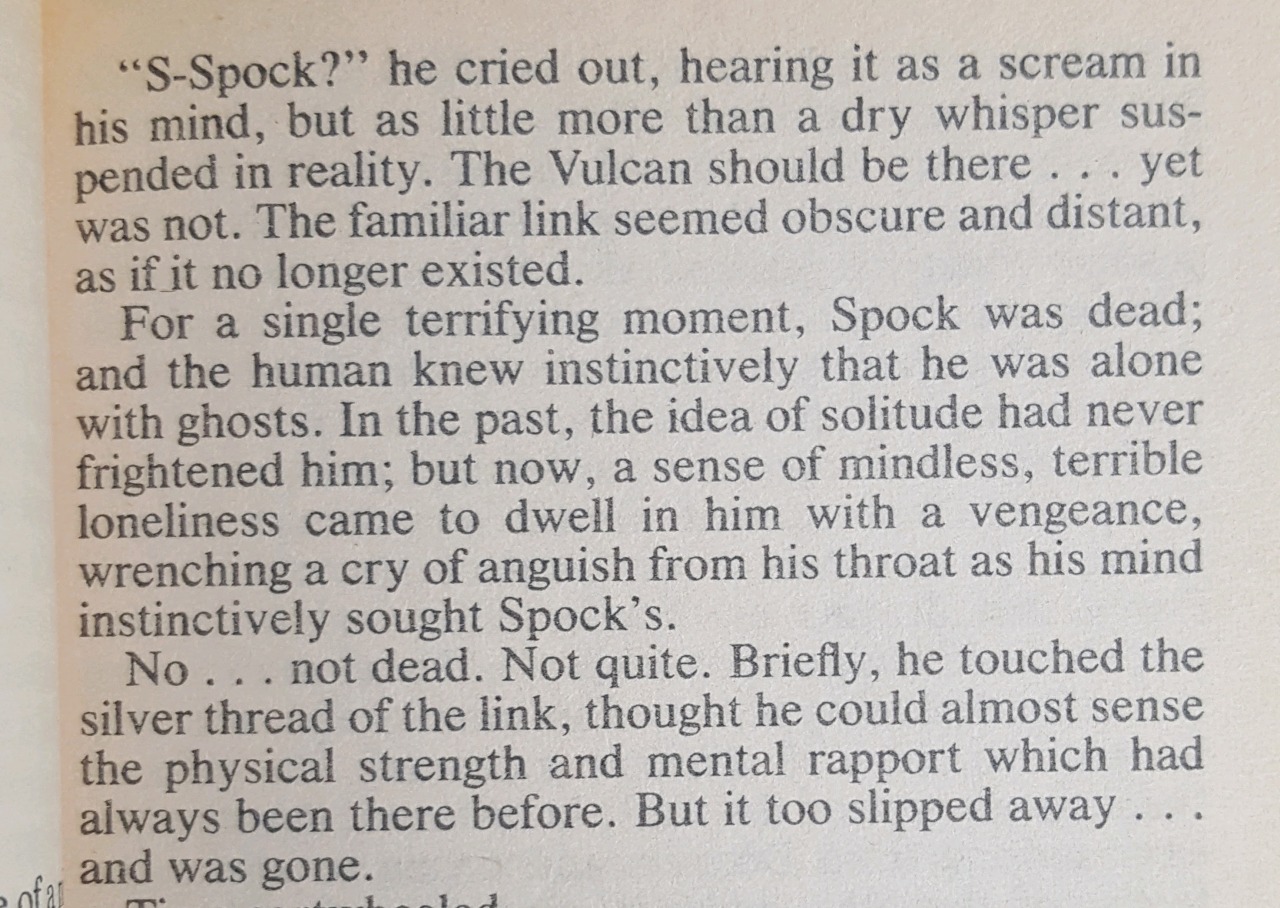
THE MIND MELD IS BARELY EVEN A METAPHOR
KIRK WAS ASKING FOR IT
aaaaaaaaaaah
this is the best dollar i have ever spent and yes that includes bearllionaire
I’d heard about this as some sort of fandom urban legend - everyone heard about it, no one seemed to have hard copy. Nobody was sure if it was some unpublished fanfic, a first draft, vanity press, whatever.
And it’s real.
No one had a copy because Gene Roddenberry found out about the romantic undertones and forced Pocket Books to recall the first edition so that it could be drastically revised.
Too bad for him we’d already bought the original…
W O W
I 100% had this book, and either I never got around to reading it or I just did not have one of the lucky ones.
Oh my gods. Just checked our personal library, and we have this book. The original version. Holy crap. Gonna give it a read for sure.
Ah this book. Sadly, as a kid, I had a later addition.
I met the author a couple of years ago at a slash con. Pity she doesn’t make it to many anymore. I think she’s selling original ebooks these days.
The book itself is total Streisand effect: nobody would have paid attention to the canon-like hoyay if they hadn’t freaked out and recalled it.
Hi guys! So I know we all don’t actually read the terms and conditions of things and just hit agree assuming there’s nothing important in there (I do it too oops) but if you take writing commissions or anything involving money, then there’s actually something in the AO3 terms and conditions to be aware of.
Linking to a personal website or blog/social network where you are taking donations, posting commissions or mentioning published works is permitted, but advertising it directly on the Archive is not, nor is using language which one might interpret as requesting financial contributions. For example, you can say something to the effect of “check out my Tumblr if you want to know more about me and my writing” and include the link to the site, but you cannot specifically state anything about donations, commissions or sales on the Archive.
Today someone reported one of my fics as violating this condition - presumably because I’d mentioned my patreon in the author’s note (I wasn’t actively requesting donations either… I’d literally just mentioned that it existed, and that the fic in question was written as a thank-you for hitting one of my goals).
I’ve written to AO3 to check whether just saying ‘thank you to those who support me on patreon’ is fine and I’ll let you guys know when they get back to me, but if it’s still going too far in terms of being a ‘commercial promotion’ then I’ll just avoid mentioning this in the future! :’)
As I said, someone did actually report my fic for this - so there are people out there who are noticing/reporting these situations. Please be aware of this if you take fic commissions, or use patreon or ko-fi, because your account could end up suspended, which of course no one wants!
<3 <3
UPDATE: AO3 got back to me - you’re not allowed to mention or link to patreon at all, regardless of how it’s phrased. Not sure if it’s the same for ko-fi but it might be better to be safe than sorry!
<3 @kahnah23 relevant to you and possibly some others~
That’s a fucking bullshit rule, I’m sorry. They shouldn’t deny you the opportunity to advertise your own work.
this isn’t just a self-determined descriptor; that’s a legal definition that requires adherence to specific rules and laws regarding income, profit, and donations.
this isn’t a “bullshit rule” just meant to prevent creators from advertising. in op’s post, the contact from ao3 offers a roundabout way to advertise. this rule ensures that ao3 and the organization for transformative works to stay a non-profit organization - this “bullshit rule” is essentially a way so that ao3 and the other services that the organization for transformative works can stay online.
it’s not just about maintaining nonprofit status. (i question if that’s even applicable here, since the profits in question don’t go to the organisation, but i know very little about nonprofit law. just a gut feeling.)
the actual point is, they run a legal services organisation for fans who get into legal trouble. they literally exist for the purpose of helping you not get into legal trouble. profiting from fan fiction very much opens you up to the possibility of getting into legal trouble. they’re not going to let people do things on their website that they know will land them in exactly that trouble.
and to be clear, just because everyone who slaps a patreon button on their tumblr isn’t getting sued, doesn’t mean they aren’t doing something for which they could be sued.
let me say it again: profiting from fan fiction very much opens you up to the possibility of getting into legal trouble.
here’s why.
use of other people’s characters is subject to copyright law. the general principle that makes downloading a movie or a song piracy also applies to the use of a character, assuming certain factors such as uniqueness.
how fan fiction has come to scrape by in the past: by not being a commercial enterprise.
in contrast, for use music, video, images incorporated into new works: by being significantly transformative.
these two factors, commerciality and transformativity, are considered side by side. the greater the transformativity, the less weight commerciality will be given. if something is highly transformative and non-commercial, then it’s almost certainly fine. down the other end, if it’s not at all transformative and commercial, forget it.
it’s a matter of judgement as to what degree of transformativity there is in the work that will push it over the line to overcome the general prohibition against commercial use. but fan fiction in the truest sense is barely transformative. in fact the goal is to come as close to copying a character as possible.
an analogy with the use of music: a cover band, despite every part of the performance of the song being done by that band, is still playing a song that was created by someone else. you, the fic writer, as covering someone else’s character.
the cover band you see at your local bar? they, or the local bar itself, have paid a fee to obtain permission to play that song. (even if they were playing for free they would still have to obtain permission, because any public performance of copyrighted music is prohibited.) in contrast, use of a line from one song in another another song that uses the line for parody? fine (Campbell v. Acuff-Rose Music, 510 U.S. 569 (1994)). let’s call that the AU with the names changed, the location different, and everything about that character’s backstory is gone. they just look like the actor and have a dialogue pattern that matches.
the better you are at writing a character in character, ironically the more likely you are to violate copyright law. and that’s why the commercial factor becomes incredibly relevant.
basically, don’t get paid, keep being cool with the law*.
*this is not an endorsement of the principles of copyright law itself. this is about what that law is and how it works.
People also forget the reason why disclamers on fics became so prevalent.
Please understand that profiting off fanfiction, fanart and all forms of fan-content is direct violation of copyrighted material.
Your commissions to draw popular characters? Direct violation of Copyright. AO3 works hard to maintain fandom expression protected. You hurt their cause by not adhering to their term of use.
They’re there so you won’t get sued.
On this front, fandom creators in the US may want to batten down the hatches because the Trump administration is pretty much guaranteed to highly favor intellectual property owners–especially groups like the MPAA and RIAA–over fair use and transformative works.
We’ve got a lot more legal precedent than we used to on our side, but this kind of ‘bullshit detail’ has historically been a lever for these people to hang a lawsuit on and no doubt it will be again.
Yeah, afaik fanworks have more legal protection than they used to, but that could go away in an instant.
Anybody else old enough to remember writing at the beginning of each chapter of their fiction “I DO NOT OWN X, I AM NOT MAKING ANY MONEY OFF X, I WRITE ONLY FOR THE LOVE OF A/B. X is the property of Y, please do not sue me I am 13 and you will only get 37 cents” because I am and this is why you don’t fuck around with copyright law. Fanworks have come a long way in respectability and legality. But profiting off it can still get you in trouble. Be careful kiddos.
The OTW has done so much in getting non-profit transformative works to be legalized, especially getting copyright exceptions for vidding. Let’s not screw this up now, guys.
The discussion of copyright could be refined a little here…but let’s be blunt, to some extent, it doesn’t matter. Regardless of the law, AO3 was established with a deliberately noncommercial ethos–in fact, in specific response to contemporary attempts to commercialize fandom. The rule exists in service of that ethos. Don’t like that “bullshit?” Well, then, I guess you should just go read and publish fic on that other free platform that doesn’t exist to turn you and your personal data into a product to sell off to capitalism’s highest bidders. What’s that? You say that doesn’t exist? Hmmmm, I wonder if that’s a coincidence.
Kids. Teenagers. As someone staring 40 in the face lemme tell you a thing.
You are going to be horrified and embarrassed at some point by the shit you are doing now.
And you are going to wish with all your might you’d done more of it.
You’re gonna wish you had more selfies, more photos, more videos being dumb with your friends. You’re going to wish you’d had your hair even higher or your shoes even sparklier.
Go. Document the shit out of your ridiculous life. Fuck trends but if you wanna be trendy, go all in. Fuck in-groups and subcultures but if one sings to you, do it all. Be exactly as cool or punk rock or goth or fandom or country or hardcore or hip hop or whatever, and don’t let anyone tell you differently.
Just don’t hurt people. That’s the only thing you’ll ever genuinely live to regret.
I think I have talked about this before, but because life doesn’t end at twenty or thirty or forty or fifty and thinking that folks are going to fall out of social media or that there won’t always be someone your age and my age and twice both of our ages interested in [insert anything, ever] is a very limiting worldview.
Somewhere there is a sixty-five year old who unironically loves Taylor Swift’s music and a fifty-two year old writing Superwholock fanfic and a ninty year old who absolutely lives for the next episode of Archer and a seventy-one year old that can kick anyone’s ass in k-pop trivia. There will always be these folks, and all the Internet has done is give fans of all ages a chance to interact in a way that they never had before.
Before BBSes and the Internet and Usenet and the World Wide Web and fanrings and forums and social media, those people would just love it in their own way, in the privacy of their own homes. But now anyone can make an Ao3 account or a basic fansite or tumbl about whatever they want, and sometimes you’re gonna learn those people are old but they still get it, and sometimes you’re going to find out those folks are still kids, twelve or fourteen at the oldest, and marvel at their maturity and skill and attention to detail.
And that is rad as hell, that is fucking incredible, that is… whatever the kids are saying these days, hah.
As a sidenote, once, about a decade ago, I decided to email one of my favourite authors before she bit it … she was pushing 90 at the time. ( … she’s still alive now).
Anyways, we got to having a long discussion, because I shared my deadname with her late husband, and I actually had quite a long conversation with her.
The part of the conversation I’d like to share with you about this now pushing 100-tear-old author isn’t that she developed a liking for her breakfast eggs from her honeymoon in Vienna, or that her Husband would sometimes steal her drafts to read them as soon as he could, or that she superglued a potted plant to her bookshelf to watch her orange cat try to knock it over and fail.
Nono, I mention this to bring up what she would do as a writing exercise whenever she didn’t feel like writing her serious work.
In short, erotic darkwing duck slashfic. You can find it online.
This is the greatest addition this post has gotten so far.
I LOVE THIS FUCKING POST.
I love all the posts written by older fans, with their insight, and their generous attitude towards young fans, and young fanfic writers, and young fanartists.
Older fans who patiently explain to whomever questioned the validity of older fans participation…
that it’s older fans running the AO3 servers and the entire OTW organization;
Older fans most often writing the actually well written fanfic;
Older fans planning, organizing and executing massive cons;
Older fans who write out fandom history dating back to pre-internet so that history can be known and preserved and enjoyed;
Older fan lawyers enforcing Fair Use lawspro bono to keep fans from being sued for creating fic or art or any other media;
Older fans behaving well with life-lived-and-learned healthy boundaries;
or conversely dealing out smack-downs to those not behaving well be they older trolls or naively inexperienced younguns;
Older fans letting fans of all ages remember that zany enthusiasm is not the province only of the young - it is the province of humanity.
And we’re right there loving being human with you.
I’ll say yet again, Tumblr users are older than we think. There’s nothing unusual about a 40-something on here.
I wonder where the break happened that such wide swaths of younger fans don’t grasp fandom things that used to be unspoken understandings. That fic readers are expected to know fiction from reality, that views expressed in fic are not necessarily those of the author, that the labels, tags and warnings on various kinkfics are also the indication that they were created for titillation and not much more, please use responsibly as per all pornography. The ‘problem’ isn’t that so-called ‘problematic’ fic exists but that some of the audience is being stupid, irresponsible, at worst criminal, at best not old enough to be in the audience to begin with. And that’s on the consumer, not the author who told you via labels, tags, ratings, warnings and venues what their fic was about and what it was for.
Does anyone have access to a DVD burner and a few hours of time to assist with a vidding history project? You’ll need to be based in the United States. Please PM me or send an email to mdawn6@yahoo.com
I find myself really yearning to explore and understand early XF fandom culture. I get little snippets of clues, I sometimes play with the waybackmachine, livejournal, and fanlore.org, I’ve heard crazy stories of people faking their deaths and lawsuit panic. How, even, certain fics caused absolute shockwaves in the fandom (looking at you, Iolokus). It’s incredibly interesting from a sociological perspective. Have any of you been here from the start? What are your experiences? What do you remember?
Have a look on wayback at Autumn Tysko’s site. I lurked wide eyed on Haven from 1996 through 2000 and read every piece of fic I could find. Ephemeral would have pages and pages of new post ep fic after an episode aired. Is @dashakay around?
Iolokus was crazy divisive! I remember when it came out. I pretty much lurked throughout my teens in the 90’s and bailed after S8, but online culture was so different. The idea of intimately interacting with strangers was a pretty new idea, and it’s why a lot of older fans are a lot more private than younger ones.
It’s really fun to explore the archives on the XF alt.tv.xfiles list. You get a sort of real-time flavor of what went down. I was definitely a big lurker back in the day. I didn’t participate as much but I absorbed everything with wide-eyed delight.
The fic wars were amusing to see. A lot of good writing, but a lot of swiping at each other and spreading rumors, nastiness, etc. Ah, internet, never change.
It has to be mentioned that “XF fandom” and “crazy stories of people faking their own deaths” immediately conjures Evie Whiting. It is impossible to fully capture the total insanity swirling around at the time, but @dashakay has a write-up about it here. I’ll also add that Evie said her twins (Dana Katherine and Fox William, naturally) were born on 10/13 and that somehow nobody noticed (publicly, anyway) that the episode “Eve” has a scene at the “Whiting Institute for the Criminally Insane.”
I find myself really yearning to explore and understand early XF fandom culture. I get little snippets of clues, I sometimes play with the waybackmachine, livejournal, and fanlore.org, I’ve heard crazy stories of people faking their deaths and lawsuit panic. How, even, certain fics caused absolute shockwaves in the fandom (looking at you, Iolokus). It’s incredibly interesting from a sociological perspective. Have any of you been here from the start? What are your experiences? What do you remember?