Hi, about your userinfo page, what's the alt(.)tv before x-files for? Also, out of curiosity and since I don't know who else to ask, what are the major platforms that fandoms (as a whole) have been on throughout the years (i.e. Ao3 (is it meant to be referred to as OTW or Ao3?), Fanfiction(.)net etc.).
alt.tv.x-files is a Usenet group. The “alt” hierarchy was where the random new groups were added, especially the fandom ones. (Other parts of Usenet were often restricted to serious science topics or whatever.) Fandom means a lot of different things, but looking at the Kirk/Spock type fanfic fandom history, here’s a list in vaguely chronological order. For perspective, fanfiction.net was founded in 1998. LJ was founded in 1999 but got big in fandom in 2002.
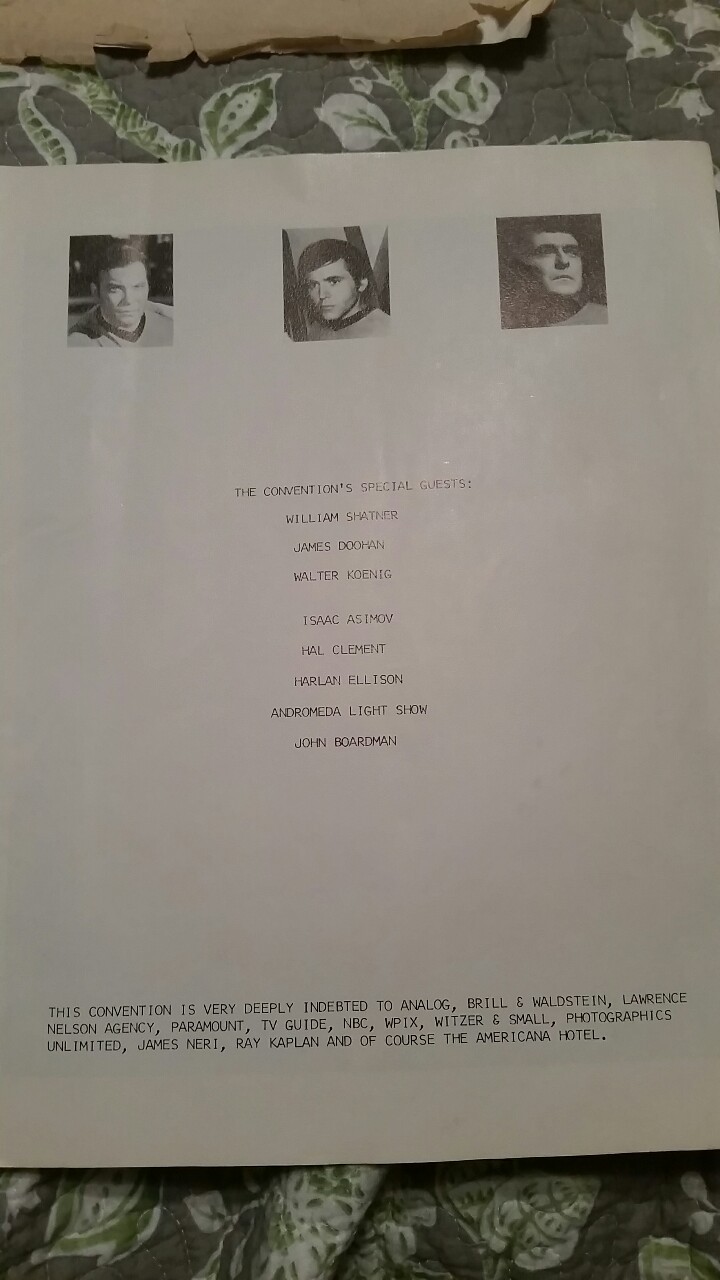
Zines, conventions
Usenet, privately hosted mailing lists
Forums, early archives, eGroups/Onelist/Yahoo Groups mailing lists
Imagine describing fandom to someone with no prior knowledge of it at all. What’s the need-to-know?
You’d tell them it consists largely of online communities who organize via blogging sites (and formerly message boards or mailing lists); fiction and art that’s often erotic in nature, and is sometimes commissioned or sold via self-promotional sites like etsy and society6; conventions that people travel internationally to attend; cosplay that takes so much skill to assemble that some people do it professionally; analysis of the source material backed by fans’ knowledge of subjects that range from medicine to weapons operation to feminist social theory to stage design.
I can imagine a lot of reactions, depending on the person, but I’m having trouble figuring out who could hear that and then conclude most of the participants are kids.
I will be moderating a panel on Fangirling Over 30 next month, and I was looking up this post so I could quote it at at the panel, and I just wanted to throw in, additionally, something that is implied above but not stated outright:
Who do the young’ins think are performing the executive functions of fandom? Who’s paying for a domain name and server space so they can host a fanfic archive? Who’s establishing and moderating message boards and mailing lists? Who’s throwing a ‘zine-assembling party at their house? Who’s forming an LLC and liaising with a hotel for the convention they’re organizing? Who’s doing the research on intellectual property to determine what constitutes fair use so that fan artists know what they can sell and where?
Hint: not kids.
The fandom playgrounds we’ve been frolicking in for 50 years did not materialize out of thin air. They were built by the people who are “too old to be in fandom.” Respect them.
Cannot believe I’m seeing the tired old RPS debate on my dash in the year of our lord 2016.
This debate was old when I entered fandom ten goddamn years ago, and it’s just gonna keep getting older.
Like last I checked, it was considered the polite norm to keep it out of the main fandom tags, actors asking fans to stop writing fic about them got them to stop, and shit like sending fanfics to the actors was considered this like, ridiculous thing that happened in Ye Olden Days. The major problems seemed to have resolved. Did something change recently?
What I’ve never understood when the “stop RPF” arguments come around, is that they always seem to fixate on the people who ship actors. Like, that’s such a minor part of the RPF section (if you ignore the Supernatural segment which is, frankly, kind of like spiders georg statistically and messes with the data.) Actor-shipping is absolutely obliterated by the sheer volume of people shipping musicians together and sports players together. Like, have you seen the Hockey RPF tag on AO3 alone? It’s staggering. When I first joined fandom on LJ, I legit thought “hockey rpf” was a tv show or anime or something I’d never heard of, because it showed up fucking everywhere.
If you really wanna slay this beastie, you’re gonna have to stop the sports fans and bandslash people. And honestly, seeing as I’ve seen this debate go on for ten years, and it was going on in the years before I joined fandom, and it’s likely been going on long before I was born, I expect this to continue going around and around in a circle forever.
From time to time, fans also start objecting to darkfic. It is basically ship wars and bullying wearing a different coat.
“In 1988, it was estimated that there were 300 publications
that enabled fans to explore aspects of television series, 120 of them
centered on Star Trek, a number that no
doubt underestimates the production
of fan literature because it doesn’t include literature circulated only in
photocopy circuits or the more covertly circulated publications"
- Rosemary Coombe,
The
Cultural Life of Intellectual Properties: Authorship, Appropriation, and the
Law, 1998, p. 107
Hahaha. There were more than 300 fanzines by 1988. On Fanlore, we have over 8,000 fanzine pages spanning 1968-today. By 2006, fanzine production slowed to a trickle. It would be wonderful to see someone pull together stats based on what we have on Fanlore, arranged by year and by fandom.
Beta Testers Needed: We’re exploring ways to expand the Media Fandom Oral History project into a DIY effort along the lines of Story Corps. What we’re looking for:
Two (or more) fandom friends willing (a) to interview one another (aka rambling fandom chats) and (b) to include their recordings into the existing oral history project
We need fans to test these methods
*Fans willing to chat with each another over phones using a conference call system
*Fans willing to
chat with each another over Skype in connection with free recording software (we need people willing to test both PC and Mac)
*Fans willing to do
chat with each another
in person using free iPhone or Android recording software on their smartphones
Once done, you will upload the audio files into a Dropbox account. A permission form will also need to be signed by both parties and uploaded (scanned or photographed copies are fine). There will also be a set of sample questions you can use.
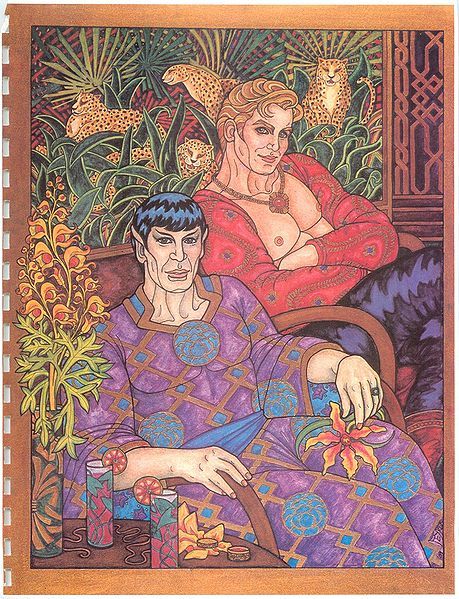
Original Star Trek art by Caren Parnes, logo design by Morgan Dawn
Question: Is there a time limit on this?
This would be really fun to do in a group at a con like 221b or destielcon or something. Too bad I’m not going to sherlock seattle.
No time limit on this. We started it in 2014 and just opened it up to DIY. So I think we’ll be good to go at least through the end of 2017.
Beta Testers Needed: We’re exploring ways to expand the Media Fandom Oral History project into a DIY effort along the lines of Story Corps. What we’re looking for:
Two (or more) fandom friends willing (a) to interview one another (aka rambling fandom chats) and (b) to include their recordings into the existing oral history project
We need fans to test these methods
*Fans willing to chat with each another over phones using a conference call system
*Fans willing to
chat with each another over Skype in connection with free recording software (we need people willing to test both PC and Mac)
*Fans willing to do
chat with each another
in person using free iPhone or Android recording software on their smartphones
Once done, you will upload the audio files into a Dropbox account. A permission form will also need to be signed by both parties and uploaded (scanned or photographed copies are fine). There will also be a set of sample questions you can use.
Original Star Trek art by Caren Parnes, logo design by Morgan Dawn
@allthingspieandhockey Interested? I’m not decided entirely, but I’m definitely intrigued.
No doubt got lost in the messages (and I forgot to say over ice cream), but yes, I’m interested. Is it any/all fandoms, or fandom specific. I am curious to see the questions.
Yes, any and all fandoms, anime, hockey RPF, furries - all part of the fannish experience,. Questions are generic and are just a guideline. I am going to edit the post and add the email (it is in the OP once you go to the Fanlore page. I find it cuts down on some of the questions if people can read the FAQ first).
Blast from The Past: An Homage To Every Fan Who Has Voluntered To Run A Fan Vid Show
This post was from 2007, back when I was well enough to volunteer on fan-run conventions. If you have ever VJ-ed a vid show, you may appreciate it……..
“As some of you may know, I help run the Bascon vid show. My mission: solicit vids, create the playlist for the 2 hour Sat show and the 1++ Bonus show. We have a few rules and requirements about submitting vids and how we show them and what we need from the vidders … But after watching Vividcon host three days of vid shows over the past five years involving hundreds of vidders - and doing it very well with only a few snafus, I, as the solo Bascon vid show playlist DVD person, promise you this:
1. I will do my best to show your vid and have it look as best as possible. Having said that….. 2. I do not promise to show your vid unless you’re an attending member, in which case I do promise to show at least one of your vids - if you’re lucky it will be at the very end of the show sandwiched between a 6 minute long montage of black and white footage from the A Team set to Britney Spears and the vid about polar bears. I also promise to never tell you which vid I am showing or why. I will lose every email you ever send to me. 3. I will fuck up your vid. I will squeeze it into the wrong aspect ratio. I will encode it in such a way that it looks fuzzy and we stare at it like it is a Rhorshack drawing. 4. I promise that your audio will drop at least twice and your video will go black at least once - and that this will *not* be because you used a fade to black effect. 5. I promise that the vid show DVD will always freeze when it reaches your vid - and only your vid. 6., I promise I will confuse your name with the lemon vidder on your left, to mix up your song title/vid title and to copy and paste Evanescence and/or Linkin Park into where your really cool artist/band name should be. 7. I promise that when your vid is shown, there will be at least one person trying to narrate the entire 12 season arc of X-Files to her neighbor loudly - even if your vid never has one X-Files clip. The audience will laugh at all the wrong places and cry when you thought you were being funny. You will receive the weirdest, most insulting and frankly disturbing feedback from my audience. If you receive any feedback at all.
Now I realize that is a lot to promise. I hope I don’t screw it up.
So now that we’re all clear on what to expect, please sit back and enjoy the show.
Reading fandom history wikis gives me respect for those pioneering women who saw Spock and Kirk and were like: They need to kiss. We should write them kissing.
50 years on and people are still writing about space husbands. It’s wonderful.
I know discourse is the word of choice in fandom nowadays but I kind of wish we would have stuck with “fandom wank” because it carries the implication that the anger involved culminated into effectively nothing and that the act was wholeheartedly masturbatory in nature rather than for any greater cause.
I saw this post about an hour after I saw a post that said, essentially, “There should be a word for that thing where [exactly describes ‘squeeing’].”
I feel like the time has come to produce something like this:
Squee: The noise you make when something is so good that all you can really do is squeak or squeal. A high pitched sound of delight, often accomanied by hugging yourself or others.
Squick: A fic/art/concept/topic that is repellent to you, so you reject association with it and instead retreat to your personal comfortable spaces- all the while remembering that someone else’s comfort is not your own.
YKINMKATO: Also called “kink tomato.” Abbreviation meaning “your kink is not my kink, and that’s okay.” Used to explain why you are rejecting art or fic brought to you by someone else. A solid mantra to recall instead of sending flames in people’s comments
Flames: The comment equivalent of anon hate.
AMV: “animated music video” or “anime music video.” Often, this is stylized to fit a specific fandom, such as a “PMV” (pony music video) in my little pony. May also be referred to as a lyricstuck.
Filk: Combination of the words “film” and “folk,” this is a music genre, to which “fan songs” and “fan parody covers” belong. If you don’t really understand what this means, take a quick listen to American Pie, then compare Weird Al Yankovic’s Saga Begins
BNF: Big name fan. You know that one person who is just so fuckign popular in your fandom? Their art is always on your dash, everyone knows their fics? Being spoken to directly by them is basically being noticed by everyone ever’s senpai? That’s what these people are called.
DL:DR; Not unliked the teal deer (tl;dr, or “too long, didn’t read”), DLDR means “don’t like? Don’t read!” It’s a reminder that you are under no obligation, ever, to expose yourself to uncomfortable (or, squicky), or potentially harmful (or, triggering), material. Not ever. If you don’t actively like something? It’s not worth your time. Skip it.
Gen: or “genfic” “genart” etc. Fan works which contain no or very little romantic content. Often these are styled after the canon material, and may be called “episodic” ro “slice of life” in addition.
Lemon: Work containing strong pornographic elements
Lime, or Citrus: Work containing mild or implicit pornographic elements
Sockpuppeting: The surprisingly common scenario of someone making a bunch of fake accounts/sideblogs to send themselves reviews or hate, to try to increase views or drama surrounding a work. The accounts they make are called Sockpuppets.
WAFF: Warm and fluffy feelings. A genre of fic that exists just to be therapeutically sweet. Nowadays, usually just called “fluffy.”
Schmoop: Take WAFF and somehow make it even more syrupy. You’ll know it when you see it.
Whump: Imagine if you will, a hurt-comfort fic. The comfort might be considered WAFF. The hurt? That’s the whump.
Wapanese: When white autors pepper their anime fanfic with random, tonally inappropriate japanese words.
Anthropomorfic: Nowadays we just call these “humanstuck” or “humanized AU.”
Wank: Wildly disproportionate drama that crops up because someone wrote/drew/did something that someone else didn’t like. Seriously, I cannot begin to express the fiascos that have come about from all this. Just… Just go look at this.
Plot bunny: Story ideas that you probably won’t ever actually deal with, but that multiply entirely out of control, creating huge worlds in your head that you’re probably not going to write. But hey! You might! And until then they make great sideblogs/askblogs/tumblr posts.
Casefic: Fanfics that try to create an episode-like feel for procedural and crime dramas, moster of the week shows, etc.
Jossed: When popular fan theories and fanon are addressed in the canon of a series, and whoops, turns out we were all very, very wrong.
Kripked: When popular fan theories and fanon are addressed in the canon of a show and, hot damn, we fucking called it.
Secret Masters: The people who run the websites/ communities/etc that we all do our fanning on. Less relevant now that we have things like tumblr, but when everyone had to run their own archival and social sites for each fandom, it was more important to pay our respects to the strange and powerful beings that brought us all together and gave us our fannish homes. Think the staff of AO3, for example.
Bashing: When a writer purposefully writes a specific character as a horrible, horrible person so that they can throw them out of the storyline, usually to allow their OTP to get together without trouble. Distinct from fridging in that it doesn’t require the character to die, but rather to be such a screaming harpy that they get rightfully removed from the main characters’ lives for being an abusive hell beast. Generally, a type of character hate. Be wary of people who bash women, queer people, and POC with consistency: they are not safe to be around.
‘Squick’ also has an alternate horrible meaning for Harry Potter fans who were in fandom a while back. Dear god.
Drabble: A fic that is EXACTLY 100 words. Often used as a creative exercise in telling a story in a very small constraint.
Ficlet: Fic that clocks in somewhere between 100 to 2.5K words.
Crossover: A piece of media in which two or more source materials are treated as the same universe. Characters from Fandom A can meet characters from Fandom B. (The Doctor Goes To Hogwarts And Meet Harry Potter!)
Fusion: A fusion takes the characters of one source material and *surplants* them into another universe entirely. Characters from Fandom A cannot meet characters from Fandom B. (Dave Strider is part of an Inception team!)
TPTB: The Powers That Be. Almost always redundantly referred to as “the TPTB.” A collective term for showrunners, actors, producers, writers, et al, anyone who is part of the team that creates the source material.
YMMV: Your Mileage May Vary. A shorthand way of saying “this is how I see it/have experienced it though I realize others might have a different perspective.”
Tinhatting: Often used in RPF fandoms, the situation where some fans are convinced two celebrities are in a relationship but its being kept a secret.
I keep getting lost on fanlore. It’s so interesting though and I’m totally addicted. Like… reading about our foremothers/sisters writing about a couple of gay guys in space is just amazing. I love this fandom.
The year is 2008 and someone was rambling about vidding.
“I have this idea for a panel…Vidders: Understanding Both Halves of Your Audience.
And it would be a vastly over-simplified panel dividing the vidding audience into two “vastly oversimplified and somewhat random but let’s just play along” groups: Kinetic Viewers and Narrative Viewers.
Narrative Viewers are viewers who absorb visual information through lyrics or, absent lyrics, a narrative/story-telling framework. Clips are used to evoke an emotional reaction in the viewers based on their fannish understanding/love of the show. This reaction is often apart from the visual information actually contained in the clip (ex. using a clip where Buffy smiles at Spike may have different meaning/emotional reactions depending on where and when the smiling is taking place in the Buffy-Spike storyline). Narrative Viewers look for edits to take place on the lyrics and are not as focused on the beats or the energy and pacing of the song. Some people claim that Narrative Viewers are a function of the past - before MTV taught us to absorb the world in 5 second sound bites, but that would actually be inaccurate. There are many people who still respond to this style of editing and there will continue to be because how we absorb visual information is quite complex. It does not only depend on how much MTV we may have watched. :-)
Kinetic Viewers are more focused on sound and movement. To them a static clip on a dramatic musical section is just as bad as a fast edit would be on a slow solemn swell of notes. Movement needs to match the tonal sound and beat as well. Lyrics are added on as an additional layer, but are not the key for this audience. They absorb their ‘narrative’ through the combination of sound and movement and do not rely on the lyrics as their main source of story-telling. And while context-dependent images (a static shot of a face or a talky face) are not a total turn-off to the Kinetic Viewer, they must be used sparingly and need to match up to the song’s sound/beat to be effective (if at all). The Kinetic Viewers main emotional connection is not to the underlying source as much as it is to the structure of the vid and how it offers up the source.“
Then I’d ramble about how when I started making and watching vids in the 1990s I was a Narrative Viewer and slowly grew into a Kinetic Viewer. But when I started programming for a local vid show, I had to relearn how to view vids through the eyes of the Narrative audience in order to better position vids that appealed to both groups. And now, I can literally turn off the one and become the other - and this means I now understand and appreciate more types of vids than I ever did before. It also means that I can be found weeping in horror and cheering with glee at a vid simultaneously which can be somewhat disturbing if you’re sitting next to me in a darkened convention hall. But don’t be afraid - this is *creative* schizophrenia.I’d also have short clips of vids to illustrate my (did I mention they were vastly over-simplified???) points.
I was thinking about problems in fandom that people now don’t have to deal with anymore, and how much this one used to take up my time.
In the earlier days of online fandom (like around the late 90s, early 2000s) a lot of web hosting companies offered free web sites, but they were only free up to a point. If the site got too much traffic, you had to pay for bandwidth. (That’s the activity on the server caused by people hitting the pages of the site, viewing images and so on.) Fan sites tended to be image heavy because the owners scanned in photos, made graphics, and also had long HTML files with stories, episode guides, and so on.
If a free site got too much traffic and hit the maximum badnwidth allowance set by the hosting company, the site owner could end up getting charged for it, or having the site shut down with no notice, or both. (The assumption on the hosting company’s part is that a site with a lot of traffic is making money and needs to pay fees, though of course a fan site is not making any money and the owner may not be able to pay that sudden $200.00 bill to keep their popular site up.)
But there was a way to steal bandwidth. Instead of storing images on your own site, you could link to the image on another site in an img tag, so the image would appear on your page, but would be stored on the other site, and that site would take the bandwidth hit. So you had site owners who were basically having their site shut down or being handed bills for traffic on someone else’s site. You can’t really call it plagiarism, it was more like parasitism.
And web site parasites were really good at pretending they didn’t understand what they were doing was wrong and actually costing other people money. (Often with a smiley face!) (This was also the time when fannish entitlement was a big issue and running a fanfic archive meant you’d get demanding emails from people who wanted you to update every day and supply exactly the kind of stories they wanted, and they would get increasingly abusive, but that’s another post.)
And a lot of fan site owners had no access to tools to stop it happening and didn’t know what to do about it. And even if you did know how to block or redirect the links, it was still a pain in the ass.
This problem was really bad in the Hercules and Xena fandom, because the stupid awful marketing company selling the video tapes (which was also famous for scary and abusive phone sales tactics) would encourage people to set up a fan web site, and the easiest way to do it was to parasite someone else’s site, link to all their images and sometimes copy their original material (stories, episode guides, meta, etc) and just forget to put their name on it.
Anyway, I’m glad I don’t have to deal with it anymore and I’m glad you guys don’t either.
This reminds me of the time my little internet start up got acquired by an ad company and then later they decided this interweb thing was for the birds and suddenly decided to send a SysAdmin over from NYC to shut us down almost w/o warning and I had to burn all the fan stuff we were hosting (with permission! but the SysAdmin was clueless and hostile about proprietary information escaping) onto a bunch of DVDs and stuff them down my pants to walk out the door.
"The Footnote," by Judith Gran (judygran@aol.com).
Originally posted to alt.startrek.creative, 12/04/1997

Well, I wasn't going to do this, but Robert Francis O'Reilly wrote,

<<There's no evidence to suggest that he was attracted to Spock in a
physical sense.  That in and of itself suggests that Kirk was not
physically attracted to Spock.  There's also a footnote of sorts in
the novelization of the first Trek novel in which Kirk essentially denies
that he was ever attracted to Spock.>>

When someone takes the name of the Great Bird in vain and misinterprets
Sacred Text (in this case, The Footnote, that is, GR's "editor's note" on
page 22 of the novelization of ST:TMP), I have no choice but to respond.

Before I begin, though, I need to point out the logical fallacy (um, I
almost wrote "phallusy") in Mr. O'Brien's first two sentences. In essence, he
argues that "nothing for which we have not yet seen evidence can be true."
Oops, there goes a few thousand years of scientific method. But hey, what
good is logic compared to dogma?

But here it is. A line by line analysis of The Footnote.
I was thinking about problems in fandom that people now don’t have to deal with anymore, and how much this one used to take up my time.
In the earlier days of online fandom (like around the late 90s, early 2000s) a lot of web hosting companies offered free web sites, but they were only free up to a point. If the site got too much traffic, you had to pay for bandwidth. (That’s the activity on the server caused by people hitting the pages of the site, viewing images and so on.) Fan sites tended to be image heavy because the owners scanned in photos, made graphics, and also had long HTML files with stories, episode guides, and so on.
If a free site got too much traffic and hit the maximum badnwidth allowance set by the hosting company, the site owner could end up getting charged for it, or having the site shut down with no notice, or both. (The assumption on the hosting company’s part is that a site with a lot of traffic is making money and needs to pay fees, though of course a fan site is not making any money and the owner may not be able to pay that sudden $200.00 bill to keep their popular site up.)
But there was a way to steal bandwidth. Instead of storing images on your own site, you could link to the image on another site in an img tag, so the image would appear on your page, but would be stored on the other site, and that site would take the bandwidth hit. So you had site owners who were basically having their site shut down or being handed bills for traffic on someone else’s site. You can’t really call it plagiarism, it was more like parasitism.
And web site parasites were really good at pretending they didn’t understand what they were doing was wrong and actually costing other people money. (Often with a smiley face!) (This was also the time when fannish entitlement was a big issue and running a fanfic archive meant you’d get demanding emails from people who wanted you to update every day and supply exactly the kind of stories they wanted, and they would get increasingly abusive, but that’s another post.)
And a lot of fan site owners had no access to tools to stop it happening and didn’t know what to do about it. And even if you did know how to block or redirect the links, it was still a pain in the ass.
This problem was really bad in the Hercules and Xena fandom, because the stupid awful marketing company selling the video tapes (which was also famous for scary and abusive phone sales tactics) would encourage people to set up a fan web site, and the easiest way to do it was to parasite someone else’s site, link to all their images and sometimes copy their original material (stories, episode guides, meta, etc) and just forget to put their name on it.
Anyway, I’m glad I don’t have to deal with it anymore and I’m glad you guys don’t either.
Speaking of Pinboard and Delicious today, one of the things that Delicious facilitated was being able to bookmark your own fanfic, then click a little link next to the bookmark and see all the comments and tags of other people who had bookmarked the same URL.
So I sometimes checked on particularly new or controversial fanfics of mine, and I once found that someone had bookmarked a fanfic with “Good, but no werewolves.” Since this was a House MD fic, and not an AU, like, no werewolves had been implied, I was a little perplexed.
I shared this strange review with @junietwohundred, who is much wiser and more cynical in the ways of fandom than I am, and she said “Look at the rest of their bookmarks. I bet I know what you’ll find.”
Sure enough, this person had like…four hundred bookmarks, all rating every fic they had bookmarked on the presence or absence of werewolves. None of the comments were nasty or mean, it was just fanfic after fanfic – “Not enough werewolves.” “Excellent werewolves.” “Interesting new werewolf ideas.” “Werewolves are background only.”
It was one of the most magnificently niche reccslists I’ve ever seen. I salute you, werewolf archivist, wherever you may be. I hope the werewolf tag on AO3 is constantly bustling for you.
I hear of people in fandom tell me that it is “impolite” to discuss stories when the author isn’t present, because then she won’t benefit from the discussion or be able to ask that the discussion not happen. This concept makes me crazy and has now seeped into other areas of fan creativity. In the early days of vidding, vidders *wanted* their vids shared among the fen. They wanted their vids seen. The most reliable way to get vids was from other fans, not from the vidders, who would have rather spent their time making new vids than cranking out copies of the old ones. Now, there are a few vidders who not only don’t want their vids shown in any venue in which they are not present – again, it’s that whole thing about the criticism being for the benefit of the creator – they don’t want them distributed unless they are doing it. As a result, there are fewer and fewer con tapes and people aren’t *seeing* vids because of the vidders need to control feedback and reaction for their own benefit. Doesn’t this make these vidders the same as the Hollywood moguls they complain about who control their own creations (the things which fuel our fandoms and which we use to create our own fictions and our vids) with an iron fist. Same with the writers that I’ve heard about in other fandoms who say, “here is my story, but you CANNOT talk about it.” Excuse me?
i didnt realise ao3 was started in response to lj deleting account relating to p//edophi|ia and they explicitly support the posting of such works yikes
it wasn’t, like, ~~~we luv pedophilia, it was way more complicated than that!
although it’s true AO3 does allow all fannish content provided it’s properly warned for, there’s a long history there - of spaces being used by fans until the host decided whatever we were doing was too weird and distasteful and either kicking us off, banning certain content, or changing the nature of the site until it was no longer viable as a host.
you’re referring to the LJ Strikethrough of 2007, which, being an ancient crone, I lived through, and since I was hanging out in the last vestiges of SGA and in bandom, I saw some of the fallout. this was before LJ was sold to the Russians (which is a whole ‘nother story), when it was still owned by Six Apart; in an effort to clean up LJ’s act, Six Apart decided to delete all accounts using tags like underage, incest, rape, etc.
this was supposed to get rid of actual child porn on the site, and I hope it did, but it also targeted fan communities. this was a problem for a couple reasons; for one thing, not every story tagged with these words is in favor of them; for another, these things happen to real people and these personal posts were also potentially in danger of being attacked; for the last one, look, I ain’t into this kind of fic but people write about what people write about, and if it’s fictional and not explicitly banned in the TOS (correct me if I’m wrong; I don’t think written content about this stuff was banned?) then it’s not cool for a content host to just start deleting communities without warning.
but that’s what happened! these deletions were also primarily targeting slash communities, which smacked of some serious homophobia since things were deleted that had nothing to do with any of this kind of content.
eventually someone found out it was this super conservative religious group who’d sent a list of journal names to Six Apart, and who if I remember correctly targeted slash fic on purpose, even after it became clear that the fic was, well, totally fictional. after a while, Six Apart admitted they’d made a mistake and started to reinstate journals, but all of fandom was pretty shaken up.
THEN Boldthrough happened, which was essentially the same debacle several months later, at which point fandom began its long slow migration from LJ to GJ, IJ, and eventually AO3, Twitter, and tumblr.
AO3 was opened in 2008 in response to several incidents, of which Strikethrough was a really intense one. remember, also, that back in 2008 the stigma surrounding fandom was significantly greater and more shameful than it is today, so finding hosts willing to archive fic was difficult unless someone had the dough to pay for server space - often not an option. this was also back when fanfic.net’s HTML restrictions were so great that users couldn’t use any special characters or bold or italicize anything, and it didn’t allow R-rated content, so it was clearly not ideal. in addition, although cease & desist letters were much less common than they were in the early 2000s and before, DMCA takedowns were still a phantom on the horizon.
LONG STORY SHORT, even though pedophilia is reprehensible and I personally cannot stomach fanfic that involves that kind of content, AO3 was founded specially as a safe space for fandom communities that could not find homes elsewhere. it requires warnings precisely for that reason, and if you find a story that is not properly warned, you can alert the admins and get the story labeled appropriately.
IDK, maybe it’s just because I am, again, ancient, but I was in and around fandom before homosexuality was legal in all 50 states. so were most of the people who started AO3. for most of my formative life, being gay was associated with pedophilia, and so was writing about gay characters. just - it’s a lot more complicated than you might expect, and there’s a reason many older fans who have been involved in several generations of fandom were so grateful to have AO3 as an option.
reblogging because this is important: strikethru and boldthru and all the various “purges” that fandom went thru about 10 years ago: this had to do with OUTSIDERS deciding that fandom in general and fanfiction in specific were evil and needed to be destroyed; unless we were writing and shipping good vanilla M/F married people. These were outsiders, going after fictional writing about fictional characters.
AO3 and OTW are HUGE, because now we have an organization, with very smart women and a lot of lawyers, that have our back. Fannish history is important, people! It has not always been this way.
This is so, so important: there’s that other post about AO3 and fanfiction floating around, about our history. People decry violent video games but no one is trying to force companies out of business. But people can and do attack fanfiction: an activity primarily written by women for women, about fictional characters. And often about sex. We have to constantly defend ourselves, protect ourselves, support each other against charges like “paeodophilia”.
Beta Testers Needed: We’re exploring ways to expand the Media Fandom Oral History project into a DIY effort along the lines of Story Corps. What we’re looking for:
Two (or more) fandom friends willing (a) to interview one another (aka rambling fandom chats) and (b) to include their recordings into the existing oral history project
We need fans to test these methods
*Fans willing to chat with each another over phones using a conference call system
*Fans willing to
chat with each another over Skype in connection with free recording software (we need people willing to test both PC and Mac)
*Fans willing to do
chat with each another
in person using free iPhone or Android recording software on their smartphones
Once done, you will upload the audio files into a Dropbox account. A permission form will also need to be signed by both parties and uploaded (scanned or photographed copies are fine). There will also be a set of sample questions you can use.
Original Star Trek art by Caren Parnes, logo design by Morgan Dawn
edited: if you want to know more, please read the FAQ. The direct email is:
oralhistoryfandom at gmail dot com
Come meet the archivists who are helping preserve our fandom culture. Join the archivists from University of Iowa, Texas A&M University, and Bowling Green Ohio as they discuss their efforts to showcase fandom and its 50 year history. The Live Chat is being hosted by Open Doors, a project of the OTW.
“…..on Sunday, September 18th from 17:00-19:00 UTC (check when that is in your timezone) we’ll be doing a live chat to which you are all invited! Three librarians who work with popular culture, science fiction and fantasy collections, all of which include fanworks, will be available to answer questions about their work, their collections, and preserving fannish history.
Versaphile’s guest post with the OTW discusses the import of several fan archives by Open Doors & has advice for other mods: https://goo.gl/tVlY6F
What advice would you give archive owners or mods that are having similar issues with their archives that you’ve had?
I think these days people are less inclined to create fandom or character-specific archives, as AO3 is such a wonderful resource. But there are a lot of old archives out there (especially eFiction based), many of them semi-abandoned as fandom activity tapered off or the archivist moved on to a new fandom. I would implore those archivists to bring their archives to Open Doors before all those stories are lost. Spam isn’t going to go away and unfortunately all development on eFiction is now glacial and near vaporware status. The same goes for author-only archives or LiveJournal-based fic. They all need to be saved! Fandom has to move into the future without leaving its past behind. As archivists, it’s our responsibility to save everything we can.
Come meet the archivists who are helping preserve our fandom culture. Join the archivists from University of Iowa, Texas A&M University, and Bowling Green Ohio as they discuss their efforts to showcase fandom and its 50 year history. The Live Chat is being hosted by Open Doors, a project of the OTW.
“…..on Sunday, September 18th from 17:00-19:00 UTC (check when that is in your timezone) we’ll be doing a live chat to which you are all invited! Three librarians who work with popular culture, science fiction and fantasy collections, all of which include fanworks, will be available to answer questions about their work, their collections, and preserving fannish history.
In 1996, slash fans were grappling with the Internets and the ensuing existential angst of online fandom life. Below are random quotes, written by different fans
“My view on slash becoming more universally known to fandom and the general public is easy. I want everyone to know it exists, so that eventually it will become an accepted aberration, no more strange than straight random writing hurt/comfort about Kirk and Spock. It may not happen within the next few years, but perhaps in ten. I don’t think that’s too optimistic a viewpoint, considering how swiftly public opinion changes. TV producers, writers and actors already publicly acknowledge its existence, and a large number of straight fans have heard about it, even if they are not personally interested. The only fly in the ointment is the fact that slash is now so widely available on the Internet that everyone, including minors, have easy access. Although on the whole it must be good to reach a wider audience, this seems to me like slash shooting itself in the foot.”
“Re Net, personally I feel the same way about this as about TV, people are responsible for what they choose to read. Parents are responsible for what their children read. If something is clearly marked as porn or slash or death stories or whatever, someone who reads it anyway has no right to complain unless the thing read was not as advertised. Isn’t there some way to mark stories on the Net so that unsuspecting tans do not read them? If they do and get upset, well I’m not unsympathetic (I have been there and had that done to me). As for the newspapers getting the news. Isn’t that too late?? I thought they already had gotten a hold of this news.”
“I’m not a Net crawler yet, although we hope to be soon. I know there is tons of fiction available to be downloaded, but frankly I don't have a whole lot of hope that it will be worthwhile or interesting or well-written. I’m not sure why I feel that way, except for the old adage that you get what you pay for. Thus, if something is free, how much can it be worth, and how good can it be?“
“It would be nice to be able to download those stories you want in the fandom you want but there already exists a two-tier scenario within fandom in general. Those who are able to easily access the stories and zines they want by either knowing someone who produces them or is able to get to cons where they can procure them, and those who are either new to fandom in general or are unable to get to cons and don’t have the contacts.”
“At the speed with which computers and the Internet are proliferating. I don’t think many of us will remain unconnected very long. And as to the idea that this latest toy will lose its novelty, think telephone, radio, television, etc. It seems that anything that expands our communications horizons stays with us forever.”
So which is considered the oldest fandom? ( By what is considered a fandom by today’s standards) Sherlock or Star Trek?
Star Trek fandom basically created the idea of fan fiction, but Sherlock fandom nagged the writer to bring Sherlock back from the dead so the series didn’t end.
Sherlock or Star Trek???
*dusts off lectern*
Star Trek is generally considered the first western tv/film fandom. (The Man from UNCLE had a fandom slightly before then, but it didn’t persist or make a huge splash like Star Trek did).
Sherlock Holmes is generally considered the first western modern fandom in the sense that it’s the first piece of media to have a fandom amidst modern ideas of copyright. (There are other fandoms that came a bit earlier, especially with the serialized publication of novels, but, again, they didn’t persist or make a huge splash like Sherlock Holmes did.)
As many other people have pointed out in response to this post, fandom (aka participatory culture) has been a thing basically forever, both in terms of writing fanfiction (though it wasn’t called that) and in terms of having Feels and Opinions about stories and sharing them with the creators.
Modern notions of fandom are generally characterized by our concept of intellectual property ownership and the methods of media distribution, both of which create a divide between producers and fans that makes each identity more discrete.
(Sorry for being a bad academic and not citing anything here, but I’m on mobile and don’t feel like sourcing it all.)
We’re featured alongside @melissaanelli, @flourish, @usquidditch & @hpallianceua-blog in a Slate talking about Harry Potter fandom history including IP issues and concerns within fandom circa 2000/2001. Hope you like it!
“When she first got excited about Harry Potter in 2000, Tandy recollects, mailing lists and Usenet (an early form of discussion group) could be difficult for less internet-savvy people to access, especially because many fans tried to fly under the radar. “A lot of people thought being hard to find was important to fandom because if you didn’t, the Powers That Be would find out about you and shut you down,” Tandy said. Other groups shared fan fiction with adult themes and wanted to avoid exposing children to it. People who got very excited about, say, Star Trek were often met with ridicule and worse for their nerdiness, leading to shame or just an excess of caution when it came to talking about their taste.”
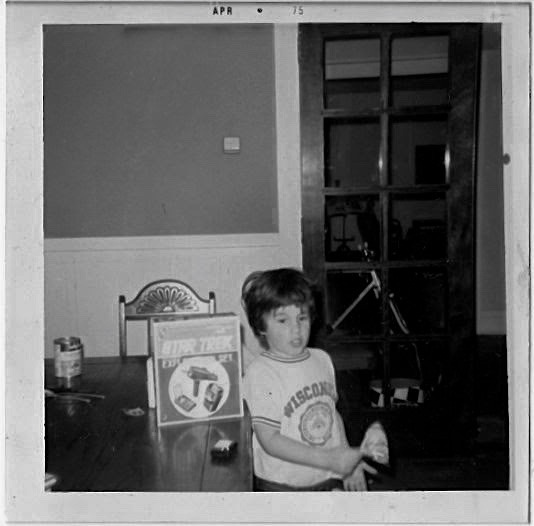
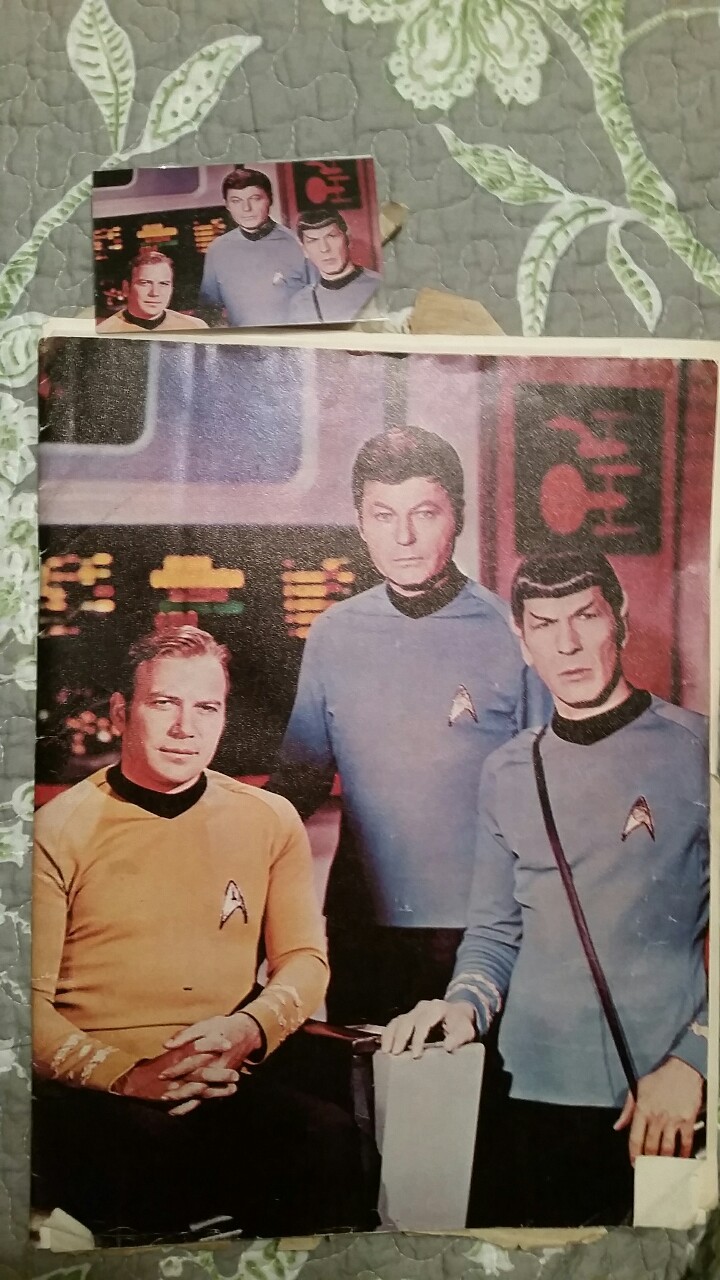
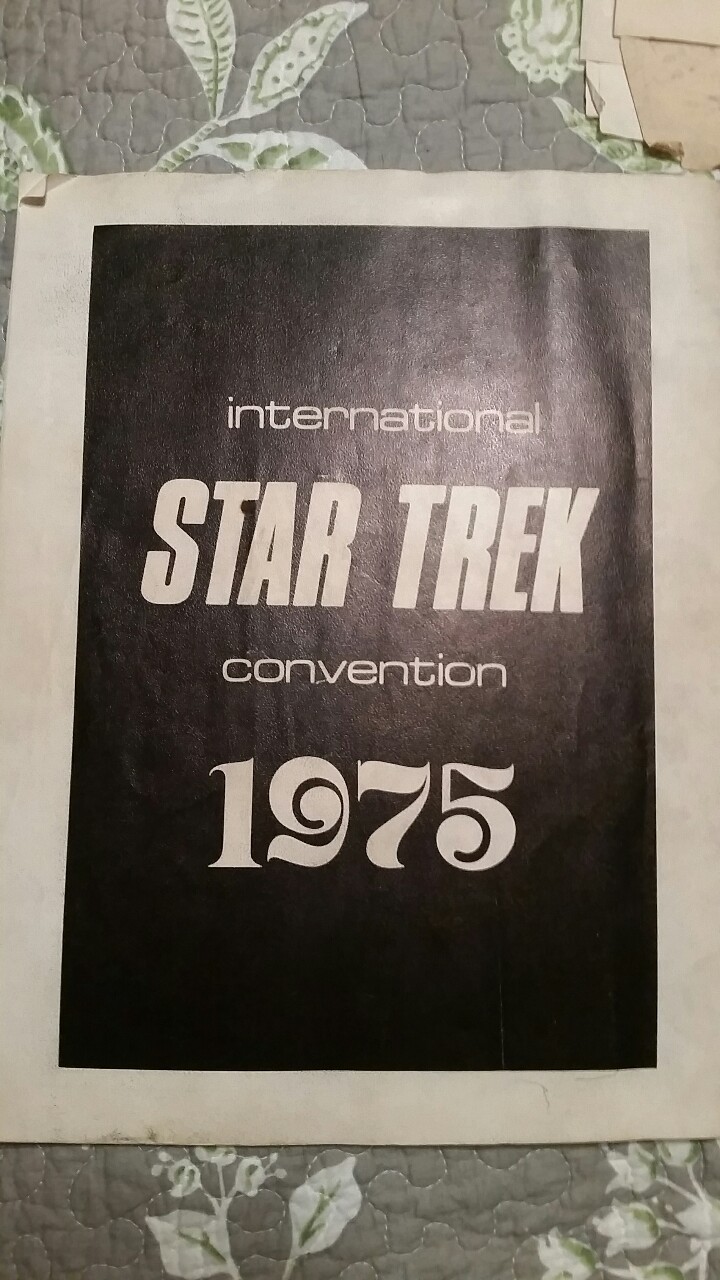
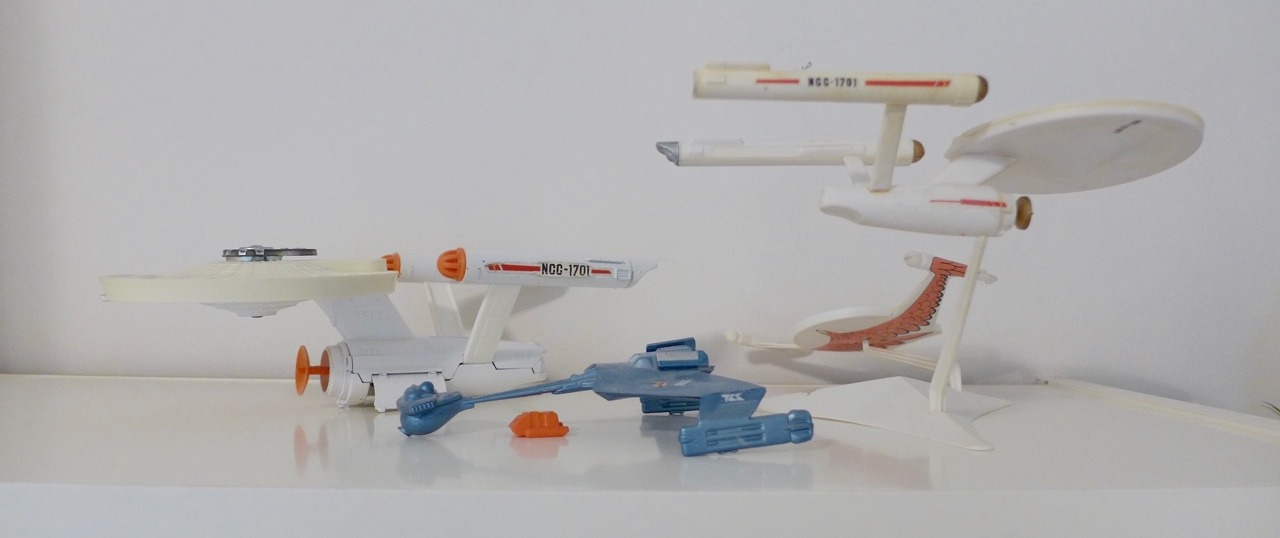
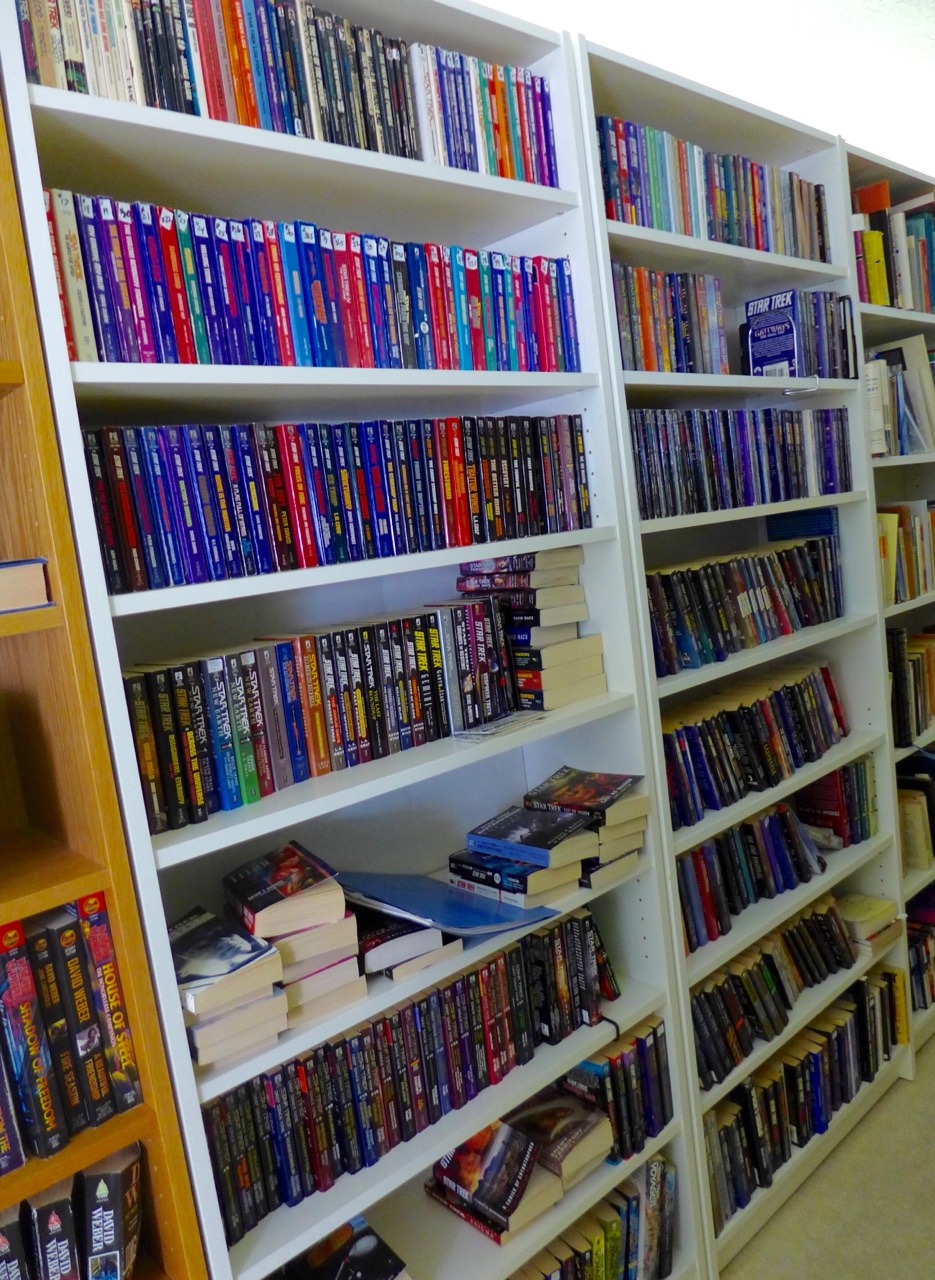
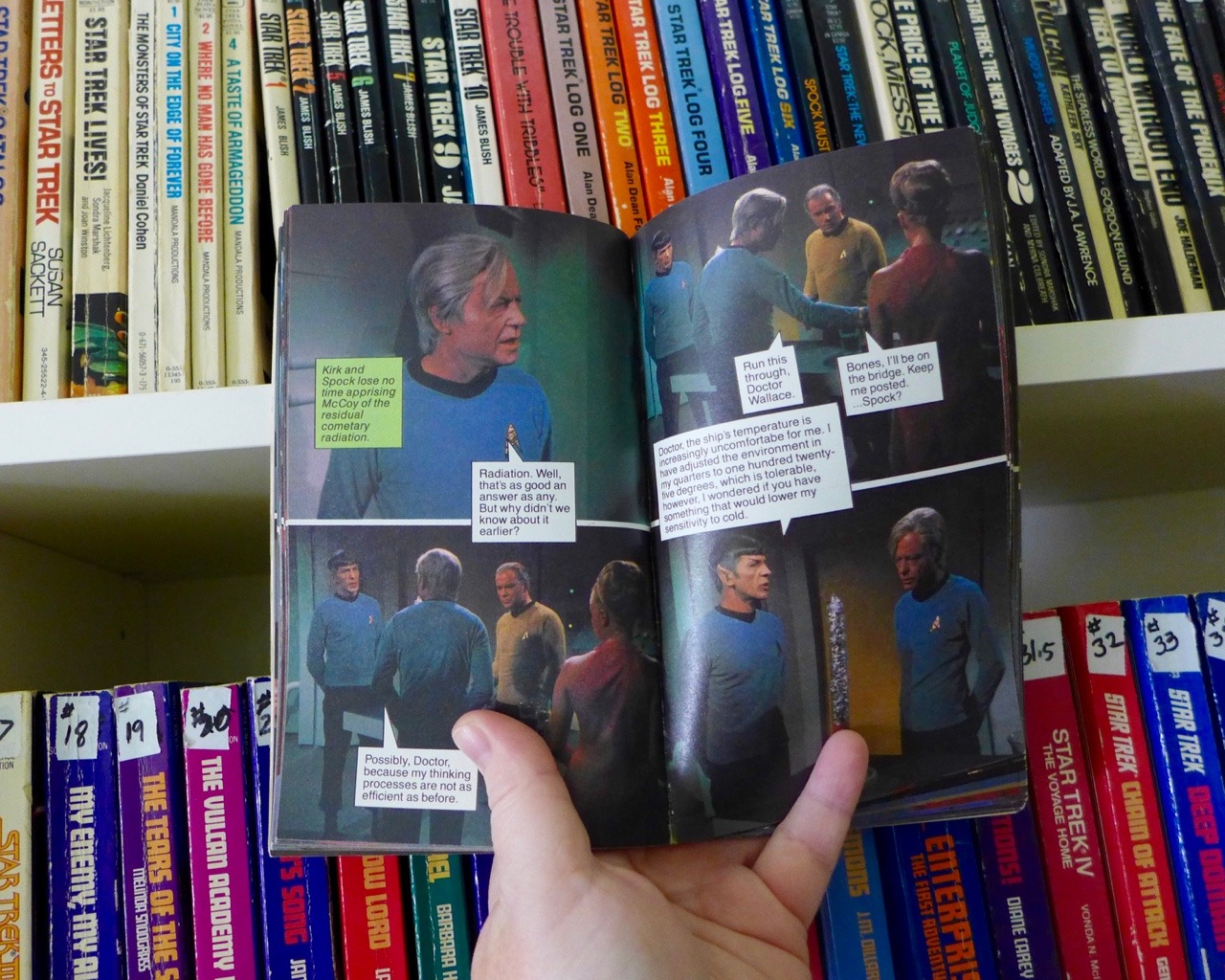
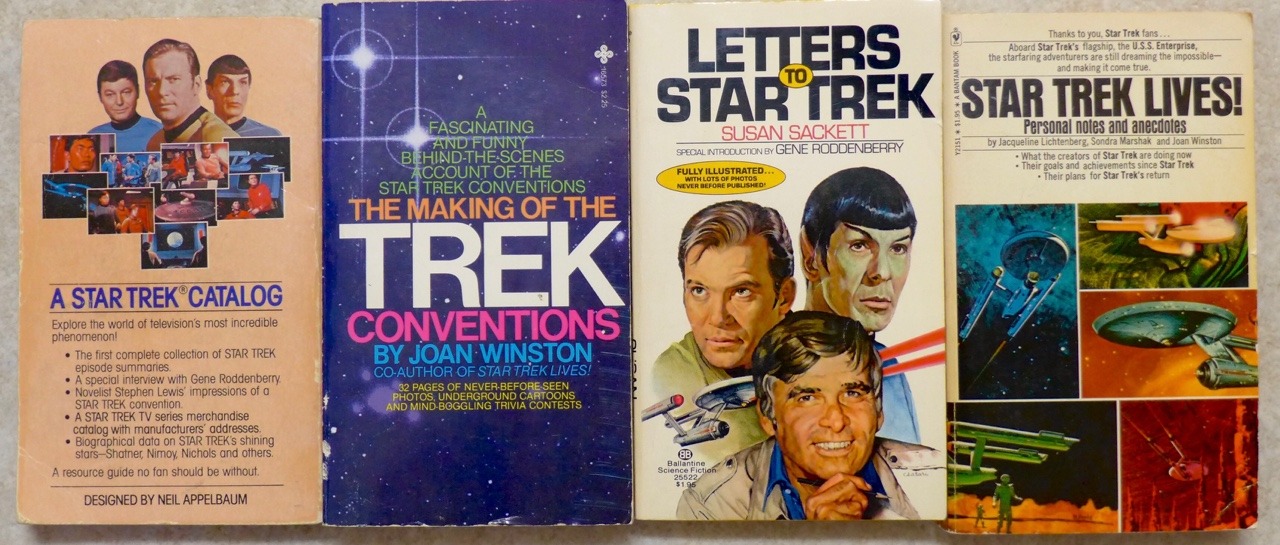
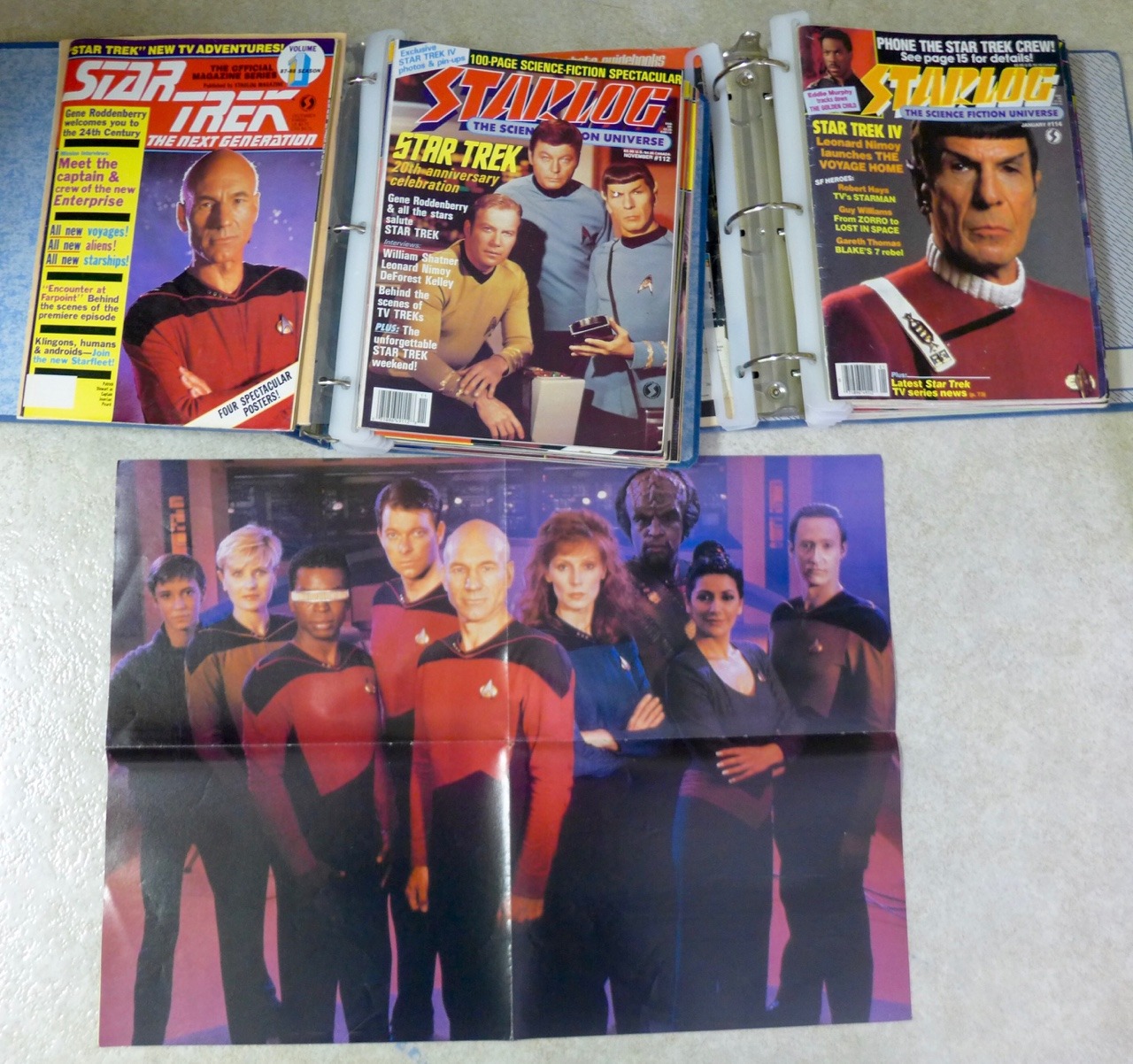
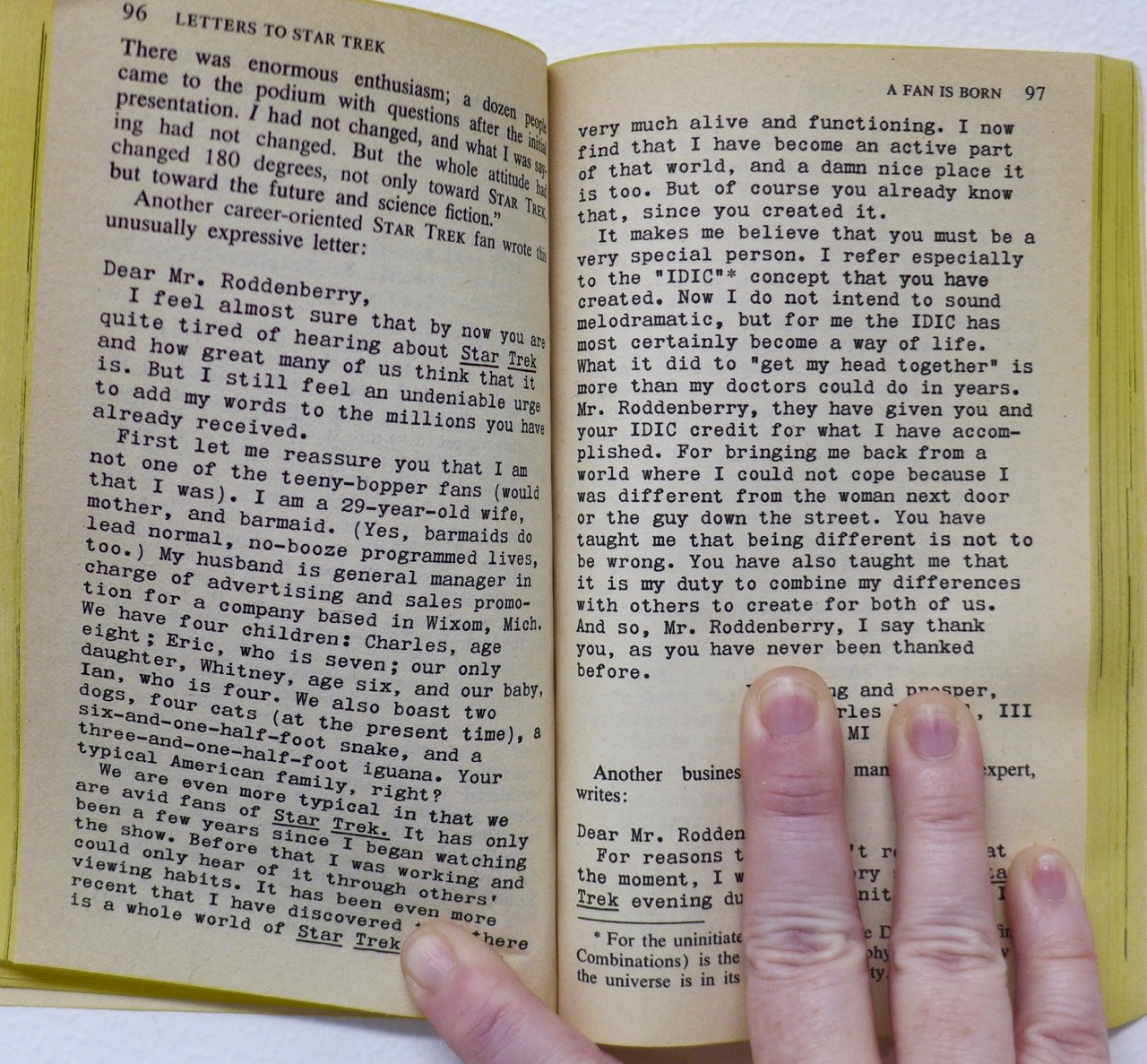
(My toy models, Mom’s Star Trek library, my episode photonovels which were what we had before VCRs, early Trek fandom books, Starlogs in the 80s, and a random page from Letters to Star Trek with a typical example of fanmail from 50 years ago.)
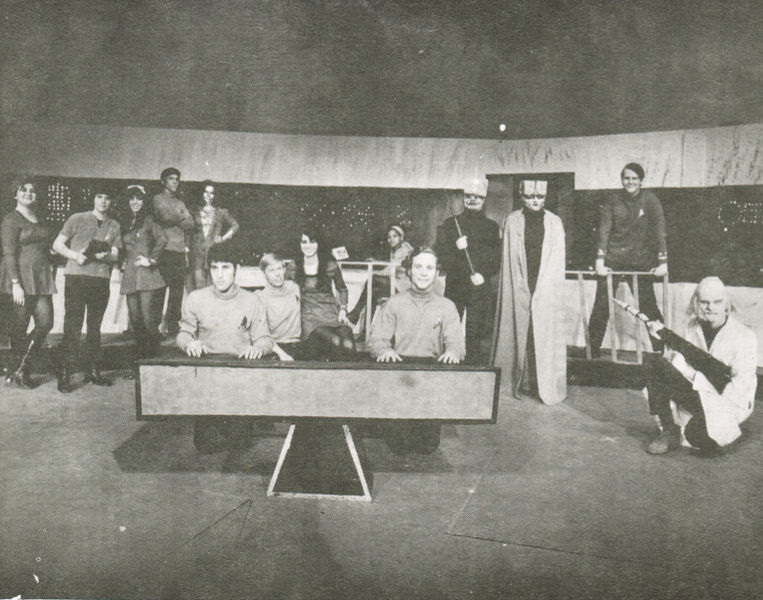
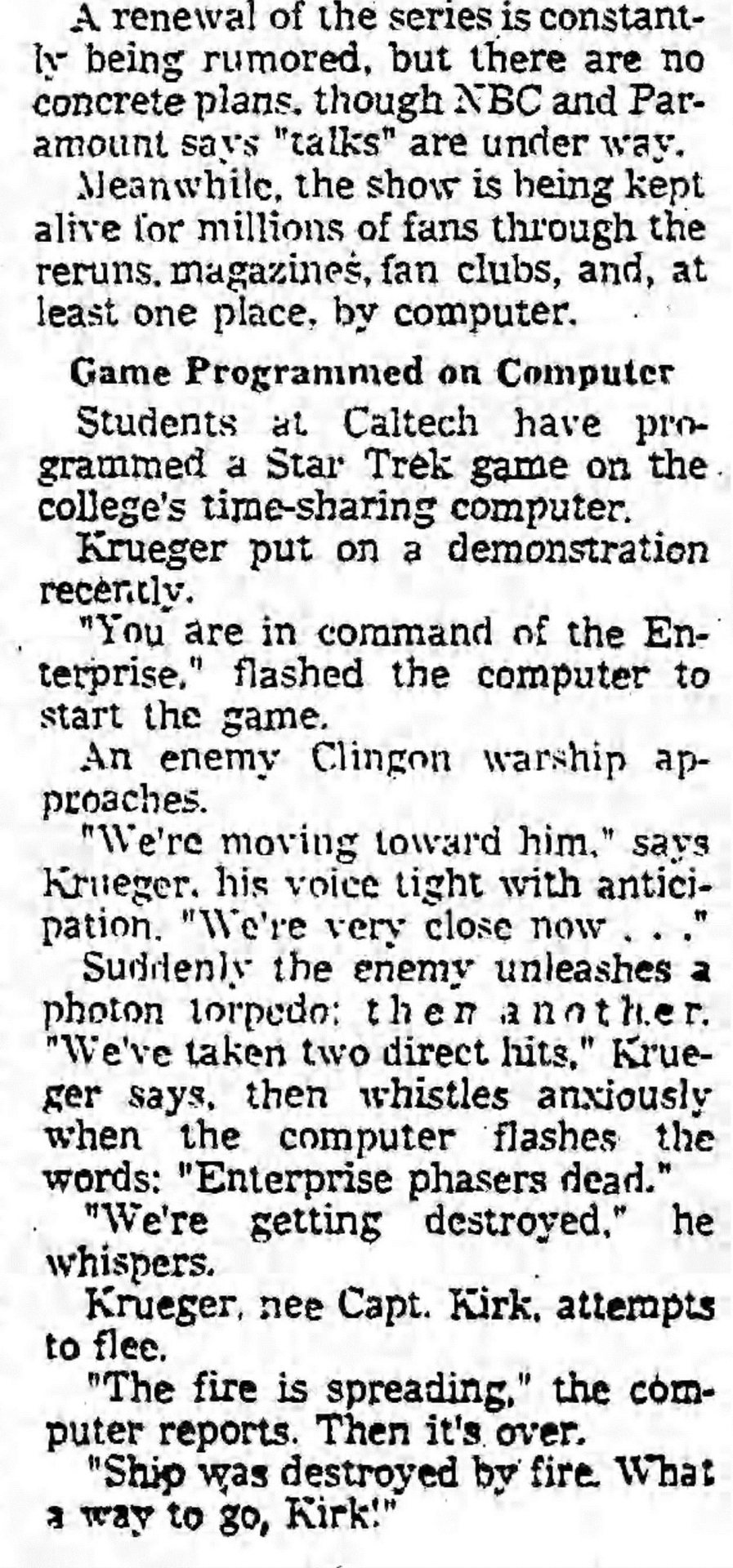
“Baltimore recently played host to a rather unique stage production. ONE CUBE OR TWO?, a musical comedy satire, based on tv’s STAR TREK, was performed at the University of Maryland’s Baltimore County Campus, March 16-18, for the benefit of Retinitis Pigmentosa. Permission for this special charity play was readily given by ST’s creator, Gene Roddenbcrry,and by Paramount Pictures to produce the production. Similarly, six different music publishers permitted a number of their songs to be especially re-written for the show. Yours truly, George Stover, played a cube-headed Coalation, an unfortunate victim of the mad scientist of Pentor 8, who thru the efforts of Captain Kirk and crew is finally transformed back to normal at the climax. — George Stover & Bill George” [2]
“Among those attending the February convention was a delegation from the University of Maryland Baltimore County, who had gone a bit further than most Trekkies. They had written a new “Star Trek” entertainment, incorporating all the familiar characters and adding elements of gentle spoof and musical satire.
Begun as a joke some eight months before, the project bloomed into a full-scale production, sanctioned by the university, with proceeds to be donated to the Retinitis Pigmentosa Foundation.
The three authors - Dorothea Rau, Joyce Rodey and Delia Schmidt - compiled the script from a series of scenes each had written. As a gag, they sent a copy to Gene Roddenberry, creator of the original “Star Trek” series. To their astonishment, Mr. Roddenberry liked the idea and Paramount Studios, which owns the rights to “Star Trek” copyrighted the script and gave the students permission to produce it.A scene from the show was performed at the New York convention, and proved to be a hit. The girls were worried, however, that audiences less predisposed to adulation of anything remotely Trekkian might have a hard time catching the esoteric references and jokes. They needn’t have worried.
Playing to packed houses at the college last Friday, Saturday and Sunday nights,“One Cube or Two” was a boffo smash, and the mock-up of the; bridge of the Enterprise, with Federation regalia and suitably inscrutable aliens, would have drawn nods of approval from the “Great Bird of the Galaxy,” as the original “Star Trek” production crew dubbed Mr. Roddenberry.
So which is considered the oldest fandom? ( By what is considered a fandom by today’s standards) Sherlock or Star Trek?
Star Trek fandom basically created the idea of fan fiction, but Sherlock fandom nagged the writer to bring Sherlock back from the dead so the series didn’t end.
A great article. And Fanlore got a mention and a few links.
“"We never quite understood the scope of the people who were interested,“ Devra said at their Star Trek Mission panel. "All of us were working or we were in college, we were not people who had a job that was the Trek Con, we were people who had a job and then did the Trek con.”“None of us did this to make money,” she added. “I think over the years I made about 12 cents an hour.”
“The sense of community was one of the best things about fandom of that time,“ Hellinger told Revelist. "A lot of people stayed in touch, even if it was small groups. The ‘Star Trek’ convention brought a lot of people together in a very, very different way.” Now, we have the internet with which to communicate with distant fandom friends — but the passion, love, and optimism that early "Star Trek” fans shared with one another still exists today. All you have to do is seek it out.
Fifty years ago tonight, “The Man Trap” hit TV screens across America.
It was America’s first look at Star Trek, which had been in development for around two years at this point. The first handful of regular episodes had been shot and network executives chose the story of a lonely creature driven to kill over the two other episodes that had gone through the post-production process and were ready for broadcast. The network understandably thought a straightforward bit of space horror would be a good introduction to the series, especially compared to the space prostitution storyline of the “Mudd’s Women” and the exposition-heavy, slightly clumsy second pilot “Where No Man Has Gone Before.”
“The Man Trap” got good ratings, placing first in its timeslot with around 45% of televisions tuned in, but that was the best that the series would ever see. Over its three-year run, Star Trek struggled with the Nielsen system and network disdain in equal measure.
(Some have said that if modern demographics had existed in the late 1960s, we’d be looking at a very different version of the series’ history. Even when its ratings were at their worst, it performed abnormally well with people who had disposable income and the spare time with which to enjoy it.)
Despite valiant efforts from fans and two victories in the war against cancellation, the show was axed after three seasons. Gene Roddenberry pushed hard and got it replaced a few years later with a terrible-looking cartoon that ended after two seasons. A movie called Planet of the Titans became a TV series titled Star Trek: Phase II became Star Trek: The Motion Picture, a very expensive theatrical release that audiences and critics alike thought looked fantastic but was boring as hell.
That should have been it, but somehow, Star Trek kept going. Somehow, it continued to draw in audiences.
There was (after some serious shuffling of the proverbial deckchairs and some stern lectures about budgeting) a second movie, then a third and a fourth, and then a spinoff and two more movies and, well, you know the rest.
So, what made Star Trek succeed? It was told repeatedly through sheer math that it didn’t matter. Why did people keep clamoring for more and why did Paramount care?
The simple answer is there in the 79 episodes that were broadcast on NBC before becoming a staple of UHF stations over the subsequent decades.
Star Trek shows us that we can make it.
It shows us that there is a future, and it’s fantastic.
Over the years, there’s been a lot of talk about how warp drive, the ship’s computer, the communicators and the tricorder has inspired scientific advances and brought people to STEM and the space program. That’s great, it really is, but that’s not what defines the show’s future in my mind.
Tools are the beginning. Science is the beginning. It’s what people do with it that makes the real difference. After all, Lost in Space featured faster-than-light travel and a heck of a robot, and look at how that show’s viewed now. It lacked intent and intelligence, two things that have set Star Trek apart from the very beginning.
Star Trek shows that green-blooded aliens and cocky white men and black women and loud-mouthed southerners and even horny Russians can just drop their differences and unite in their desire for a better future.
Star Trek tells us that there are solutions besides force.
It teaches us that it’s usually better to listen than to speak.
It reminds us that racism is pretty stupid, and that lust for money or power leads to suffering.
It lets us know that there are things we may never understand and that’s a good thing, because curiosity drives us.
At its best, Star Trek is a deeply human look at what we can be. At its worst, it still reminds us that we can and will make it to the twenty-third century, as long as we get over ourselves and start thinking about the big picture.
That’s why Star Trek matters.
Thank you, Gene Roddenberry, for your initial vision and subsequent dedication. Thank you, Herb Solow and Robert Blackman for guiding the show through treacherous waters and getting it on the air. Thank you, Gene Coon and DC Fontana for helping set and maintain a tone that helped the show connect with so many.
Thank you, William Shatner. Even at your scene-stealingest, your commitment to craft and passion helped define a captain that I would follow anywhere.
Thank you, Leonard Nimoy, for creating a character that freaks, outcasts, and weirdos everywhere could cling to and admire; we really appreciate it.
Thank you, DeForest Kelley, for Leonard McCoy, my favorite character in fiction. People that follow this blog might have noticed that I’ve never written very much about Bones; that’s because I’ve found it impossible to talk about him with any kind of objectivity. Kirk and Spock are people I look up to; Dr. McCoy is the kind of person I want to be, and a lot of that is because of Dee Kelley’s performance.
Thank you, James Doohan, for taking control of a character and making the idea of an engineer that can do anything a cornerstone of the genre.
Thank you, George Takei and Walter Koenig, for dealing with line-counting and budgetary adversity and diminished roles and sticking with Star Trek. The ship wouldn’t feel right without you one of you at the helm.
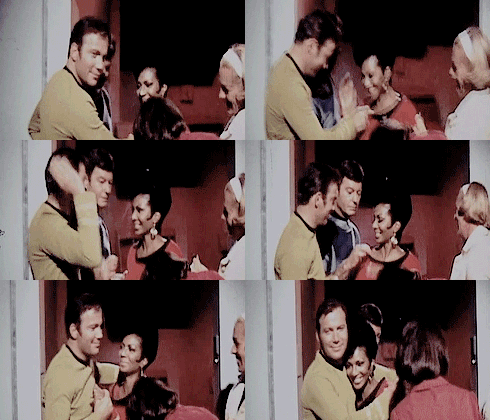
Thank you, Nichelle Nichols, for listening to others and claiming your place as an icon of civil rights, telling generations of black women that they matter and that they can and should stand right beside the white men of the world and do the same jobs.
Thank you, Majel Barrett and Grace Lee Whitney. Your roles may have been minor in the grand scheme of things, but your performances helped make the show that much more human.
Thank you, George Clayton Johnson, Samuel A. Peepless, John D.F. Black, Richard Matheson, Robert Bloch, Adrian Spies, S. Bar-David, Jerry Sohl, Barry Trivers, Paul Schneider, Theodore Sturgeon, Oliver Crawford, Don Mankiewicz, Steven W. Carabatsos, Boris Sobelman, Carey Wilber, Robert Hamner, Nathan Butler, Don Ingalls, Harlan Ellison, Gilbert Ralston, Jerome Bixby, Max Ehrlich, David P. Harmon, Art Wallace, Margaret Armen, Robert Sabaroff, Jud Crucis, John Kingsbridge , Laurence N. Wofe, Art Wallace, Edward J. Lasko, Jean Lisette Aroeste, Rik Vollaerts, Judy Burns, Chet Richards, Arthur Heinemann, Joyce Muskat, Lee Erwin, George F. Slavin, Stanley Adams, Michael Richards, Jeremy Tarcher, Shari Lewis, and Arthur Singer for conceiving and writing episodes that still thrill me to this day (and having to deal with Gene Roddenberry and Fred Freiberger’s subsequent, occasionally devastating, rewrites.)
There’s a name missing from that litany. That’s because I want to offer a very special “thank you”to David Gerrold for “The Trouble With Tribbles,” the thing that made me want to start writing in the first place.
Special thanks to Joseph Pevney and Marc Daniels for helming so many episodes and Joseph Sargent for creating the visual and narrative guidelines that others learned so much from. Thanks you, Robert Butler and James Goldstone, for directing “The Cage” and “Where No Man Has Gone Before.” Thanks to Lawrence Dobkin, Leon Penn, Harvey Hart, Vincent McEveety, Robert Butler, Gerd Oswald, Robert Sparr, Robert Gist, Don McDougall, Michael O’Herlihy, Ralph Senesky, John Newland, Herschel Daugherty, Gene Nelson, James Komack, Marvin Chomsky, Tony Leader, Herb Wallerstein, David Alexander, Jud Taylor, John Herman, Murray Golden, and David Alexander for following in their footsteps.
Thank you Matt Jeffries, for the Enterprise. As anyone who knows me can attest, I speak of that ship with reverent tones. She’s a beautiful lady, and we love her.
Thank you, Gerald Finnerman for showing us what the future would look like through inventive camerawork and creative lighting. Thank you, William Ware Theiss, for doing so much with so little and no, I’m not just saying that because the costumes for Andrea and Marlena helped a boy in the 80s figure out he liked women.
Thank you to the dozens of writers that took the franchise into prose and comics, especially Diane Duane, Margaret Wander Bonanno, John M. Ford, Peter David, Vonda N. McIntyre, and Judith and Garfield Reeves-Stevens.
Finally, thank you to fandom. You kept Star Trek’s heart beating when a network had jettisoned it and pop culture was laughing at it. You made people like me feel like we weren’t alone Yes, you get pretty damn weird sometimes, but that’s what makes it interesting.
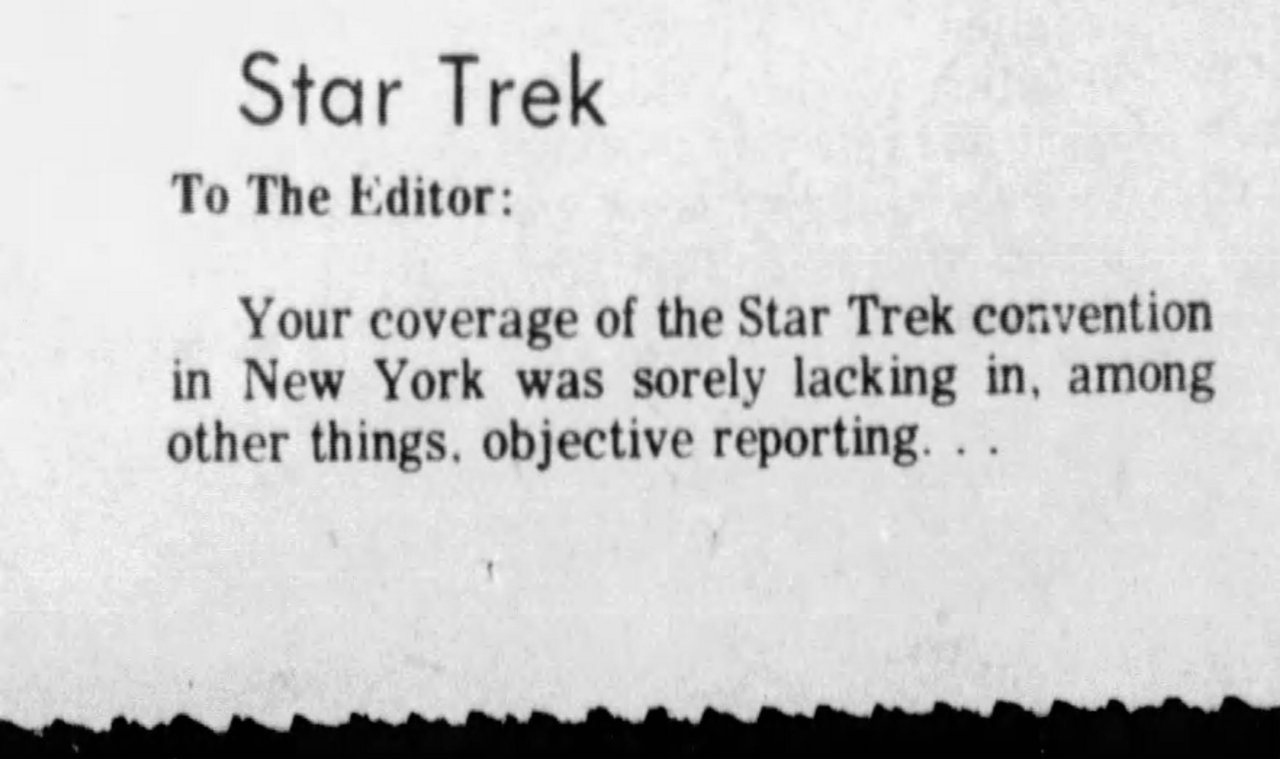
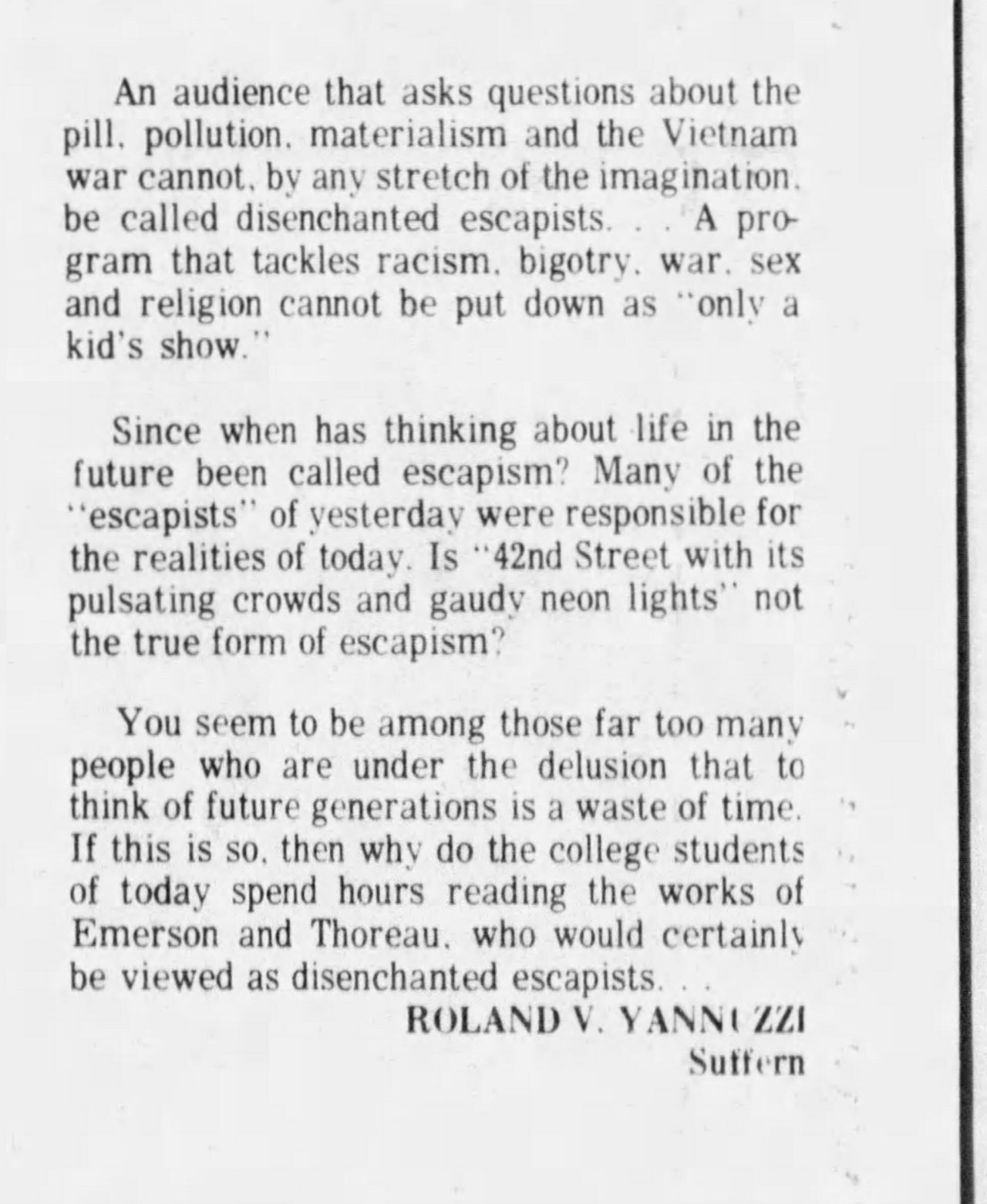
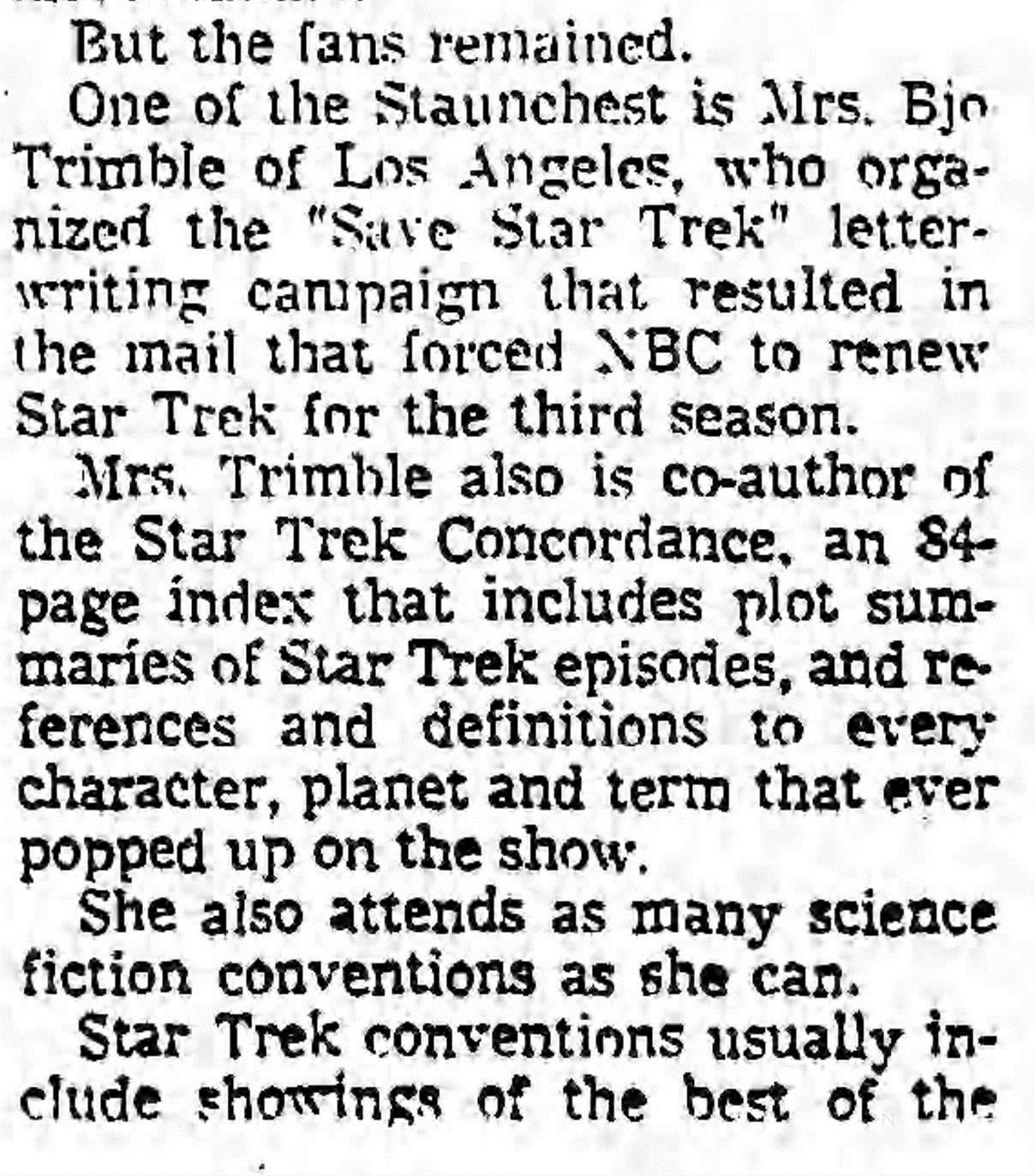
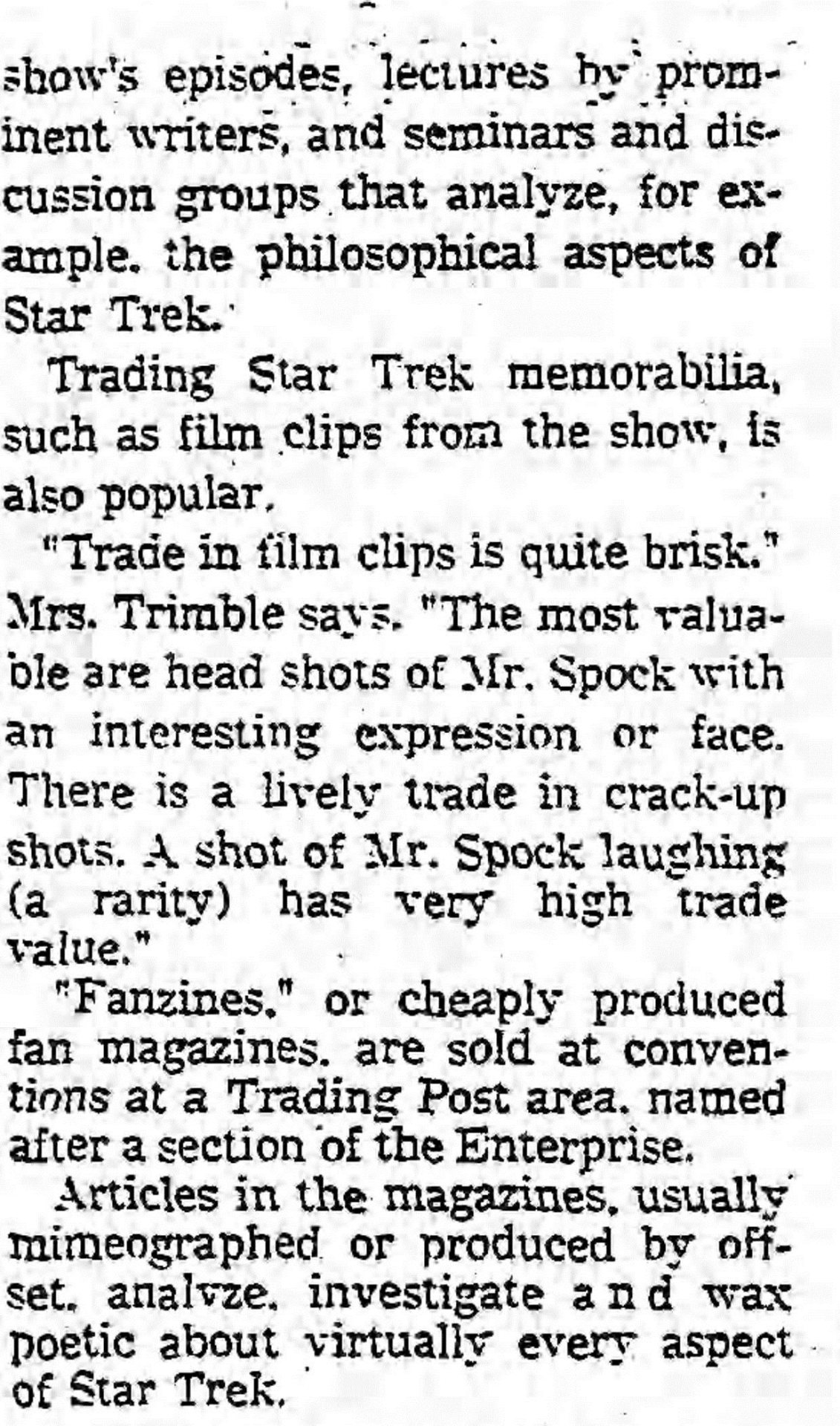
You go tell them Roland. From a letter to the editor to the New York White Plains Journal News on Thu Mar 29 1973. Sadly, the original article the letter is responding to was not in my archives.
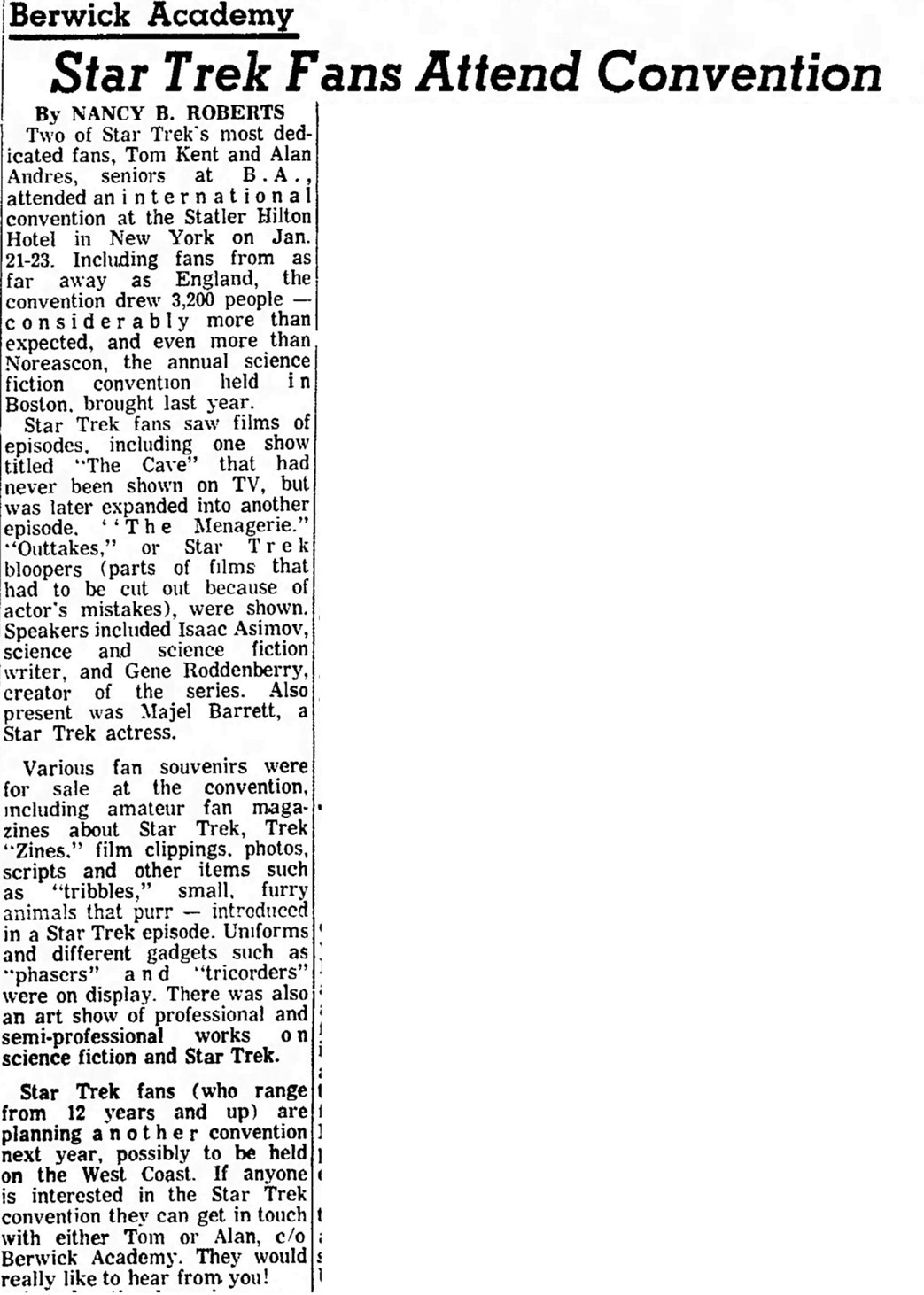
This March 1972 newspaper article printed in The Portsmouth Herald talks about two local high school students who attended the first Star Trek convention in New York.
The phrase “Star Trek Lives!” was used on the flyers advertising the first convention in 1972 and was part of the Star Trek revival campaign undertaken by fans in the early 1970s.
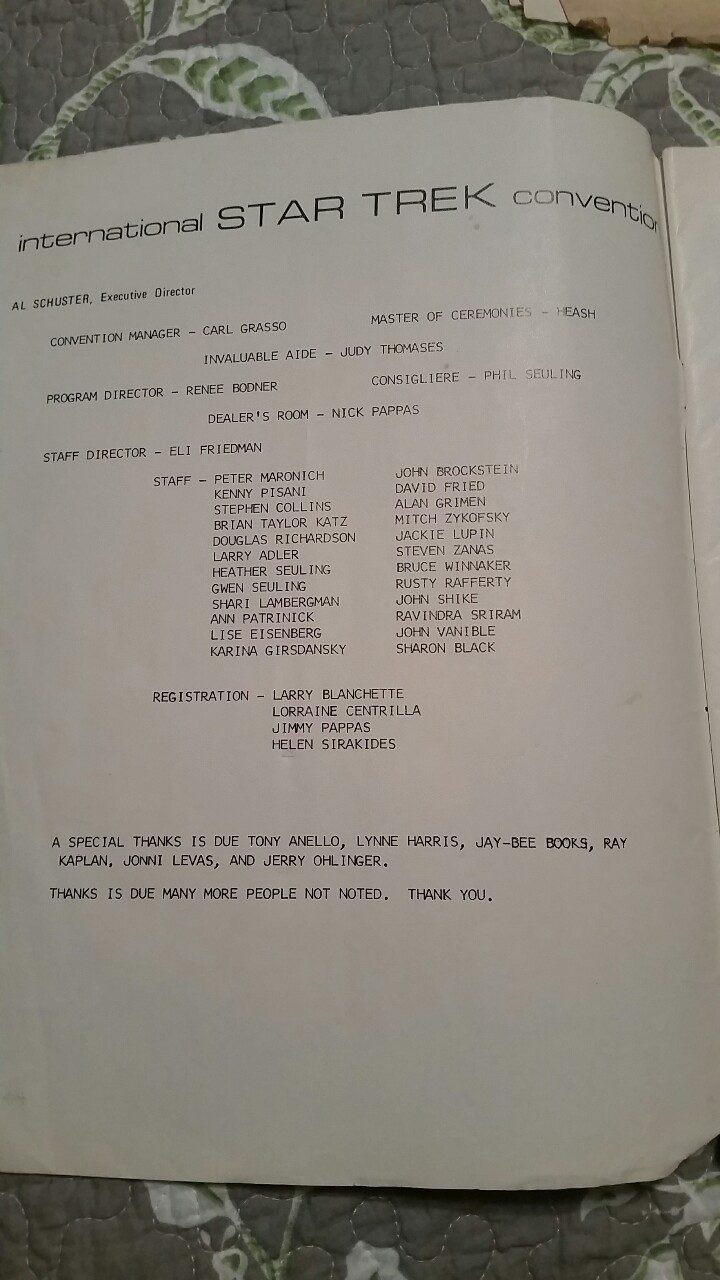
The organizers of “Star Trek Lives!” anticipated only 500 attendees. When 3000 fans showed up, by the final day of the event registrars were issuing ID cards made from torn scraps of wrapping paper and some fans were let in for free: “We ran out of everything,”Devra Langsam remembers. “We were cutting and sticking labels and pinning them on with straight pins.” [1]
“….[They] had expected about 500 to attend the convention. But, four hours before it was officially due to start, [Al Schuster] looked around at the mob scene on the 18th floor [of the Statler Hilton Hotel] and said, ‘It’s wild. We’re going to have at least 3,000 people here. They’re coming in from all over, Arizona, California, Canada. There’s a whole busload from Toronto.’[2]
undated photo of Gene Roddenberry addressing fans at a Star trek convention in the 1970s
An article in the Village Voice in 1972 describes the first convention:
"The convention was dreamed up and organized by three adult sci-fi freaks and show buffs, but it seemed to have been taken over completely by kids – they manned most of the tables and did most of the trading. Few people over 16 were in sight, but there were plenty of 10- and even eight-year-olds lugging around huge suitcases crammed with treasured nuggets of Startrekia, and they approached the business at hand with the same circumspection that’s evident at a big Parke-Bernet event. One pale, serious kid who looked about 11 approached another – 'Aren’t you that ”Dark Shadows“ freak?’ 'Yeah. Got anything?’ 'Some early glossies, to trade for Shatner shots only.’ 'So, let’s have a look.”[3]
In spite of what the outside world thought about fandom, fans were ecstatic to be gathering:
“The auditorium had seating for 500 - and 1500 crowded in to hear Roddenberry speak. Yet the event never got out of hand; Trek fans have a reputation for being well behaved, if exuberant, and this proved that it is one they deserve. The mood was exhilarating, and when Roddenberry spoke, the crowd exploded. Even he was surprised at the amount of love and appreciation for the series that the fans gave him. At one point, the fans even burst out chanting “Star Trek lives!” Suddenly it seemed possible that the series wasn’t dead after all.”[4
Even though the 1972 convention netted the organizers only $92.36 each (after expenses)[8] the organizers assembled for another, larger convention in 1973 and over 10,000 fans registered to attend. The Committee planned better in 1973, picking a larger hotel, The Commodore, and this second event was the first one that actors James Doohan and George Takei attended. Mr. Spock, aka Leonard Nimoy, made a surprise appearance - he happened to be in town - and was almost mobbed.[9] One fan has blogged about his recollections of attending the 1973 convention here.[10]
One of the highlights of the convention was the fan built life size bridge of the Starship Enterprise. In his book “Star Trek: The Complete Unauthorized History”, Robert Greenberger describes how fans disassembled the bridge, which was housed in update New York, and transported it down to Manhattan to be reassembled for the Committee conventions . Fans would photograph themselves on the bridge often wearing costumes.
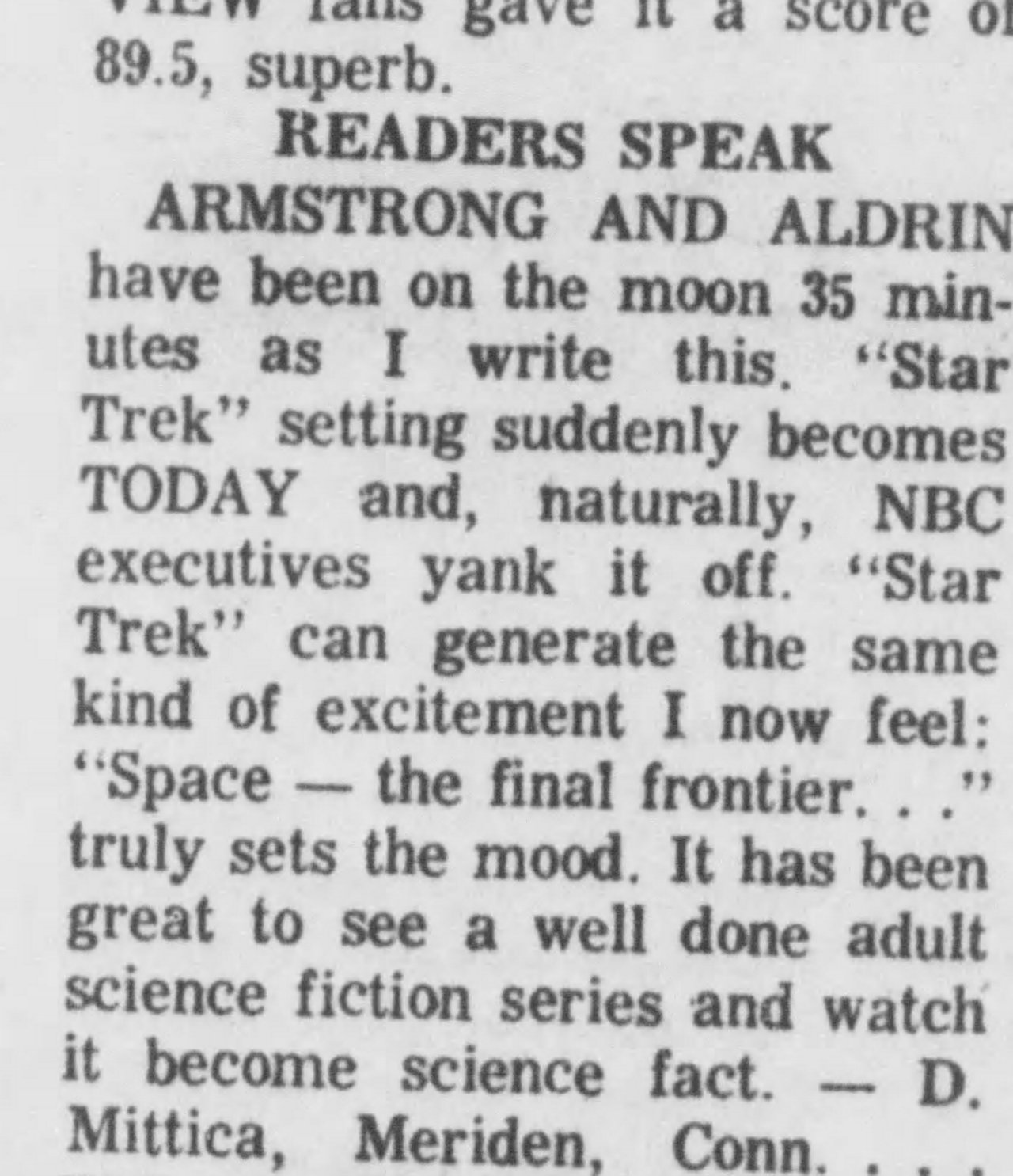
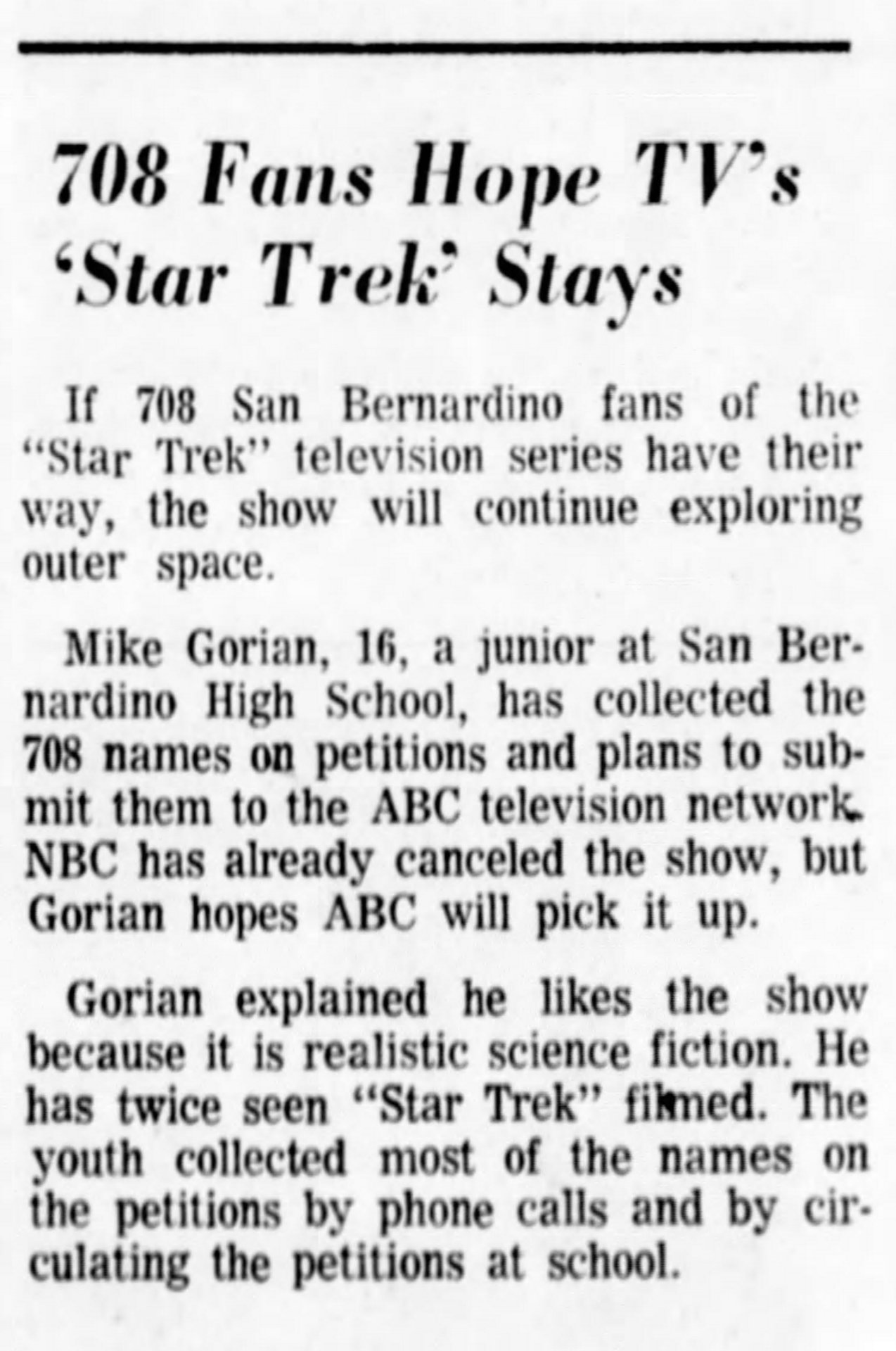
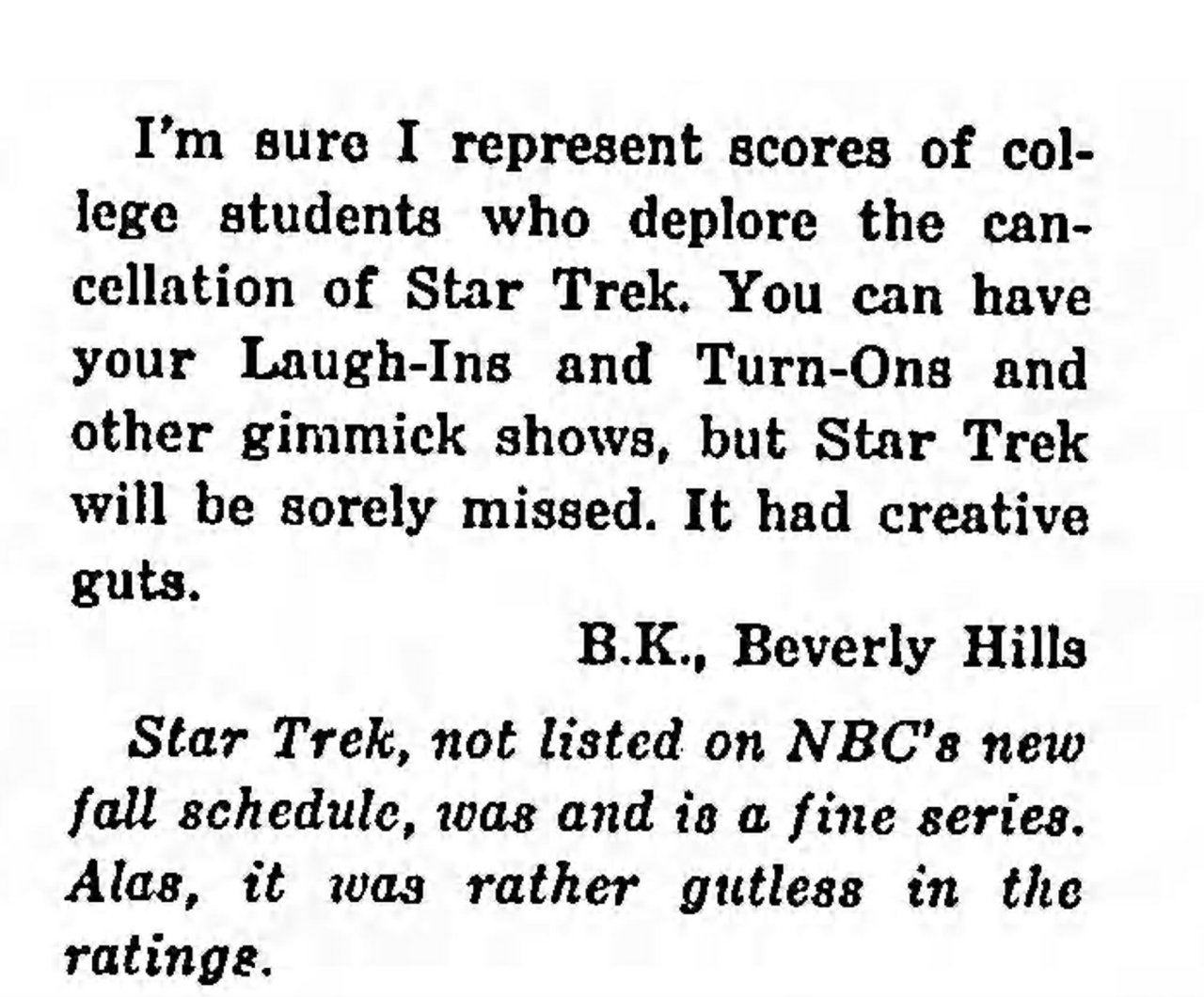
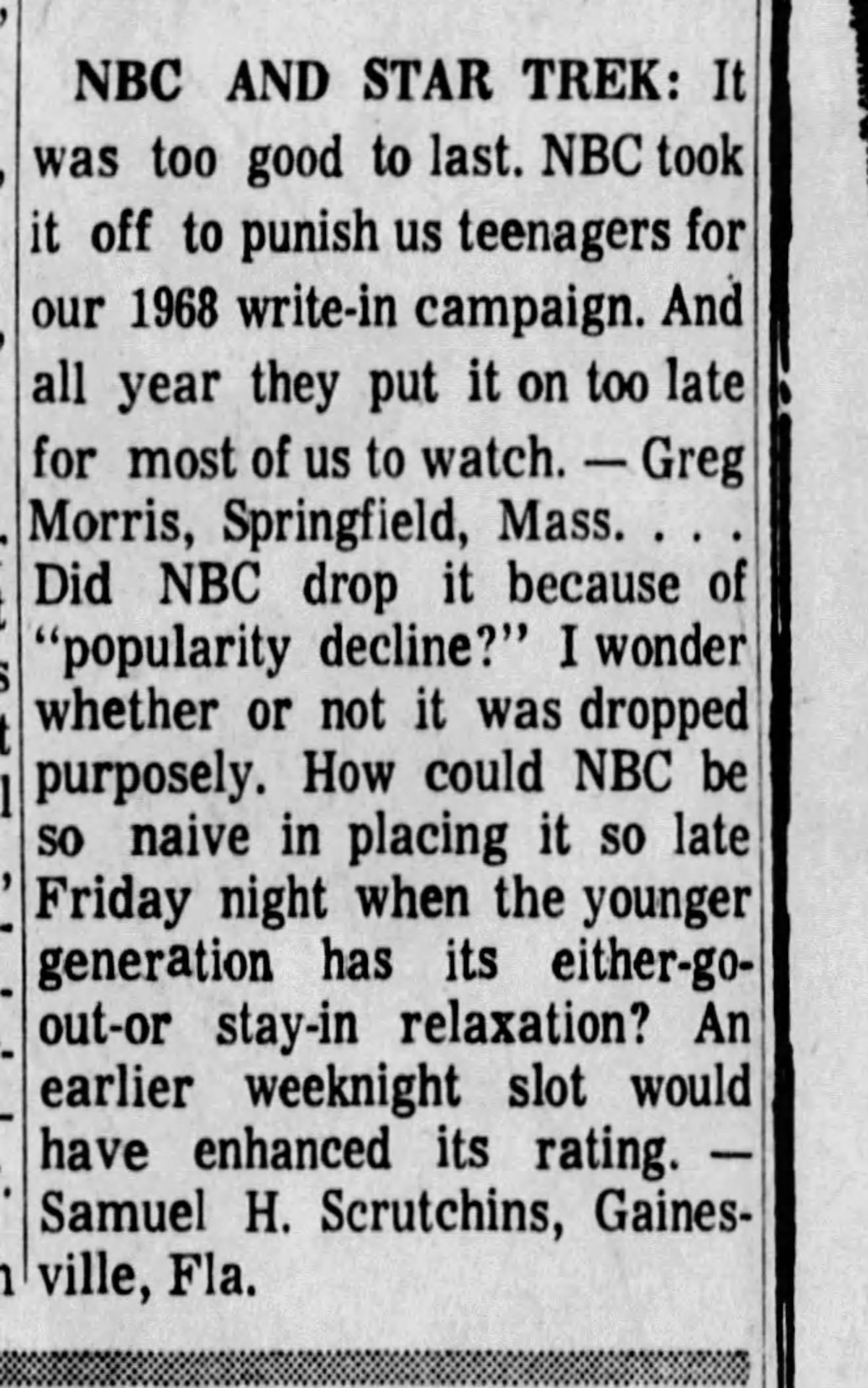
In the spring of 1969, Star Trek canceled. A few months later, the first men walked on the moon. This is a sampling of letters to the editors written by fans of Star Trek that year.
Okay, so I'm an innocent babyphile and... did I just read something about a fic writer who faked his own death? I feel like I've walked into some kind of dangerous mafia. Will I be safe here?!
Next thing you know we’ll have a shippers vs. noromos war on Usenet and a famous fanwriter will be discovered to be massively sockpuppeting, and at least six secret lesbian couples will form (and two will break up), and Brandon Ray will mansplain at all of us womenfolk for seven paragraphs, there will be more than five separate discussions of Scully’s characterization in Iolokus, and at least twelve heartrendingly angsty WIPs will be updated, and that one creepy guy will post a fic where Scully erotically eats her own poop, and the Mulderists will accuse the Scullyists of something dreadful, and Erin Blair will post six fics in 24 hours, and I’ll DEFINITELY post something about shortbread or snickerdoodle cookies to get everyone to calm down, and the private e-mail lists will be buzzing about whether Mulder would be a dom or a sub in a BDSM relationship with Scully, and there will be a scandal when someone plagiarizes X-Files fic in the Nanny fandom, and there will be a side conversation about DD’s dick (that has never really ended to this day), at least one fangirl will cry when she realizes everyone else was invited to the big secret fangirl gathering, and everyone will bitch about there no Gossamer update in three weeks, and we’ll end the day with a rousing discussion about whether Mulder/Krycek slash is out of character or not.
Over on the Idealists Haven messageboard, there was a long-time poster (and fanfic writer) named Evie Whiting, who was much beloved and a sweet, bubbly person. Last year, she suddenly became very ill, and was rushed to the hospital for some unidentified reason. For several weeks, she was able to post tons of messages from her “deathbed”. She then fell into a coma and later died, and all the while through her coma/death, her husband (who was not a regular) continued to post to the Haven, where her friends were devastated and had been sending all kinds of sympathetic and grief-stricken messages of support. Things got very weird after her “death” mainly because he was continuing to post and wallow in all the attention, and when a few people gently began asking whether or not this was all true, suddenly someone who claimed to be Evie’s sister popped up and started attacking people left and right.
The entire thing turned out to be a hoax. Another long-time and well-respected poster received a private email from the dead woman herself; Evie claimed that she had no idea any of this had gone on. In her defense, she spun a convoluted tale about someone using her computer without her knowledge – for weeks! – and that this person had done it to humiliate her. But when pressed for more info, she clammed up and never returned. Ultimately, no one really knows what happened: if Evie was ever even sick or not, or if she had EVER been who she pretended to be - for YEARS. It was so bizarre, and it gobsmacked the scores of people she had befriended during that time. And like you’ve done here, some people became VERY interested in ferreting out the truth (they never did), while others continued to defend her, and still others just wanted it all to go away.
Unfortunately, all the posts and evidence of this disappeared this winter when the messageboard was hacked (unrelated to the hoax), and they had to start up a new one. But I think if you ask any XF fan who’s been to the Haven (the MB) about Evie Whiting, they’ll remember the story. Things have died down, and Evie’s never returned to any corner of the fandom as far as anyone knows, but everyone who was around then remembers the tale. I had never even heard of her before this all began (I’m not a regular at the Haven because I think the site is full of nutters), but I remember it all quite clearly. Her friends were VERY hurt, angered, confused and yet some still defended her.
I just want to add that some of us who were Haven regulars got veeeery suspicious and looked for evidence of her death by checking online obits in Sydney, Australia, where she’d said she lived. Nothing. When I innocently asked her “husband” where her memorial was going to be held so I could send flowers, he spun this crazy tale that since Evie was half-Indian, her body was going to be shipped to India so her remains could be disposed of in the Ganges. This is when our bullshit meters went REALLY off because it was so ridiculously convoluted and most of us were sure at this point that her death was a total fake.(Also, Evie had shared every single detail of her personal life but had never said anything about Indian ancestry.)
Also, in hindsght, Evie had this really unbelivable personal history. She said she was 24 or something and was already a practicing doctor (fake doctors seem to be a running theme in our fandom) and had three children, including twins named Dana Katherine and Fox William. Yeah.
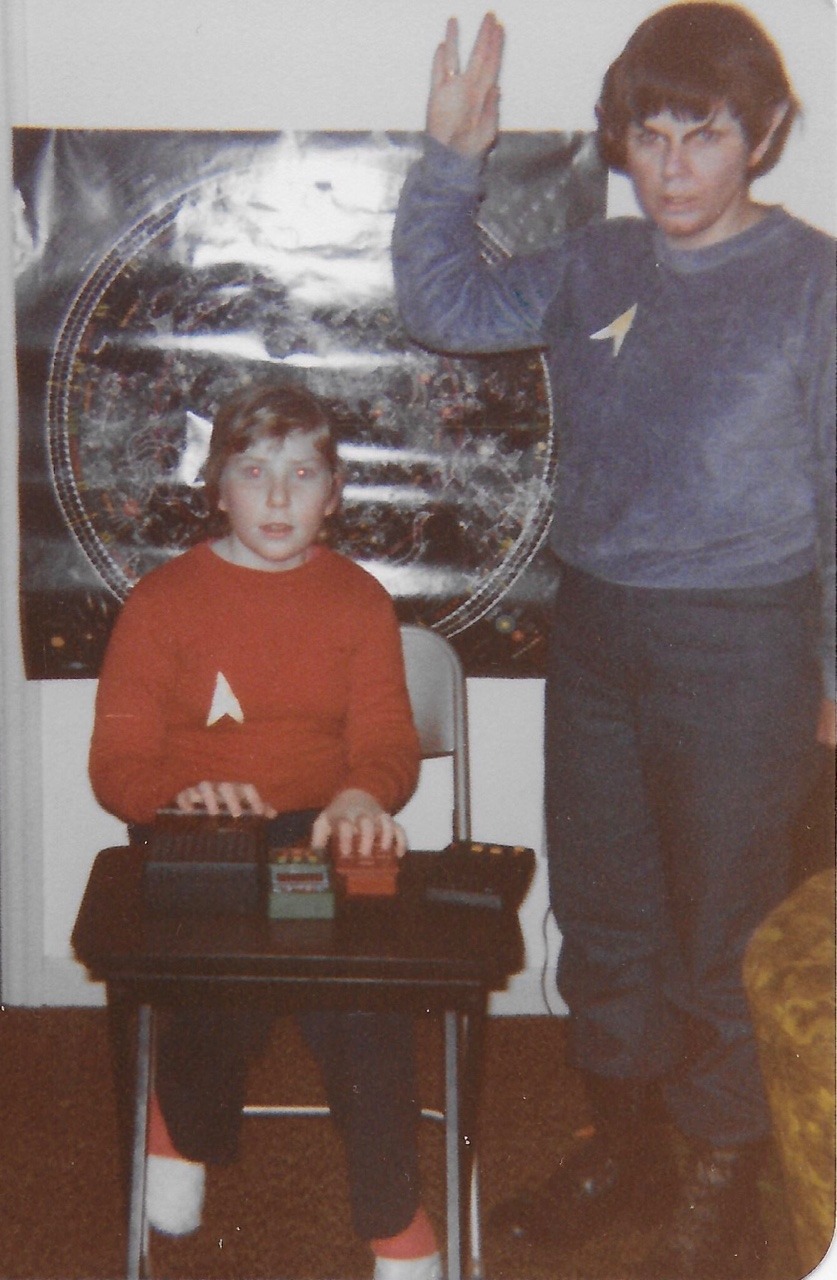
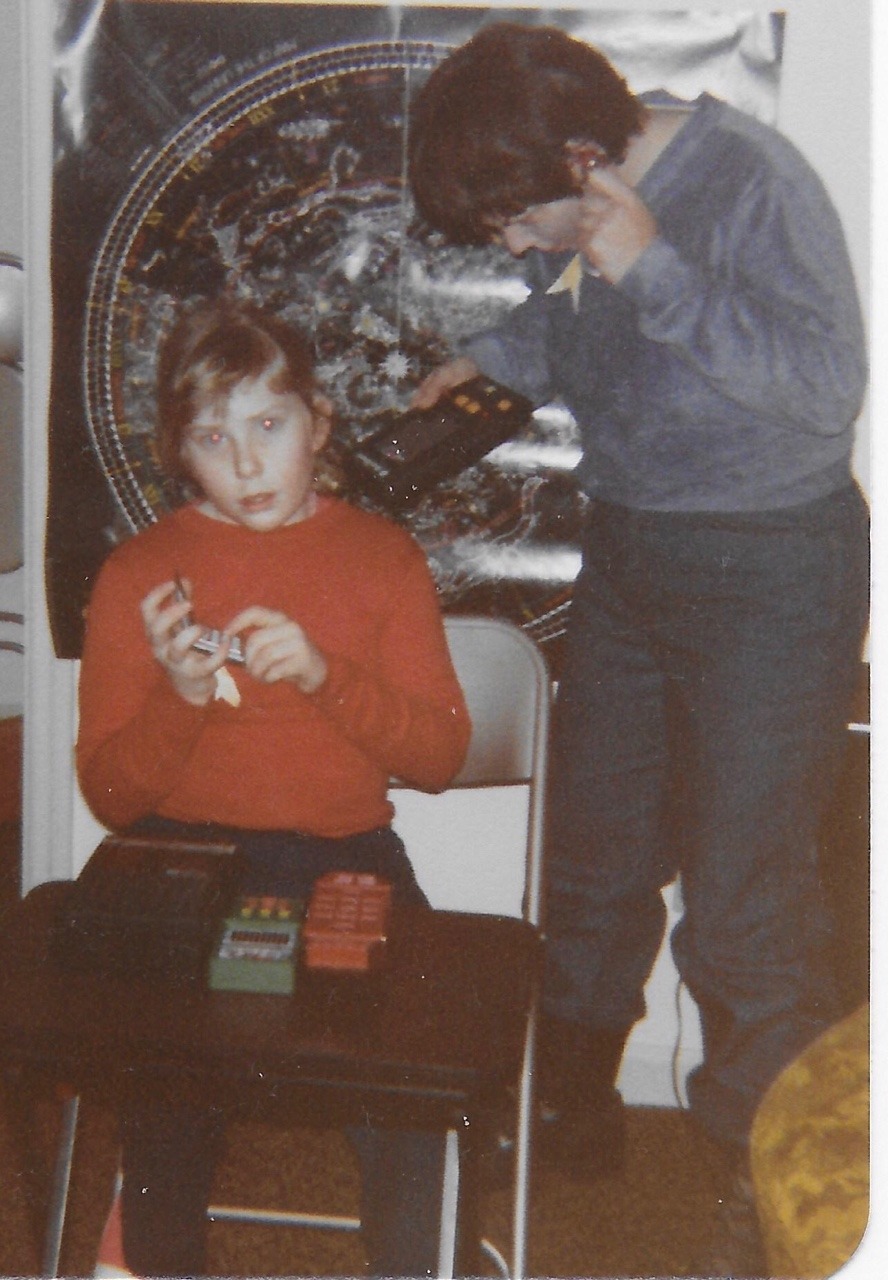
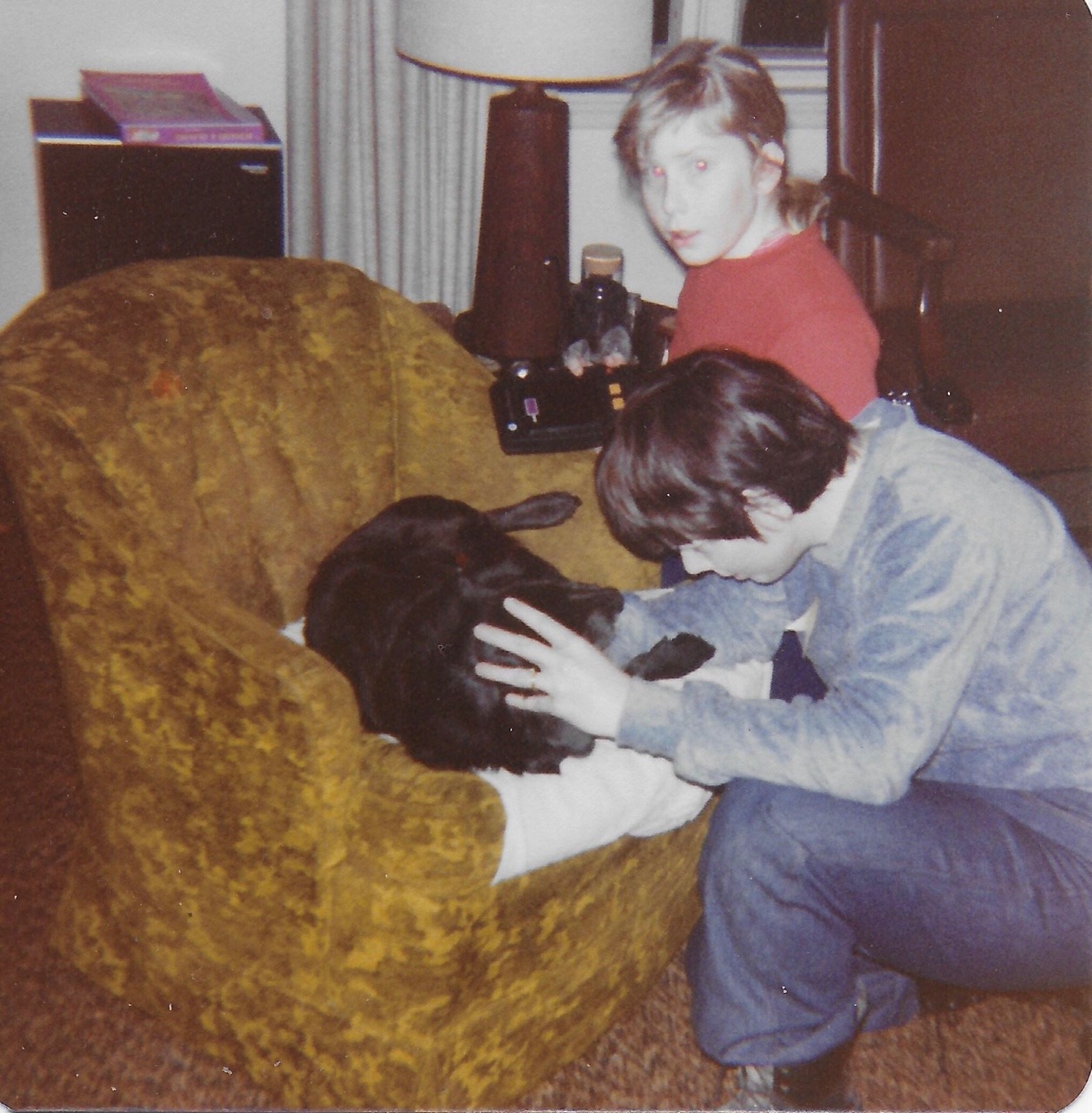
Star Trek cosplay, 1979?: me as Scotty and Mom as Spock
Bridge “viewscreen” was a star chart, with Enterprise console assembled from my cassette recorder, Merlin game (first portable!), football handheld game, space invaders game as a tricorder, Mom’s fancy flat calculator with flip cover for a communicator, and coke bottle stopper for Uhura’s earpiece which Spock sometimes wore.
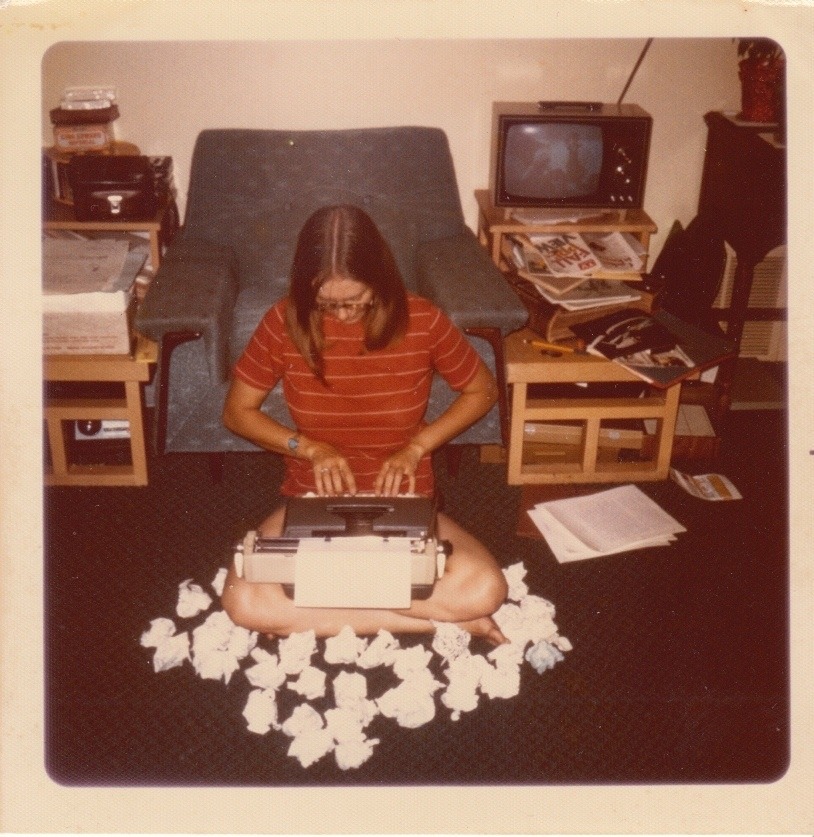
It is the summer of 1975 and this Star Trek fan was hard at work editing her fanzine, The Communicator. She is surrounded by paper tribbles, a by-product of The Fannish Writer in her natural habitat.
*photo used with permission of both the photographer and the editor.