Desperado Summary: Hutch shrugged, refocusing his now embarrassing leer on Starsky’s knees. Is that all I want from him? A quick tumble… a slap and tickle and then “I’ll call you” as I race on to the next one. No. The answer came from deep within, with a rightness that immediately eased his fears. “I never slept with a woman I didn’t care for.” Well, that was a lie; but whatever else he did or was, he cared for Starsky. Why he cared for him was the one thing in his life he had learned not to question. Starsky wasn’t for public wonderings or private dissections. Starsky was for laughter and for tears. Starsky was for ever.
Fiction written in the community based on one television series has been printed in pale blue ink on yellow paper, which photocopies as a blank page. Editors and authors would release the work only to people they knew, and then only after the purchaser had promised not to pass the work any further. Secondary readers - those known to the purchasers but not to the editors or writers - could be given the option to read the work in the home of the purchaser, but generally could not receive full access until they became well known in the fan group.
Fans of another television show circulate their fiction almost entirely through underground photocopy. Stories created in this group are passed anonymously, or with pseudonyms. Members of the community may find out who created specific stories and will know who creates the community as a whole, but participants guard their outside identities.
Camille Bacon-Smith, writing about pre-internet fanfic communities in her book Enterprising Women: Television Fandom and the Creation of Popular Myth (via surrexi)
Let’s see if I can remember the fandoms CBS is referencing
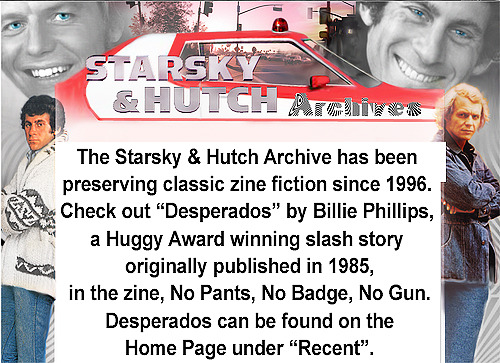
The first is….Starsky & Hutch RPS? (no, wait that was The Purple Pages) - named because they were printed on purple paper. There was a Starsky & Hutch gen and slash zine that was printed in blue ink on red paper: Pushing The Odds.You can see images of the zine here as well. So I am drawing a blank on the blue ink/yellow paper fandom.
The second is The Professionals a UK based crime show. The writer is describing the Circuit which began in the UK and then spread worldwide (mainly US and Australia).
From Fanlore, the fan run non-profit wiki
“By the late 1980s, Professionals fandom had begun to offer zines, but most of the fiction was still on the “circuit,” which by now had been gathered together in the Circuit Library.[1] ….. The US library was initially called “The Hatstand Press Lending Library,” but it too came to be known as the “Circuit Library.[3] While the US and UK circuits had significant overlap, time, distance and the informal nature of distribution meant there were differences in what was included in the circuit library in each country. In addition, in the early days of the fandom there was some resistance to sharing UK circuit stories with the Americans. According to one UK fan, distribution of stories to the US was slow to start. There were tensions between some British and US fans regarding the quality of the US written fiction, the inclusion of Americanisms in US fiction, and the "right” of those not living in the UK to write about a UK show. To ease tensions, some UK fans increased the number of copies they mailed to the US.[4]
The majority of circuit stories were slash and were passed from fan to fan either in person or through the mail. The stories were written under pseudonyms…..Copies were originally printed using typewriter carbon paper but as the number of UK readers grew fans mailed their stories to a UK fan who had access to a photocopier at work.[5] As an interesting side note: UK circuit stories were printed on A4 paper so when the stories were copied in the US onto smaller letter sized paper, the titles and the author names were sometimes cut off. Fans would write what they thought were the titles and names in the margins with the info scratched out and corrected by subsequent readers. Pages grew more and more faded after multiple copying and, on occasion, the top and bottom lines were cut off during US photocopying. Some of these factors led to the creation of the US electronic circuit library (see below).
In the early 1990s, the U.S. library had over 1,000 stories. You could order up to 10 stories at a time once a month. It cost $12 a year to join, plus mailing fees both ways. (At 10 stories a month, it would take about 10 years to read them all.) The library worked best when you worked in unison with a partner or two, so that fans could double, triple, or quadruple the amount of stories they could receive per month. Fans would photocopy the stories and bind them. These bound stories would often be lent locally to other fans in effect becoming their own mini-circuit library.”
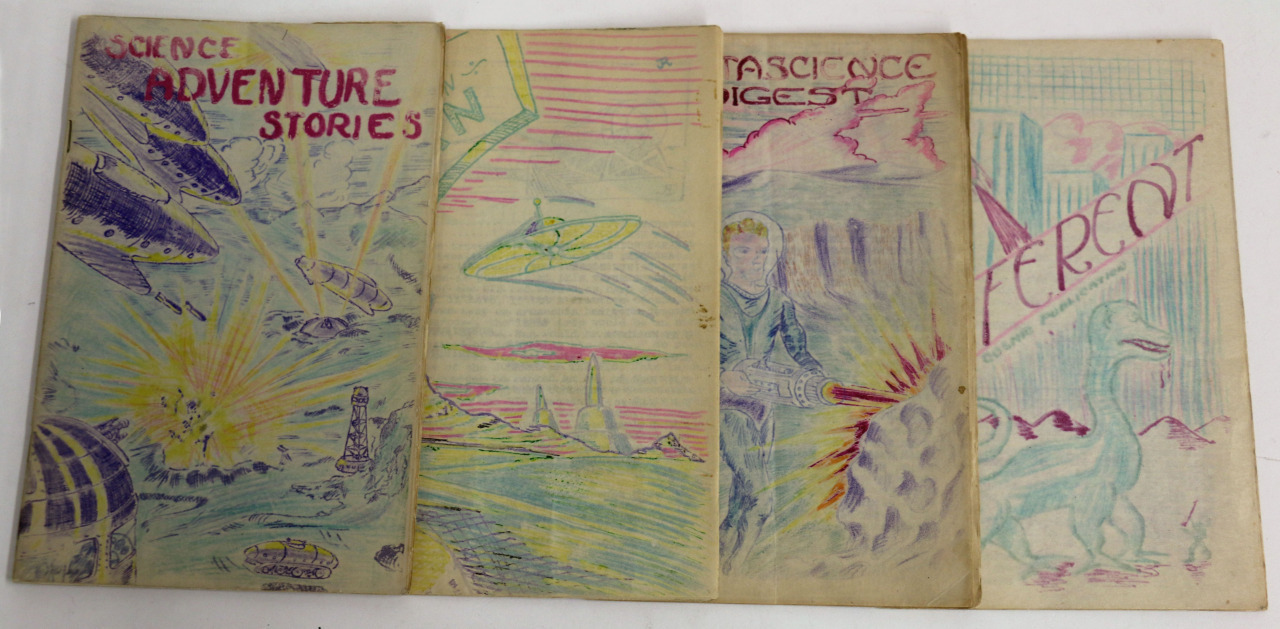
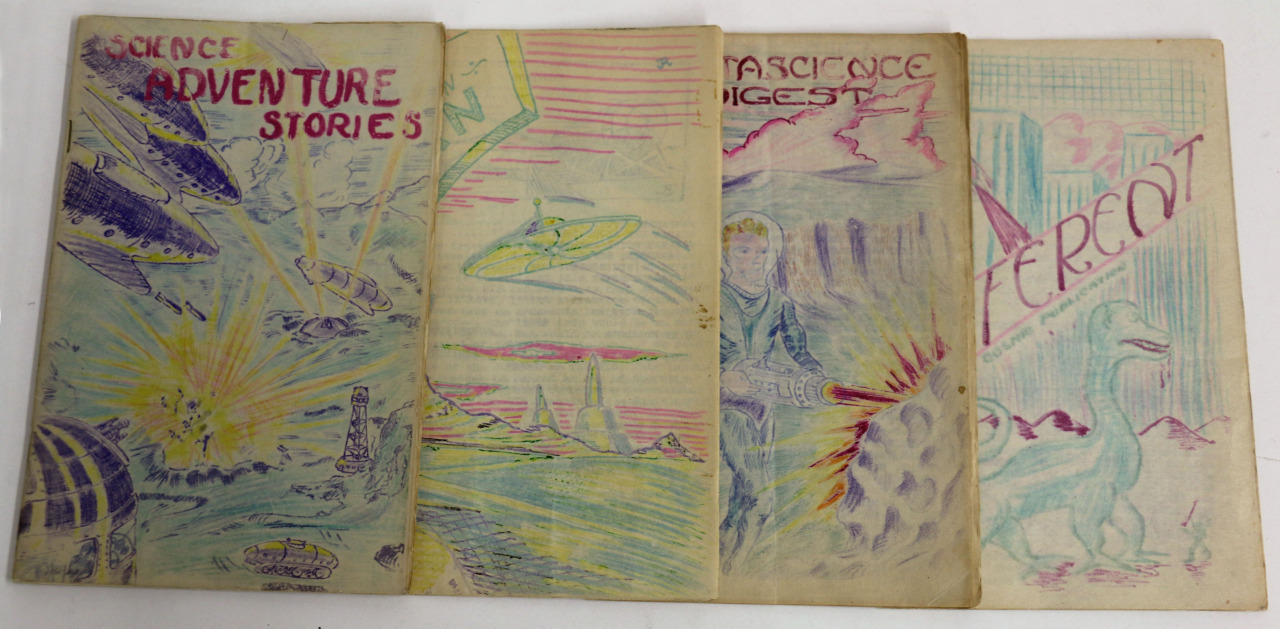
A note to media fans: the collection that is being digitized is a collection of amateur fanzines focusing on original science fiction and fantasy writing and not the type of fan fiction media fans have been producing for decades (fiction based on TV, movie and books using pre-existing characters). The Hevelin Collection has an awesome tumblr where you can follow along and see parts of the collection: http://hevelincollection.tumblr.com/
A note about the origins of Fanzines and Fan Fiction:
Fanzines and fan fiction originated in general science fiction and fantasy fandom in the 1930s. Decades later the practice of printing amateur fanzines and writing “fan fiction” were adopted by media fans. Today the phrase “fan fiction” almost exclusively refers to media fandom; however both sci-fi and media fandom still publish fanzines.
From Fanlore: “The term fan fiction is from science fiction fandom and according to Brave New Words antedates 1939. However, fan fiction originally meant either amateur science fiction published in a fanzine by a fan or fiction by a fan about fans…. Post-Star Trek, the original meaning of the term appears to have been completely supplanted by the new definition–fiction by fans using pre-existing characters and/or settings.”
It popped up again in a 1944 lexiconic fandom handbook titled Fancyclopedia, edited by John “Jack” Bristol Speer, the first noted fan historian. Then formalized as “fan fiction,” the entry defined fic as:“…[sometimes] improperly used to mean fan science fiction, that is, ordinary fantasy published in a fan magazine… occasionally bringing in some famous characters stf [science fiction] stories. […] Fictitious elements are often interspersed in account of fan activities, which may make them more interesting, but plays hob with a truth-seeker like [Greek philosopher] Thukydides. Round robins have been attempted in the fan fiction field.
This generalized description held sway from 1930-1950, during the reign of sci-fi titans like Isaac Asimov, until the first modernized fanfiction boom: the golden era of Star Trek fanfiction and its marriage partner, the fanzine.
“In reality, it all throttles back in time to the first human with the nerve to lean across a fire and whisper the innovation that has truly defined humankind with the variable version of a story. Everything else has been the same story ever since; never a final frontier, always a new, mercurial pocket of the multiverse.
Welcome to the world of fanfiction. It’s been waiting for you.”
A note to media fans: the collection that is being digitized is a collection of amateur fanzines focusing on original science fiction and fantasy writing and not the type of fan fiction media fans have been producing for decades (fiction based on TV, movie and books using pre-existing characters)*. The Hevelin Collection has an awesome tumblr where you can follow along and see parts of the collection: http://hevelincollection.tumblr.com/
A sample photo from their tumblr
*For many decades media fans struggled to find acceptance amongst the older male dominated literary science fiction and fantasy communities. However, many common terms and phrases are shared by both communities From Fanlore: “The term fan fiction is from science fiction fandom and according to Brave New Words antedates 1939. However, fan fiction originally meant either amateur science fiction published in a fanzine by a fan or fiction by a fan about fans….
Post-Star Trek, the original meaning of the term appears to have been completely supplanted by the new definition–fiction by fans using pre-existing characters and/or settings.”
From Fanlore, the fan run non-profit wiki about media fandom:
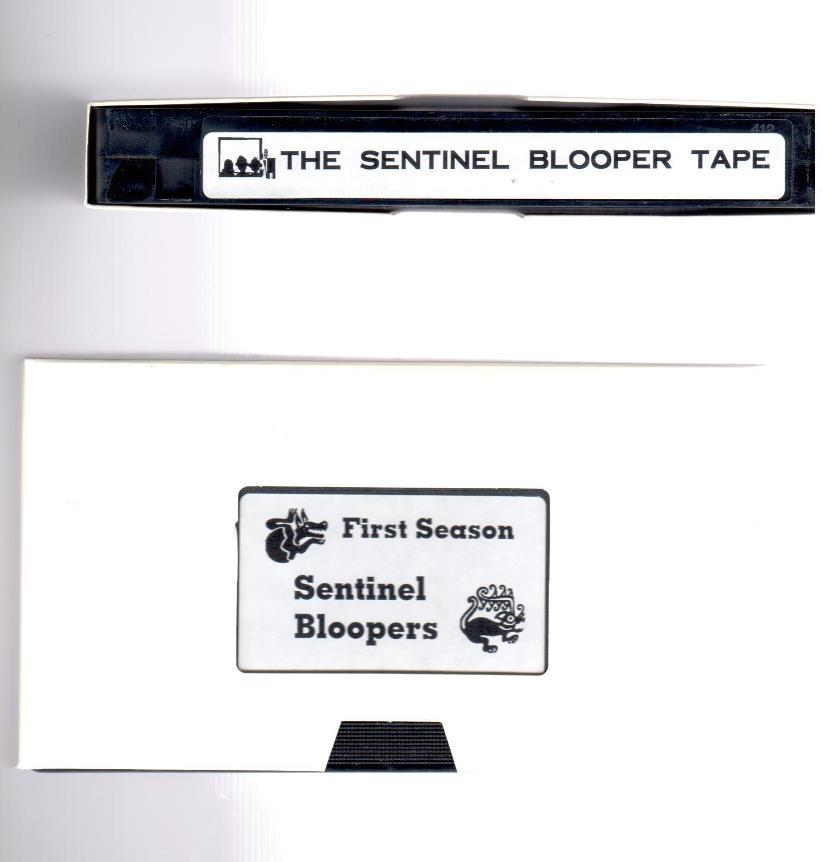
“Blooper Reel
A blooper is a mistake in filming, a misspoken word, a set mishap, a wardrobe malfunction, a continuity error, and/or deliberate clowning around by actors and production staff.
The collection of these bloopers, first on movie film, and later in other forms such as VCR tapes, is called a blooper reel or a blooper tape, or sometimes just, bloopers…..
…The Sentinel has a particularly famous blooper reel, which was also distributed via fannish tape circle. These bloopers featured not only many hilarious outtakes by all cast members, but was particularly known for its slashy vibe. The two main actors near-kissed and flirted a lot, often breaking up laughing during the show’s homoerotic scenes or making the show’s subtext into text. For instance, in one notable outtake from “Dead Drop,” in which Blair and others are trapped in a sabotaged elevator, Richard Burgi abandons his script to ask, “Blair, honey? Is that you? I don’t care about the others, let them all die, crushed like little ants, but are ‘you’ okay?”[12]”
I wonder if The Sentinel DVDs will have the bloopers?
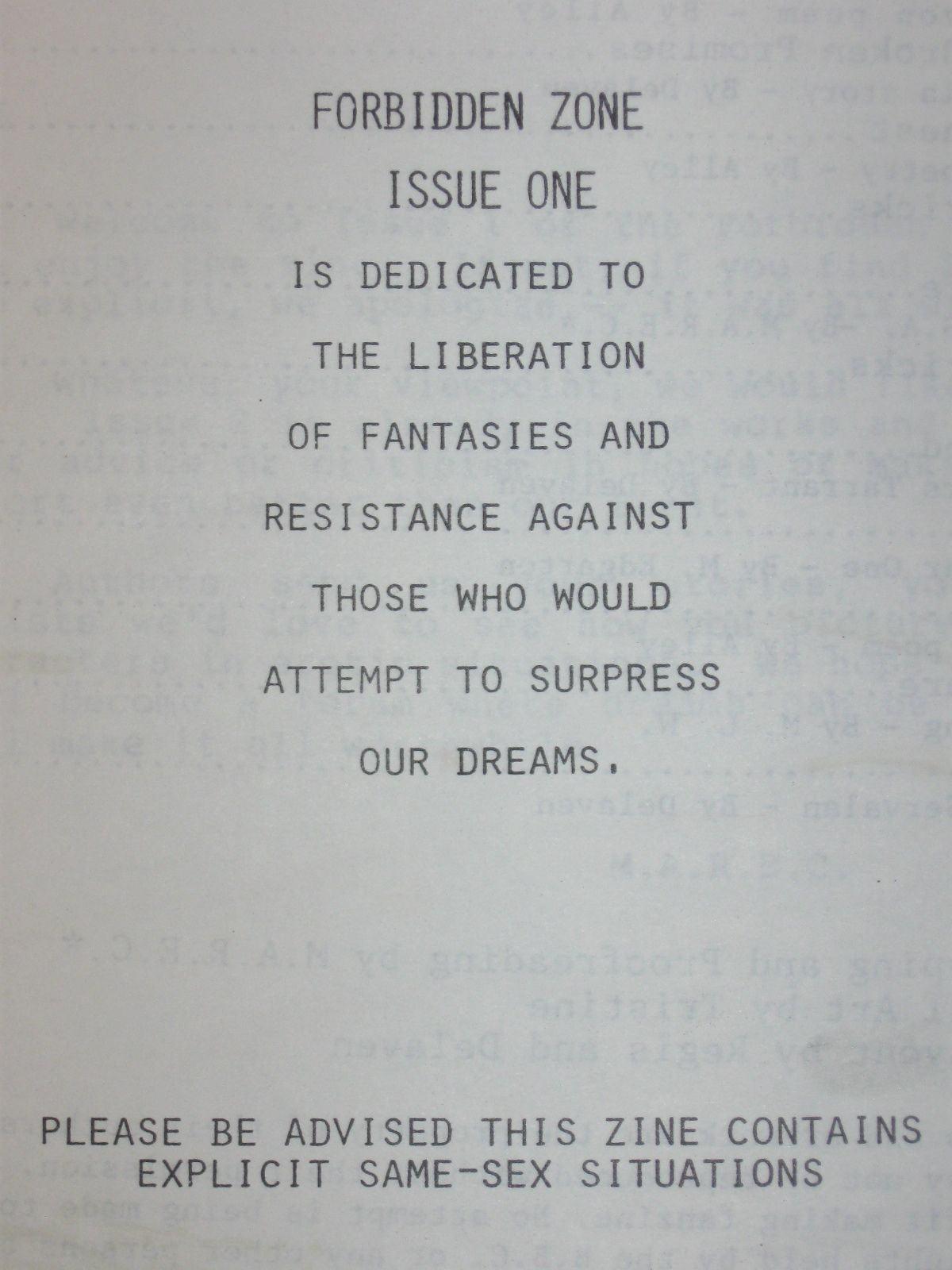
Dedication inside the Blake’s 7 fanzine The Forbidden Zone.* Blake’s 7 was a British TV show from the 1970s that had a significant following in the US. In the late 1980s, the fandom fractured irreparably when for profit convention organizers attempted to take over the fan run convention circuit in the US. The slash component of the The “Blake’s 7 Wars” has entered into fandom urban legend while the larger for profit motivations, the breaking of the Fourth Wall and the intrusion of TPTB into fannish activities have been largely forgotten.
From Fanlore, the fan run non-profit about media fandom:
*The Blake’s 7 Warswere a series of events taking place in the late 1980s in the Blake’s 7 fandom community. It goes by many names, including “The Fannish Controversies,” “The Controversy,” “The Feud,” and “The Blake’s 7 Slash Wars.”
The events disrupted and divided the fandom community, leading to what some believe was the mass migration of fans away from Blake’s 7 fandom. It also created ripple effects of fear and uncertainty that eventually transformed into fandom urban legends…
…..Slash and gen writers and readers had co-existed for many years with large number of slashfanzines being published during the 1980s. Still, as with other large media fandoms such as Star Trek and Star Wars, slash fandom was not universally accepted and many fans raising religious and moral objections to the genre.
That changed in 1989 when one of the Blake’s 7 actors and a segment of the fan community raised objections to the slash community and attempted to force it back underground. Many believe that slash had little do with with the real issues and that it was used as a pretext by fans battling over access to the actors and the ability to run for-profit conventions.
By most accounts, slash was peripheral to the main debate of fan run vs. professional conventions and actor vs fannish bruised egos. Certainly in many of the contemporary LOCs at the time[1], fans focused on the ‘for profit’ conventions and whether the actors should be paid first, and only then moved on to the topic of slash.
That being said, negative attitudes about slash did play a role in the Blake’s 7 wars. Given that the genre has always been a major flashpoint for media fandom, it is not surprising that years later the Blake’s 7 Wars are now known as the “Blake'7 Slash Wars.”
*The dedication in The Forbidden Zone is ironic: It reads “Forbidden Zone Issue One is dedicated to the liberation of fantasies and resistance to those who would suppress our dreams.” The themes of liberation and resistance were core elements of the Blake’s 7 canon. On the show, the main character Blake was falsely accused of child molestation and imprisoned in an effort to quell political resistance.
Happy to reblog some fan history. With the Hevelin Collection unboxed, I’m going to ocassionally reblog posts from SF and fandom that resonate with me. If you are a fan of Blake’s 7 and you’re ever in the neighborhood, please stop by and see our extensive holdings of Blake’s 7 fan materials.
Reblogging the reblog because Iowa has a great collection of Blake’s 7 materials donated by Sandy Hereld and many other fans. In fact the original papers that were used to write up the history of the Blake’s 7 Wars on Fanlore were donated to Iowa in Jan 2014 by one of Sandy’s friends and are now part of Sandy’s collection. I don’t think the papers have appeared in the online finding aide as the last update was in 2011.
Dedication inside the Blake’s 7 fanzine The Forbidden Zone.* Blake’s 7 was a British TV show from the 1970s that had a significant following in the US. In the late 1980s, the fandom fractured irreparably when for profit convention organizers attempted to take over the fan run convention circuit in the US. The slash component of the The “Blake’s 7 Wars” has entered into fandom urban legend while the larger for profit motivations, the breaking of the Fourth Wall and the intrusion of TPTB into fannish activities have been largely forgotten.
From Fanlore, the fan run non-profit about media fandom:
*The Blake’s 7 Warswere a series of events taking place in the late 1980s in the Blake’s 7 fandom community. It goes by many names, including “The Fannish Controversies,” “The Controversy,” “The Feud,” and “The Blake’s 7 Slash Wars.”
The events disrupted and divided the fandom community, leading to what some believe was the mass migration of fans away from Blake’s 7 fandom. It also created ripple effects of fear and uncertainty that eventually transformed into fandom urban legends…
…..Slash and gen writers and readers had co-existed for many years with large number of slashfanzines being published during the 1980s. Still, as with other large media fandoms such as Star Trek and Star Wars, slash fandom was not universally accepted and many fans raising religious and moral objections to the genre.
That changed in 1989 when one of the Blake’s 7 actors and a segment of the fan community raised objections to the slash community and attempted to force it back underground. Many believe that slash had little do with with the real issues and that it was used as a pretext by fans battling over access to the actors and the ability to run for-profit conventions.
By most accounts, slash was peripheral to the main debate of fan run vs. professional conventions and actor vs fannish bruised egos. Certainly in many of the contemporary LOCs at the time[1], fans focused on the ‘for profit’ conventions and whether the actors should be paid first, and only then moved on to the topic of slash.
That being said, negative attitudes about slash did play a role in the Blake’s 7 wars. Given that the genre has always been a major flashpoint for media fandom, it is not surprising that years later the Blake’s 7 Wars are now known as the “Blake'7 Slash Wars.”
*The dedication in The Forbidden Zone is ironic: It reads “Forbidden Zone Issue One is dedicated to the liberation of fantasies and resistance to those who would suppress our dreams.” The themes of liberation and resistance were core elements of the Blake’s 7 canon. On the show, the main character Blake was falsely accused of child molestation and imprisoned in an effort to quell political resistance.
livejournal, fanfiction.net and ao3 which one were you?
*giggles* and then there’s us old fucks who did zines, newsgroups and lists first :D
I did fanfiction.net and yahoo! groups simultaneously, and spent a great deal of time on fandom-specific Smallville and BtVS fiction archives and individual author websites before LJ became a thing.
The Many Houses of Fandom: Zines, Usenet, Mailing Lists, Bulletin Boards, Fandom Archives, Livejournal, FanFiction.net, A03, Tumblr, Wattpad…