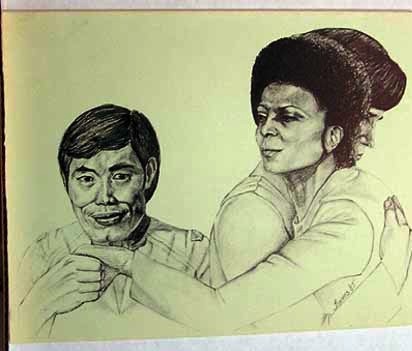
From 1981, the Star Trek fanzine Menage A Trois. In 2012, two fans remembered their encounter with the zine and one of the actors depicted in the artwork.
Kandy F: … [the zine] had a picture on the front cover, very well drawn, of Uhura being hugged by Sulu, but then reaching out past him to Walter [Koenig], implying that it was going to be a three-way. Well—
Marnie S: Oh, I know that zine.. I think I have that zine out in my garage.
KF: —Walter’s coming around through [the dealer’s room], and he goes, “Oh, you’ve got slash. You got any, listen— Kandy, why is it can I never find any slash that has Koenig it in?” I mean, Walter in it. I mean— (laughter)
MS: Yes, yes.
KF: He wanted to know why his character wasn’t being slashed. I’m kinda going—
MS: He was not—
KF: Eeeee
MS: —deterred by it. In fact, he used to tease George [Takei] about it.
KF: Yes. (laughter) So, anyhow, he goes up and he sees this story…..he rolls it up and he decides to give a dramatic reading.
MS: Oh, god! Oh god!
KF: About how the two guys had to go down to a planet and seduce the court of the queen, so they’d give them dilithium crystals, for the ship is trapped in orbit and can’t get out. And so these two young men had to go down there and please the ladies of the— So, he’s reading this thing out loud, very dramatically, and just enjoying the heck out of it. So—
One of the sad things I have to do from time to time is add this tag to Fanlore pages. Today it was for this lovely fan, Pat Harris, who passed away last week.
“Pat Harris was an early Star Trek fanzine publisher and fan artist. She published the gen zine Infinite Diversityand also illustrated for the Starsky & Hutch letterzine. She was active in the Bill Shatner fanclub, was an on-site fan photographer in Golden Gate Park for the filming of ST:IV, and also published Sonni Cooper’s novel, “I Celebrate Myself” as Infinite Diversity issue #6 She passed away in May 2015.”
increasingly, i am running into the following viewpoint: that all posts people make are, by default, open to the public and available to be commented on by strangers, regardless of stated wishes in tags, readmores, topics of…
more snippets from 2013:
“….I really like the term “outbound information source” to describe Tumblr. That’s what tumblr does best: spread information/opinions/art, promote fleeting contact with people who have similar interests, and often make it difficult to maintain that contact for longer periods of time.It’s very different from a meatspace coffeeshop or a run-of-the-mill blogging platform (I would attribute this difference to the tagging and cross-referencing system) because it is not about the person, it’s about the subject….
….
This is the inter-blog level of tags, wherein lies the real power and uniqueness of tumblr. Strangers see your stuff. I was used to speaking to my followers only, in a conversation that was a lot like my irl or lj conversations. But with the tag system that links your interests thematically with others, you aren’t connecting with specific people, you’re connecting with a stream of interests. This is part of the reason two-way conversations are so difficult to wrangle in tumblr, imho: the medium is designed so you’re nearly never speaking to one other person. Instead, tumblr is a place for shouting….
…
tl;dr version: tumblr doesn’t sustain secretiveness because you’re not connecting with (trusted) individuals, you’re just broadcasting to a (receptive) audience. TAGS, BABY.”
increasingly, i am running into the following viewpoint: that all posts people make are, by default, open to the public and available to be commented on by strangers, regardless of stated wishes in tags, readmores,…
Back in 2013, some tumblr users saw aspects of the private vs public debate as a holdover from the days of LJ/DW where we had better privacy controls. Has that changed? The majority of tumblr users have no exposure to the LJ blogging world, so what cultural expectations are they carrying into tumblr today? And are they doing a better or worse job of distinguishing their expectations and assumptions from the reality of tumblr (and online life).
sections below….
“…..we can try as hard as they like to map LJ/DW fannish norms onto tumblr, but tumblr is a functionally distinct medium with no actual privacy controls and we lose sight of that to our peril. [we need to] recognize how quickly tumblr allows (and, indeed, encourages) the message to be separated from the messenger. if you have been on tumblr for any length of time, i guarantee that you have reblogged something the OP never intended for you to see or comment on. perhaps it was a silly text post, or perhaps it already had a billion notes, or perhaps it never occurred to you that the OP would mind, or perhaps it did occur to you but you just ~felt sure~ that they wouldn’t really care, but the principle of the things remains the same! and it strains credulity to think that we can have our cake (sharing the content of strangers while rarely, if ever, going to the source to see if they want it shared) and eat it, too (expect strangers to respect our right to limit access to our content). again, my point here is not “and therefore everyone has the moral right to opine on your real life posts” but that we have to be honest about the community standards of behavior we are already upholding if we hope to effectively change any of them.
so i suppose my feeling is: i will continue to do my best to respect your wishes regarding your content. i will continue to not follow people who purposefully disrespect the wishes of others regarding their content. but i am deeply resistant to framing this issue in terms of “private conversations” or “strangers eavesdropping” or anything else that proceeds from a fanciful, nostalgic re-imagining of the actual medium we have chosen to use. we all deserve a more serious conversation than that about boundaries and respect on tumblr.”
Due South was such a gift. Do you know how useful the phrase “for reasons that don’t need exploring at this juncture” is in our every day lives? Just try it.
“I left the house without pants…for reasons that don’t need exploring at this juncture…”
“I was going down on him in the coat room…for reasons that don’t need exploring at this juncture…”
“I need you to get me two gallons of Mountain Dew and a kilo of cocaine…for reasons that don’t need exploring at this juncture…”
“I adopted this puppy while you were at work…for reasons that don’t need exploring at this juncture…”
The importance of Due South simply cannot be underestimated.
cathexys Starting a new post b/c that other user is obviously very invested in their rules being universal. My thoughts are the following:
1. The idea about untagged posts and a few other related “rules” is actually FAIRLY hidden. I have only seen it pas by my dash twice, barely. There is no…
I agree that there seems to
be a lot of unwritten rules and assumptions being passed around without much explanation.
What I take away from this is that Tumblr contains multitudes of
communities that do not - and for practical reasons - cannot share the same
norms. We ran into many of the same “how
come you don’t see the fandom world the same way I see it” discussions on
LJ when we were trying to hash out the “rules”. On Tumblr though, the fluidity
of the platform and the built in reblogging means that the communities intersect
more easily. Without the privacy tools
of LJ or the gate-keepers of closed mailing lists, the only “tool” available to
us is to expect other users to understand and follow our unwritten rules. Which
of course is doomed to fail.
In addition, some of Tumblr users “rules” are based on a platform
that itself keeps changing. For example, I learned today that in the past
untagged posts could not be found by Tumblr’s search engine. So untagged post =
semi private. But Tumblr’s search engine has changed and they now pick up phrases
in posts not just tags. If you are using add-ons like xkit that new search box
may not show up. So the more long-time Tumblr users are confused when new faces
show up on their untagged posts. And the new faces are confused at the
resulting freak-out.
Then there is the scary nature of the Tumblr platform itself -
anything that you post can, by the very nature of how the platform is designed,
be reblogged, linked and/or responded to. But because there is no ability
to lock or delete or edit a post once it has been reblogged, the entire discussion,
other’s responses, even your follow-on responses to their responses are lost to you. Even
worse, you cannot easily track the multiple discussion pathways. You
cannot chase the white rabbit because there are hundreds of white rabbits
hopping all over the place and “OMG is
that a caterpillar? What does that have to do with anything I said?”
But this debate about “everyone
should know my Tumblr rules” reminds me of when we were hashing out how
fandom (a formerly closed society) should use LJ. We were originally so
very strident “My Blog! My Rules!”
seeing our blogs as privately owned spaces. But then triggers warnings discussions
happened and that too shifted. We had a responsibility to warn - or to at least
warn if we were not warning. To be a member in good standing meant you had to
start treating your unlocked blogs posts as more of communally posts (locked
blog posts were a different matter). I am not saying I agree with this cultural
shift, but I can see echoes in today’s discussion.
It
is as if we keep wanting intimacy and connection but have the need to control
the pace and scope and direction all at the same time we’re hurtling down a technological
slope that was not built for our use. No wonder we’re flailing again and again.
Fandom needs to reset its expectations and either build a platform that is more
customizable for its needs or start investing in some good sledding gear.
“I think we’d be better served thinking
of fandom as what Mary Pratt calls a “contact zone,” which she defines as:
“social
spaces where cultures meet, clash, and grapple with each other, often in
contexts of highly asymmetrical relations of power”
I think this extends
to virtual spaces like Tumblr or Twitter, where discrete ‘communities’ are
increasingly unfeasible …. I think we’re not a
community - we’re a LOT of people who have one thing in common, and probably a
lot of other things not in common, and I think it’s easy for us to forget the
latter part of that when we think about - and concern ourselves with - the idea
of “fandom” as “community.” We will not always agree, and so the question
becomes one of what we do next…..”
Her suggestion:: “Create or find smaller sites off Tumblr
for conversations that require a greater degree of mutual understanding and a
shared/common language to really progress. ….. Don’t respond to trolls, because
they have a different MO altogether. I ignore assholes on the street, so I
ignore them here, and do my best to keep them out of my backyard. I think those
are all good tactics for engaging online, and they’re ways to make sense of
Tumblr in all its infinite diversity.
Because I do think
there’s value in being on Tumblr in all its infinite diversity. I’ve learned
more about sexuality, gender, class, race - I mean, you name it - in my year
and a half here than I have in years of living out in the world, because here I
come into contact with people I might never speak to otherwise, and all because
we have this one shared thing. I think the contact is critical - but that we
have to understand that it’s the nature of contact with people and ideas
outside our own experiences to be a bit fraught with conflict and, as Pratt
says, grappling..”
TLDR
version: We are multitudes. I’d better get used to it. In the meantime, cake
anyone?
*And
not just for fandom. Go anywhere online and you will see the conflict between
these various contact zones.
A while back I did a series of posts about how technology
has shaped – and continues to shape – our fandom culture: here, here and here. The short version: We do not use technology,
technology uses us. And
I am not alone in blogging about this.
I came across two interesting posts discussing fandom’s migration
to newer platforms and think they both fit into my belief that fandom needs to recognize the larger social and technological
forces shaping our community .
First up, a
fan discusses how twitter hinders fan communication: “The
mix of locked and public accounts, trying to follow multi-branching
conversations when sometimes you can’t see what half the people are saying, and
of course the character limit are all huge obstacles to good fandom discussion.”
Next up: a
fan argues that Tumblr benefits both visual and text based fan whereas LJ
mainly benefited text base fans (as a text based fan I can say that – for
me – Tumblr does not work as a method of discussing with other text based
fans. As always, YMMV)
“LJ was text
based, so text-based content creation was king, and tumblr is image based, so
image-based content gets more attention this way, but the main difference, in
my view, is that LJ only had text, which resulted in written content dominating
to the point of near total exclusion of nonwriters… I suspect the people
singing LJ’s praises didn’t experience how isolating it could be if you didn’t
produce the kind of content favored by the platform at the time. Meanwhile the
relationships I’ve made on tumblr as a result of a major form of fandom
interaction finally shifting to something I’m capable of doing are just as
longlasting as the relationships made between writers on LJ, and I bristle a
bit at the implication that they’re not.”
My thought: when we
use platforms designed by commercial entities for their own purposes, we end up
absorbing some of their cultural DNA – this is not necessarily a bad thing and has
been going on since the early days of Fandom Dodos (fanzines and mimeo machines
oh my!) through the early days of UseNet and bulletin boards across mailing
lists and into today. But until we own
the platforms; until we design them to meet our needs, we are influenced by these
commercial forces in ways we often fail to examine or understand. And because
we fail to understand how external forces are shaping and reshaping us, we tend
to lose sight that we, as a community, do have agency. We also run the risk of
losing the ability to both talk about
ourselves and to ourselves in ways
that bring us together.
Which is why AO3 (Archive of our Own) speaks to me on so many
levels. “We own the servers” is
not just a slogan – it is philosophical world view that peers into our future
and says: “Oh shit, that’s one big tidal wave coming down on us. Let’s build a
boat. And if we get wet, we’ll get wet together.“
And which is why I
wish that we had better tools to communicate with our fellow fans – ones that
did not encourage us to limit and self-segregate us or force us into creating artificial
divisions. I am a text based fan – but I am also a vidder and can communicate
visually. I like having more privacy controls – but I may, or may not use them, understanding that with every “locked” tweet or post I am locking myself away. I like to blog about fandom – but also
about art and music and politics and social change and kittens. I love it
when people tag their posts (easier to find what I want when I want it), but I don’t
object to tagless posts. I see myself as
a media fan while also acknowledging that many fans who are part of my community
do not identify themselves that way.
HEY it’s been a while since I last harped on about archiving this blog but bear with me:
I’ve got an enormous archive of significant threads and miscellany from MisbehavingMaiar that I’ve been meaning to migrate over to a less volatile platform than tumblr– somewhere less likely to change the…
The Year Was 1997 And You Just Received A C&D Notice From A Lawyer
In 1997, if you were a fan artist drawing fan art inspired by a book and the fan art happened to be on the same page where your “semi-pro” art portfolio existed and where you accepted (non-fannish) art commissions….well you could expect to receive a letter from a lawyer threatening a lawsuit.
And all you could do in 1997 is delete your fan art, return any commissions you received up to that point (as all your earnings were “tainted” because they sat too close to your fan art. For!Profit!Cooties!), and add a disclaimer to your website saying: “Any dragons on my website after May 1997 have nothing to do with any dragon book, in the past, in the now or in the future. Nada. Nothing. They are just dragons. Generic fire breathing lizards. With wings. Please stop hitting me with the lawyer, OK? I am sorry I made you hit me with your lawyer.”
And then maybe you’d start a support group for Fans “Burned By Copyright-holders And the Fans Who Love Them”.
If only the OTW could create a time machine. But at least we have them now.*