October 2013

transformativeworks:

Do you want to help develop Fanlore?  Or can you help us with Translation or Abuse reports? Please volunteer! http://bit.ly/1ccTHxN

FANLORE!!!!  Both the Wiki Committee Staff and  Wiki Committee Design Specialist openings are available.

Everything You Ever Wanted To Know About Alpha/Beta/Omega FanFic

 
morgandawn: Fandom is my Fandom (Fandom is my Fandom)

A historical overview here (The nonnies made them do it! [Fannish history. SPN. A/B/O]) along with a handy Timeline here.

I adore fans who write up history essays and timelines. Makes me feel all warm and fuzzy

(some links go to Fanlore, the fan run wiki about media fandom)

Fanzines: The Whole Is Not Equal To The Sum of Its Parts (copying out of print zines)

I was recently chatting with friends about copying/scanning print fanzines with fanzine publisher permission. One of the issues that came up was the statement printed inside many fanzines  that the “rights revert back to the author.” A few took this to mean that if a fanzine publisher wanted to keep their zine in print or do additional print runs or give permission for their zine to be scanned, they could not do so without obtaining the permission of each contributor. According to this view, once the rights reverted back to the author, the  publisher’s publication rights ended. This line of reasoning meant that fanzine publishers today, such as the publisher of Spockanalia, the first Star Trek newsletter, could not – and should not - be printing and selling copies of their zines some 40 years later.

In order to make sense of this oddly circular discussion, it is important  to keep in mind that the majority of fanzines printed over the past 40+ years did not have negotiated  "rights" or even a universal understanding as to what rights were being given to the publisher. You wrote a story and submitted it in exchange for a contributor’s copy. As a zine publisher, you published and sold as many copies as you could afford to sell.  A few fanzine publishers took care to go into more detail with their contributors, but for the most part “‘trib copy” and “print as many as you can” was  pretty much it.

Multiple print runs were not the norm in the early print fanzine  era  - mainly because few publishers could afford the upfront costs to fund a second print run. Often the zine publishers would advertise for “pre-orders” (or subscriptions) in order to raise enough funds to do a second print run. But typically fanzine publishers did not have to seek permission from their contributors to do additional print runs. Their right to publish the zine continued as long as they could keep publishing. Zines would go in (and out) of print, and then back into print.  In the book world, savvy writers negotiated limits to the publisher’s publication rights,  ending after X years. Others negotiated rights for only as long as a book was “in print” and ran into problems when the arrival of eBooks suddenly meant that nothing went ‘out of print.’

In the fanzine world the in print/out of print rules changed when xeroxing and desktop publishing became cheaper in the late 1980s.  Suddenly zines never went out of print and many older zines from the 1970s were put back into print. This caused some fans to become upset as there was a booming market in selling and trading used out of print zines.  Having zines back in print undercut that used fanzine market. Other fans  - who were copying their out of print  zines to share with other fans – were also unhappy because they were now being labeled as ‘pirates’ and ‘thieves’ for doing the same thing they had been doing for years.   You can read more about this here.

In the Star Wars letterzine , Southern Enclave, readers and fanzine publishers began debating the practice of copying out of print zines. They called it, amusingly, the Clone Wars. Excerpts from that discussion can be found on Fanlore here.

One snippet in the Southern Enclave discussion caught my eye and may help explain how in fandom - according to fannish custom and not IP law - writer’s rights and fanzine publisher’s rights mesh with one another. According to this description, the fanzine publisher has the rights to the zine as a compilation and, after publication, the author/artist retains the rights to do what they will with their individual creation. The writer can submit it to another zine or give it away.  Or, as the publisher suggests, the writer can give permission for their story to be copied. The publisher on the other hand, controls what happens to the zine as a whole.

“The rights of the individual author/artist [is not equal to] the rights of the zine publisher – because the whole [is not equal to the] sum of its parts. After a zine is published, the rights to each story and piece of art revert to its creator–who can permit as much Xeroxing as they like! I can’t stress this too strongly: It’s YOUR story, or YOUR piece of art; please feel free to share it with all the fans you like! But – but! - the zine as a unit, with its layout, editing, and arrangement belongs to the publisher. “ 

In later years, when the Internet burst onto the scene, fanzine publishers and writers added a new ‘limit’ to zine publication: as a contributor, you would agree to keep the story offline for at least one year to allow the zine publisher time to sell their zines.

Note that the “rights’ discussion, does not perfectly parallel contractual or copyright laws. And it shouldn’t – first because there were usually no contracts or negotiated rights in fanzine production. And second, because the application of copyright to the fandom world carries with it its own perils. But, to quote one fan, the interplay between our fannish culture and laws creates enough “wiggle room” to be able to say that: 

“Part of the reason why fandom hasn’t always cared about the legality of fandom is because we feel a sort of community ownership over the source in question. When a TV show or movie airs, when we read a book, when a rock or sports team plays, those things they create become part of pop culture, and as members of society, we have some ownership over the culture we live in, which these things are a part of. We feel that gives us the right to comment upon them, to obsess over them, to create around them…….fandom is just a subculture of overall culture and I honestly feel a similar sense of ownership over the fanworks that we create as I do for the pieces of pop culture out there. The fanworks we make become part of the fannish conversation, and they grow beyond the words/pixels/waveforms/etc. on the screen.”

(links go to Fanlore the fan run wiki about media fandom)
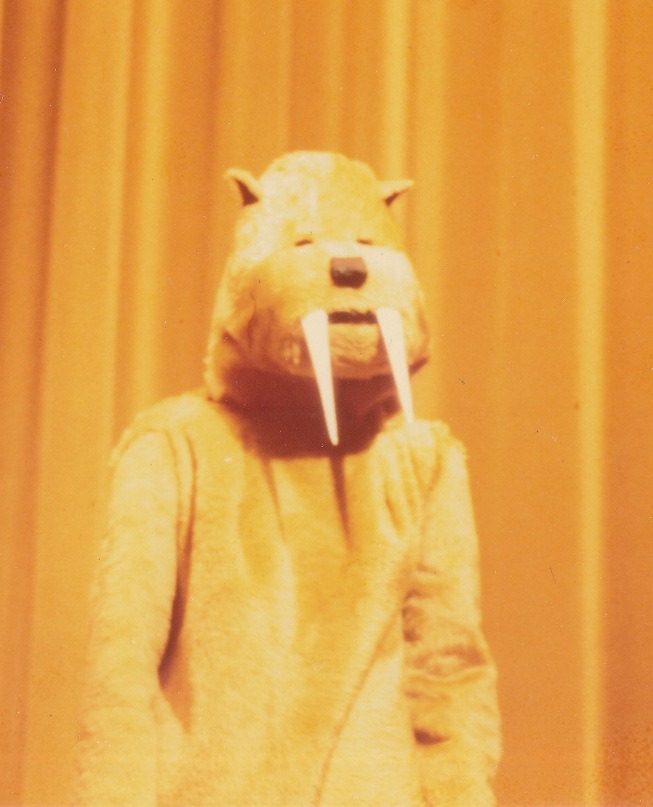
Dear Diary, this weekend I spent time with this fan. This is a photo of her in her younger years wearing her award winning sehlat costume at a 1970s Star Trek convention. She is still a Trek fan 40 years later, proving you are never too old or too embarrassed to be  a fan.

(links go to Fanlore, the fan run wiki about media fandom. Photo used with permission).

Fandom History Volunteers Needed

Here are several fandom history projects underway  that are looking for help.  These informal projects have been set up by, and are run by, individual fans. Contact info at the bottom of the post.

***************
Digital Fanzine Project

Need help editing PDF scans: We’re working on a fanzine preservation project and need help editing PDFs. All scanning is being done with the publisher’s permission.

The edits consist of re-arranging pages scanned from digest-sized zines and putting them in page order. You will need access to a basic PDF editing tool that can crop pages like Adobe Standard or one of these free tools here or here. You can work at your own pace.  

While we are starting with Spockanalia, one of the earliest Star Trek zines published in the 1960s,  we also have numerous other letterzines and adzines in many other fandoms.

 *****************

Media Fandom Oral History Project.  This project’s focus is fans interviewing fans in order to capture our own media fandom oral history.  

The interviews can be done in person, but most are done via Skype (audio) or over the phone. You can read more about the project here (link). 

Transcriptionists. We need fans to transcribe the audio interviews.  Each interview is around 45 minutes to 1 hour. You can work at your own pace. 

Interviewers. We’re looking for fans who are willing to conduct phone/Skype interviews. We will train you on how to set up the recordings and give you a set of questions to ask. You can start by interviewing people you know or dive in and start chatting with new fans.  You will be responsible for  scheduling the interviews, distributing and retrieving the authorization paperwork, conducting the interviews,  and then uploading the files.

Coordinator. We are looking for someone to help assign interviews to interviewer and transcriptionist volunteers, follow-up with the volunteers, and track progress on a Google spreadsheet.

*****************
 Vidding Preservation Project.

Outreach/Coordinator.  This project involves contacting vidders to see if they’d be interested in donating their fanvids on DVD to the Fanzine Archives (link) and/or the Vividcon Vidding Library (link). Contact with the vidders will be via emailand you will be responsible for answering questions about the project, following up on donations, and tracking progress on a Google spreadsheet.  Technical knowledge of vidding is not required, but is helpful.

*****************

Contact: Morgan Dawn at mdawn6 @ yahoo.com

Fanzines: Remember This The Next Time Your Smartphone Glitches

In 1980s, when fanzines were moving away from typewriters and offset and mimeograph printing to that newfangled desktop word processing, this fanzine publisher explained why her zine was delayed. Her computer Harriet didn’t come with a screen (aka monitor)  and you needed a screen to see the words as you typed. Her other computer, Peon, could be hooked up to a TV. But it lacked the interface board that could run the brand spanking new invention called the dot matrix printer.


“TO EVERYONE WHO MIGHT BE WAITING FOR STARSHIP BRITANNICA #3: Due to unforeseen difficulties, SB#3 will be postponed from October to December. First, changing from programming micros to programming IBM mainframes in machine language requires (shouldn’t but does) more math credit than I have, and the fall semester has started. Even more seriously, Harriet, the wonderful, hard working IBM PC responsible for getting FOUR zines our between February and August of this year, had a nervous breakdown when she saw the number of disks to be formatted in preparation for SB#3…She’ll quite willingly run programs (and did eventually format the disks) but word processing definitely needs a screen ….Peon, the Commodore, only requires a TV and has volunteered. Unfortunately, Peon also requires an RS232 interface board to run the beautiful dot matrix (could you tell) Toshiba Harriet uses. So which ever one comes up to par first runs the word processing software.”

So…have you gotten around naming your Smartphone yet? Perhaps…Harold?

(some links go to Fanlore, the fan run wiki about media fandom)

Fandom History: Why It Pays To Have One. That Is Written. By Many Of Us.

In 2010, a fan wrote passionately, about the ethics of turning fan fic into commercially published work. She asked the  community whether anyone in her fandom would ever do this and whether it was a moral practice? The irony, is that in her fandom (which dates back to the 1970s) there were fans who turned their fanfic into commercial fiction just as there were fan communities who not only did not object to “going pro”, they cheered their fellow fans for getting published. This was repeated across many fandoms: Star Trek, Professionals, Due South, etc.   At the end of this long discussion thread someone linked to the Fanlore page on Filing off the serial numbers.

My take on the discussion: Without places like Fanlore, the ability to imagine a history  beyond your own boundaries is much harder.  And any history that relies on the memories of  only a few or that is orally passed from person to person to person will be full of rumour and innuendo and misperceptions.

Excerpt:
“You may have heard about a certain Twilight-fanfic-turned-novel called 50 Shades of Grey and all the brouhaha about it. If you haven’t, the non-tl;dr version of the situation is that a fanfic writer in the Twilight fandom posted a many-chaptered AU story featuring Edward/Bella called Masters of the Universe, but then pulled it, changed the names of the characters and then published it as a book called 50 Shades of Grey.

So I ask the S&H fandom in regards to doing such a thing is: If a writer in the fandom were to take their long S&H stories off the internet and change character names, locations, time (e.g. from the 70s to the present) and then publish the stories as ‘original novels’, would you consider this legal/ethical? Would you support the books because of their S&H fanfic origins, or not?

Me, I definitely consider taking a fanfic, AU or not, that’s been posted online and changing it into an 'original novel’ for sale to be unethical. Sometimes the alterations may be enough that the characters in the published novel don’t seem like those in the fanfic, but still, there’s something sleazy to me about taking advantage of another creator’s fanbase and their work to make profit for yourself.”

(links go to Fanlore, the fan run wiki about media fandom)

More Blake's 7: Finding Blake In All The Wrong (or was that Right?) Places

From 1994, during a discussion about some of the countries where B7 was shown (and loved):“"Re the exact running dates of B7 in Communist Bulgaria: I don’t know the answer, but the way I learned about it was from a LOC to the old Federation Archives in which a B7 fan recounted the experience of being a tourist in Bulgaria, and (I think) walking around in a B7 T-shirt and having people come up to her on the streets to express their own enthusiasm for the show. So that would place it approximately in the late 80’s, I should think.

(links go to Fanlore, the fan run wiki about media fandom)

I have been asked (OK dragged) into helping document more of Blake’s 7 history on Fanlore. In my Internet searching, I found this lovely bit of fandom history: a TV news report about one of the early Blake’s 7 conventions in the UK. It was held in 1986 and the reporters interview a few fans, one of them Ann O'Neill who helped organize the event. You can see it here.

(some links go to Fanlore: http://fanlore.org/, the fan run wiki about media fandom)

whenthemonstersgetyou:

Help Support our favorite sites like Archive of Our Own and Fanlore during Organization for Transformative Works’ membership drive. 

Donate Here

$10 donation gets you voting membership!