September 2013

It Is 1979 And Do You Know Where Your ARPANET Is?

Today the date is 1979 and sci-fi fans have set up their own little mailing list, SF-LOVERS, on ARPANET. I wonder what they are talking about? 

“The latest Star Trek movie is crap” (Note: the mailing list is actually talking about the first Star Trek movie, but who is counting? Or rather, who can keep count?)

Date: 8 Dec 1979 2046-PST
Sender: GEOFF at SRI-KA
Subject: Re: Star Trek The Movie
From: the tty of Geoffrey S. Goodfellow
To: BEAN at MIT-MC

I thought the movie was “hokey”, and wanted to throw up, but
instead sat thru it and laughed (out loud) thru the “serious
moments” of the movie along with other people in the place.
I think comparing the movie against star wars is like comparing
the Prisoner Series and Green Acres, (i.e. Apples and oranges).
Yes, go see it, but don’t go in expecting much, except to see a
few gimmicks, and not much more.

A lot of discussion about mailing list tech problems. Apparently, only one email message was being delivered per day to Xerox Company’s server and they needed volunteers to manually forward the rest. As an added bonus, this post also contains the origin story of their mailing list.

Date: 8 Jan 1980 4:58 pm (Tuesday)
Sender: Brodie at PARC-MAXC
From: Richard R. Brodie <Brodie at PARC-MAXC>
Subject: My baby–she’s become …
To: Science Fiction Lovers <SF^>

In the beginning there was void, and the void was without form,
or any form of SF lovers mailing list.

Then I thought it would be a nice idea to have such a list. And
I created SF.Dl. And The People thought that it was good, for it
grew and grew to the point where it contained 52 recipients.
But I saw that it was lonely, and that it needed companionship
and an influx of fresh ideas from the East Coast, where weather
is cold, blondes are scarce, and relationships are meaningful.
And I created SF-LOVERS at MIT-AI, and linked SF.Dl to it
through the LISP-like miracle of MIT’s mail system. And The
People thought that it was wicked good, for there are now
several hundred people from all parts of the world on SF-LOVERS
at MIT-AI.

And it became very difficult to maintain the list from afar, so I
created laws of nature and physics, also known as Roger <DUFFEY
at MIT-AI> to rule over the list and maintain order in the
heavens.

But there was one thing that was not good. That was that
PARC-MAXC had no automated mailing list facility. And although I
saw that that was bad, I did grin, and think, “shucks, it’s not
too difficult to forward messages by hand to SF.Dl when they come
in over the ARPAnet, rather than having the computer do it for
me, even though one would think that Xerox PARC, being as it is
the edge of the world in computer science and technology, would
be able to handle incoming mail to distribution lists in at least
some rudimentary fashion.” And I did forward many messages to
SF.Dl by hand for many months.

But I saw that my hand was getting tired and i did decide that
very soon I will stop forwarding mail by hand. Therefore, if you
are at PARC-MAXC and wish to continue to receive mail from
SF-LOVERS at MIT-AI, which does comprise the bulk of mail to
SF.DL, you must ask Roger <DUFFEY at MIT-AI> to add you to
SF-LOVERS at MIT-AI. Just clip the coupon below and send it to
Roger Duffey, c/o TCCC-HUBNET, Peoria, IL 60431.

Rich Brodie

How there is just too much email and traffic!

Date: 10 JAN 1980 1338-EST
From: MOON5 at MIT-AI (David A. Moon)
To: SF-LOVERS at MIT-AI

Please limit yourselves to 2 or 3 messages a day. I hate to be fascist
about this, but at present the redistribution of SF-LOVERS mail is using
up an entirely unacceptable amount of our highly-overloaded computer.
Bear in mind that when you send a message to SF-LOVERS, it is going to
over 225 people. This means that you are committing about an hour of
computer time, several hundred tenex-pages worth of disk storage, and
at least 3 hours of human time. If you have a trivial remark to make,
keep it to yourself

And: “OMG This thing is gonna blow any minute!”

Date: 10 Jan 1980 1621-PST (Thursday)
From: Lauren at UCLA-Security (Lauren Weinstein)
Subject: restraint!
To: SF-LOVERS at AI

I was just musing about the sudden massive increase in SF-LOVERS
activity, and worked out the following fact. If the average
message is 1000 bytes, and there are 225 recipients, and there were
some 30 odd messages in the last 24 hours or so, that adds up to
almost 7 megabytes of disk storage across the net. We’ve got
to get this thing under control or BELIEVE ME it will collapse
under its own weight!

“There is nothing good on TV” and how reporters and outsiders will always dismiss us and our awesome stuff.

Date: 12 Oct 1979 2301-PDT (Friday)
From: lauren at UCLA-Security (Lauren Weinstein)
Subject: EXCEPTIONS
To: SF-LOVERS at ML

Commercial Television is a wasteland because it is the most massive
of mass medias. The lowest common denominator theory is not
necessarily desired by network exec’s, rather it is forced on them
through the very nature of the system. In reality, many of them
watch very little commercial TV themselves – largely sticking with
PBS if anything at all. The bottom line is ratings <==> $$$.
DIRECTLY. Every point is worth advertising revenue. And, as
commercial firms, the management must try to obtain the highest
profit possible for their stockholders.

This demonstrates why, largely, the only decent television programming
is either PBS or other noon-commercial. However, being non-commercial
isn’t necessarily good enough. The BBC is a good example. Most
of the BBC stuff we see is really good. BUT, there is alot of
bad stuff over there as well. BORING!!! Lack of funds is part
of the problem, but bad writing, concepts, etc. is another.
(Look at “Dr. Who”, which seems to exist on $100/episode but still
is basically solid Science-Fiction).

Oh yeah, about 60 minutes. Well, it may be better than most of the
rest of the crap on the old cathode-ray tube. But I’ve always
had the feeling they write their material BEFORE they investigate.

One of my persistent nightmares is what a full-scale 60 minutes
investigation of the ARPANET would look like. It would probably
show how the whole thing was an incredible waste of money so
people could play ADVENT and ZORK.

Cheers.

–Lauren–

A geeky discussion of whether (SPOILER ALERT) Darth Vader is really Luke’s “vater”

Date: 26 Jun 1980 2239-PDT
From: CSD.PEELER at SU-SCORE (MDP@SAIL or O.O7@LOTS)
Subject: Vader

I would be disappointed if Vader turned out not to be Luke’s father.
First, one small thing makes me think Vader was by design intended to
be Luke’s father: “vater” is German for father. The contrived
circumstances used to support their father-son relationship also make
other explanations more contrived. His father was a Jedi knight who
has disappeared into the past, and Darth was apparently a Jedi before
succumbing to the dark side of the force; coincidences such as this
might have been arranged simply for dramatic effect. If so, then the
real explanation had better be a good one. Besides, having Darth
Vader for a father gives credibility to this otherwise unremarkable
boy’s influence on the galaxy.

There is at least one poster who is writing everything in ALLCAPS. And no one seems to care.

You can read these email messages yourself. First stop here and then head over here. The index summaries should be readable in your browser and the digests can be downloaded as .TXT files
(some links take you to Fanlore, the fan run wiki about media fandom)

Yes Ma'am, We'll Get Right On That (Online FanFic In 1995)

This time the year is 1995 and a fan on a media fandom mailing list asks a very reasonable question:

“Why in the world aren’t there online fanfic zines? If the writers aren’t doing it for the money and the editors aren’t doing it for the money yet there’s still a ton of money being spent, doesn’t it make sense to cut the money out of the equation? Sure, not everyone has Web access but as a general rule it’s becoming easier by the day to get some sort of connectivity that connectivity that would get you the goods, so to speak.”

The good news is  that 1995 is the year that a X-Files fanfic archive appeared with many more fandoms soon to follow.

(links go to Fanlore, the fan run wiki about media fandom)

The Southern Enclave was one of the later Star Wars letterzines. It bridged the print fanzine era of fandom and continued well into the days of Internet fandom (the last issue was published in 2000).  Years ago, the editor scanned a few issues of her letterzine and posted them online. She is now scanning the rest which is how we came across this adorable letter from one of the contributors:

“I have this recurring dream; I’m in the dealers’ room, with a box that seems to hold an endless supply of inch-thick, color cover fanzines. I’m tossing them behind me, saying, "They’re free! Free! Take one! They’re FREE!!! And everyone has this beautiful smile on their faces as the zine falls into their hands. My feet aren’t touching the floor, I’m just floating through the aisle, and there is harp music in the background.”  

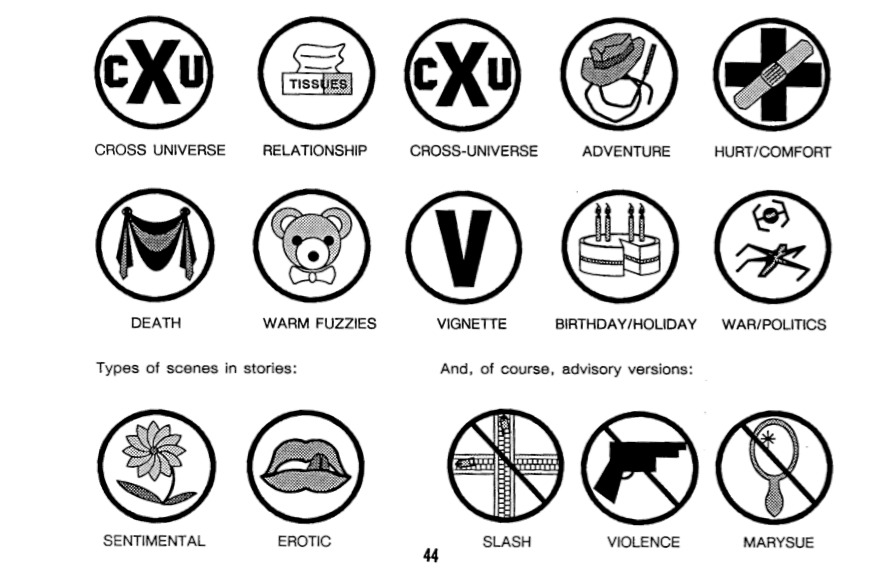
And speaking of The Southern Enclave, in 1987 Maggie N, fed up with the eternal warnings debate created a handy dandy labeling guide for your fanfic. It is only a bit tongue in cheek.

E-Mail and Mailing Lists: When The Internet Was A Toll Road

How many of us remember the early days of email and mailing lists? When you had to pay for every message you downloaded?  If you were on CompuServe or Genie or AOL, messages within their network were often free – but every message from the “Internet” cost you extra. For example, a single Internet message on CompuServe cost 15 cents. A fan would pay $8.95 a month for the basic service. If you dialed in during business hours, you paid additional connection charges.   As long as it was after hours or on weekends, you paid no connect or online charges.  But each Internet message came  postage due.  The volume of mailing list email could literally nickel and dime your wallet empty.

Example CompuServe charges from 1994

                Read/Download Internet Messages:**
                first 7500 characters            $ .15 (or 25 cents in today’s money)
                additional 2500 characters       $ .05
                 ** If Internet messages are deleted without reading or automatically
                    deleted by the system after 30 days, no charges are incurred.

                Users on CIS’ Standard Pricing Plan ($8.95/mo with no connect charges for basic   services, including e-mail) are given an electronic mail allowance of $9.00, which includes reading/downloading Internet messages)“

 Here is one fan who complained to a public mailing list in 1993 (message has been slightly edited)

 I love to hear from you, but PLEASE address your answers to the [mailing] list and not to me.  I simply cannot afford to pay the transfer charges every time a message is transfered from Internet to [my service provider].

I can afford to read the [mailing] list three times a week, but if I get too many messages replying to me personally I shall simply have to stop posting.

Fans came up with creative workarounds. You might find a friend who had un-metered email and ask them to download an entire day’s worth of messages and forward it to you as a single message.  That way you could read everything and only pay for one (very long) message. And when replying, you would send all your responses back to the list in one single message.

 When digest email was introduced, the costs came down considerably and you didn’t have to bother your friends. On Virgule-L, one of the list admins ran calculations back in 1994 and here are the numbers (adjusted upwards to today’s dollars). 

In a typical month, a mailing list could generate about 600Kb of traffic.  Assuming one message per day (digest format), that would come to approximately  a total of $21/mo, or an extra $7/mo for those fans already paying the basic monthly charge. Assuming a very chatty month with 1Mb of traffic, the figure would be $32.00/month.

Note that these figures would be *much* more if the mailing list were received on a per-message basis, because each message would incur the 7500 character minimum charge of $0.25 cents, even if the message was much shorter than that.  So, assuming that you saw about 300 messages a month, and that 100 of those are 5000 characters over the 7500 minimum, the charge would be $84.00/month.  On a busy month where you would receive 500+ messages, it would be more like $115/month. 

So there you have it: the cost to subscribe to a single mailing list ranged between $32 -$115/month.

I shared this with a friend and this is what she wrote back: 

“…when people first started getting personal computers, there was all sorts of essays and comments and reactions from fans about how "online wasn’t free,” that everyone knew print zines cost cold hard cash but buying a computer, paying for modems, being online, ink cartridges, (some even tossed in the cost of their desks and chairs!), as an example of why the fic online wasn’t actually “free,” that those with computers had to put out a substantial financial outlay (which they did!), and that netfans were actually just as exclusionary regarding access as print fans. 

But somewhere along the way, those comments completely stopped. No one now says stuff like that anymore. The cost of having computer access in one’s home has been absorbed as a general cost of doing business. Today, complaining of those costs would be like complaining about having to turn a light on so you didn’t have to squint at a fanwork in the dark.”

 When I attended Escapade, the slash convention the 1990s, the print fan vs net fan debate raged.  Netfans did not fare well in these discussions - net fans were elitists, running away to online places where the average fan could not afford to follow. Netfans treated fanfic as a product instead of a community gift. Net fandom encouraged Instant Gratification Mentality.  But these debates only lasted a few years. Then one year, someone at Escapade asked everyone in the room who did not have a computer to raise their hand. It was about 30% of the room. Three years later the same question was asked and one lone woman raised her hand. And thus we all became netfans. And it was good.

(links go to Fanlore, the fan run wiki about fandom and its history)

Kirk/Spock - Not Always A Happy Ending

This week I scanned this zine for the authors and their families.

The zine, The Rack, was a response to the K/S premise by carrying forward the then current views about homosexuality into the Star Trek future with devastating consequences. It made quite an impact when it was published in 1980. And it, in turn, created more response fic.

As the authors explained: “We have stated that many readers were emotionally upset by the tragedy of THE RACK. Some expressed their feelings through Letters of Comment, while others were compelled to write their own stories, poems and vignettes, ideas inspired by the heartwrenching, difficult-to-accept ending… Other stories, published elsewhere, were also inspired by our novella. Mariann H, in TRIAL (NEXUS 1), delivers an alternate ending which had its own impact on fandom. While we don’t agree with her premise, we know Mariann’s story did satisfy those for whom the unhappy ending of THE RACK was difficult to handle….People have been compelled to analyze the story, write alternate endings for it and continue to request we reprint ALL THE KING’S HORSES. Working on THE RACK, its sequel and this ‘zine has been a unique and important experience for us as writers. The stories have touched our lives, becoming part of us in a very personal way — we’ve learned a lot about people in general, fandom and the art of writing”

Links go to Fanlore - the fan run wiki about fandom

Fan Vidding: The TeenAge Years - Part 5

We’re at the end of our discussion of Rainbow Noise, the first (and only) vidding letterzine. Published in 1993, we have been only able to find two issues. If you have any copies, drop me an email or comment.

The last section in the letterzine focuses on two topics: “how much to charge for your fanvids on videotape” and “wouldn’t it be awesome to have a fanvid library where we could borrow vids on tape?”

The issue of whether to charge - and how much to charge - for fanworks is that one fanzine publishers, fan artists, and fan vidders have wrestled with since media fandom flowered in the 1960s. Today, the prevailing view is that it is wrongwrong and WRONG to ask for any money for your fanworks. Fanworks are gift of love. And everything should be free on the Internet, right?

But in those olden days, the days before the Internet, the only way to share a story was to physically imprint it on paper (such as a mimeograph machine that inked letters onto drums that rotated and spun and made you high with their fumes), seal it in an envelope and send it via post. Few fans had printers in their homes and before the 1990s computer ownership was not common among fans (although fandom with their geeky ways were early adopters of computer technology). Fan vids had to be made on VCRs using videotape. In fact you needed two VCRs to make a fanvid – at a time when most homes could only afford one VCR. And, like fanzines you had to ship the videotapes through sleet and snow and hail. Fan artists - well the print reproduction process was limited. And who would ship their originals to a convention hundreds or thousands of miles away just so someone could see your art? Submitting your fanart to fanzines in exchange for a contributor’s copy was the only way to “be seen.” Which led straight back to fanzines and how much to charge for them.

But back to the song video library. If a vidder did climb that logistical mountain to make copies of her “songtapes“ to send out to the world….. well the quantities were limited. Since there was no Internet, the only place to see fanvids was to travel to a convention (very expensive) or to find someone local who had a copy and was willing to open their living rooms to you. And for fan vidders who wanted to see other vidder’s work - well everyone was in the same boat. Forget about discussions of fan vids, or feedback or concrit…. if 100 people ever saw your vid, you were lucky. If 500 people saw your vid, you might as well call yourself Vincent and gogh home and paint more sunflowers.

So you can imagine how a song video lending library would have been an awesome idea.

Sadly, the technical logistics and the small circulation of the Rainbow Noise meant that the songvid library never took off.

So now, aren’t you glad that the Internet was invented just so you can watch and share fanvids? And art? And fic? And podfic? And gifsets?

On to the proposal in issue #2 of Rainbow Noise:

"Opinion Time: Like a story sitting in a drawer, a video that no one sees is wasted. Years ago I became frustrated because I would see a video once at a con and never again. Or, even worse, hear about it second hand. Or, the very worst, have only multiple gen or ripped-off copies floating around. That’s why, back in the Calicon days, I started making "contest tapes” for the convention members. There has been wonderful encouragement and support from concoms (like Candy P. who even makes special lists on her

computer) and the video makers who allow me to copy their songs. I want to publicly thank everyone for their help. But, I’m still a little frustrated. I keep hearing about videos, videomakers that I’ve missed (I was told 2 years ago about a funny video with different fandoms bowling—but have yet to see it!)

I am also disturbed by reports that pseudo fans are duping off multiple gen copies of music videos and selling these for big bucks. If anyone wants more than $5.00 for any con, or compiled (ie. from multiple video makers) tape—this is a rip-off. Please spread the word and let’s try to shut them down.

A second means of attack and a way to relieve my frustration with missing videos came to mind while talking with several video makers. I propose setting up a music video library. Video makers would send me tapes of their work and I could dupe for fans (at cost) on my industrial quality VHS, Beta and PAL machines. Creators would have a wider audience, the best possible copies would be available, and creators would miss the hassle of running bunches of copies. This arrangement has worked out well for people like Mary Van Deusen and Cybel. However, if a maker, such as Dee Jay, prefers to make her own copies, I’d be willing to pass along flyers, or info. So, I invite all video makers to contact me.

I am also willing (eager) to put together and distribute copies of con video contest tapes for cons that1 do not attend. I would like to invite any concom to contact me.“

(links go to Fanlore, the fan run wiki about fandom history)

The Digital Dark Ages...

I’ve blogged about this several times before - the monks during the Dark Ages of European history were able to preserve more history than is being preserved today. In fact, within 2 years 30% of of online data vanishes - and that number climbs every year, even with Google and the WayBack Machine.

But digital historians are testing out new reconstructions method:

“What’s interesting is that this process is a kind of internet archaeology that reconstructs an historical web page from the context in which it occurred. That’s a fascinating new discipline.In the real world, archaeologists and anthropologists have become highly skilled at reconstructing natural history in this way. The conclusions that can be drawn from the discovery and analysis of a single tooth, for example, are truly astounding.”

I Only Do It For Love, Not Money

Interesting article (a snippet below).

Read more about Going Pro/Pulled To Publish , Fandom and Profit  and fandom’s Gift Economy on Fanlore.

“Because women’s social role is often essentialized as procreative labour accordingto the extant sex-gender system, it is unsurprising that women who challenge that role arediscursively connected to women who disrupt their ‘proper’ sexualized role as wives andmothers. Women writers who publish their work refuse their role as unpaid producers of“gifts of love” – instead, they enter into the market economy to “sully” themselves in thepublic sphere. We can see this in discussions of fans who seek to profit from their work:too often, this is described in pejorative ways, such as complaints about fan authors who“try to make a few bucks” (mctina) and “earn” themselves “some cash” (akasakasan), by
forcing others in fandom to “pony up the Benjamins!” (thebratqueen).”

from “Filthy Lucre and Test Audiences: Fan Debates about Publishing Fan Fiction” by Monica Flegel

Fan Vidding: The TeenAge Years - Part 4

We’re almost at an end to our journey back to 1993 and the Middle Ages of fan vidding. In the second issue of Rainbow Noise, the vidding letterzine, a lonely male vidder writes an essay titled: “Song Videos and the Male of the Species.”

At the time, almost all media fan vidders were female (in contrast to other vidding fandoms such as anime)

In the essay, he argues that the prevalence of female vidders in media fandom is an historical accident. And that surely the percentage of slash videos will drop dramatically. Right? Right?

“Unless we can argue that there is some inherent predisposition from an interest in slash to the production of music videos, above and beyond a familiarity with video equipment which is shared with, for example, fans of Japanese Animation, we must admit that the particular way in which song tapes have evolved and the resulting preponderance of female video artists is largely a historical accident.

All this may be painfully obvious to everyone else, but if the theory is true we can make several predictions. As time goes on, the dominant sex of those creating music videos may remain female, just as a small majority of science fiction fans are still male, but the ratio will level. out More significantly, we can predict that as the hobby expands, the total number of slash videos being produced will probably increase, but the percentage of slash videos will drop dramatically.”

Links go to Fanlore, the fan run wiki.

It's IDIC! Live! From 1988!

ScotPress, one of the earliest Star Trek fanzine publishers in the UK has posted the first 10 issues of their letterzine IDIC online. You can read the issues here. And there is more info about the newsletter’s history on Fanlore here.

Here’s a snippet from the first newsletter:

“It was the advent of video which changed the face of
conventions. At first, the technology was too expensive for the average ‘man on the street,’ but conventions could afford to hire the equipment, and although blank tapes were £15.00 a time, a secondary programme of available episodes began to take shape, splitting the attendees into smaller groups. The 'one big happy family’ feeling began to dissipate; I’m told of a convention where Trek episodes were available 24 hours a day on the hotel’s in-house system, resulted in some people never leaving their rooms for the entire weekend!… Nowadays if an original Trek episode formed part of the main programme at a convention, it would have a very poor attendance indeed, and it seems that a higher percentage expect to be entertained 24 hours a day, rather than being prepared to make their own amusements.”

(links go to Fanlore, the fan run wiki)

Fan Vidding: The TeenAge Years - Part 3

The shift from analog to digital vidding in the early 2000s impacted fannish life on so many levels. For example, videotape was fragile and could wear out and break. Every copy you made from a videotape lost clarity, until you were watching small blobs running across the screen. And for many fandoms, it was not until decades later when your TV show appeared on DVD that you realized you had your favorite character’s eye  color all wrong.

But vidders were always willing to give technical tips. Here are some tips on how to watch your favorite TV shows. To closely approximate this on your DVD/DVR/Computer, please remember to use only every other key/button to preserve their lifespan:

“It is possible to love a tape to death. Recently, I borrowed a series from another fan, and I can tell where every one of her favorite scenes is located. Every time she paused the tape - backed it up - paused the tape - replayed it (sometimes in slow motion), the tape stretched a little bit. Now her favorite scenes are bracketed with wavy pictures and rolling images. You can avoid this. First, pause a tape as little as possible. Second, if you must pause, as in making music videos, try to pause in a different spot each time. Doing it just seconds before and after the usual spot can minimize the damage. Third, use a stronger tape. Professional (AKA industrial) tape is made for editing. Few of us can afford it for a whole series, although you can get best episodes in rerun.* The next best choice is an extra high grade (AKA special event) tape. I use Sony, Maxell, or TDK.”


From Rainbow Noise, the first and only vidding letterzine published in 1993.

*The cost of a single 2hr professional grade videotape in the early 1990s was around $15 or $24 in today’s dollars. Imagine paying $24 today  for 2 episodes that you recorded off-air…That would be almost $300 for an entire season of Teen Wold or Supernatural, And you’d have to do all the taping work yourself…and pay for the cable. And the VCR. And the TV. 

Links go to Fanlore, the fan run Wiki

Fan Vidding: The TeenAge Years - Part 2

We’re still in 1993, solidly placed within the era of VCR vidding. In the first issue of the letterzine Rainbow Noise, vidder Gayle F writes an article about the use of color in vids: how she selects clips based on color scheme and not because of content or context or movement.  Digital vidding is another 7 years away and the ability to change or edit the color scheme of an existing clip is beyond imagination. 

“I realize this will not be obviously apparent to the viewer, but I do believe [color in vids] influences the whole, making it a more aesthetically pleasing and emotionally effective vid. …. I do think it is an often over-looked way of adding richness and cohesion to a video. It can be used to build mood, and to smooth transitions….. While color is generally only one of these many on-going considerations for me, I do have one recent vid where I feel it works a major force in the emotional effect of the vid, fusing meaning and mood. This is the MV vid, End of the Night…..When I was listening to the Doors’ End of the Night, I decided it would be a great song for a Sonny-as-Burnett vid. Without a clear memory of that part of the series, I knew I wanted to use the dream sequence, and imagined that it would be played against a lot of night images, dark both visually and in content. When I actually rewatched the episodes, I was delighted by the frequent use of surreal color, and decided to build the vid using those images. Because so many of the images from these episodes have colored lighting, the same visual effect might have been inadvertently obtained choosing images only on the basis of content, but there were significant moments that could have been used with more natural lighting which I rejected in favor of the strange nightmarish world that builds up with the heightened color. All the night blacks are stained with either blue or red, and the cold, distant blue and the hot, flame and blood red are themselves used as the predominant lighting in other shots. The unnatural, bleached white of the dream sequence becomes the "bright midnight” of the lyrics, fusing the black nightmare world of Burnett with Sonny’s haunted dreamscape. I choose just one moment of white interior lighting before the end of the song-in Burnett’s bathroom, where the screen splits into black and while halves as Sonny/Burnett reaches out to touch his reflection in the mirror. Although the color was less exaggerated, it echoed the other scenes and epitomized the emotional conflict. Only when Sonny starts to remember and accept who he is, does natural sunlight, normality, enter the images. Even then, the first images are blue washed, impressionistic. Only in the last-paradoxically nightmarish-shot of Sonny’s return to the station is the lighting clear and bright.“

A few years later, Gayle repeated the lesson in color at an Escapade vid panel and fan vidders boggled at the idea of using color as  a primary factor in choosing a clip. It would be like designing an entire menu around the color white. Or red. Choosing your food based on color and not on nutrition or taste? Craazy vid talk!

You can see screencaps from the Miami Vice vid "End of the Line” here.

On a personal note, my first VCR vids were done with Gayle as my teacher and mentor. When I vidded with her clips were selected based on color, context (what was happening in the episode) and content (what was happening in the clip), often in that order. When I vidded on my own, my choices were content, context and only then color. When I began digital vidding, I discovered I no longer had to put color last - I now had the ability to change the color palette of a clip if I needed to. I could have my white chocolate cake with white chocolate  frosting and white chocolate cherries on the top and eat it too (although why anyone eats white chocolate anything is beyond me.)

The second in a series about the Rainbow Noise letterzine. Links go to Fanlore, the fan run wiki,

Fan Vidding: The TeenAge Years - Part 1

The year is 1993. Video editing VCRs are all the rage with fan vidders pooling their money to buy a single machine for $1000* which they pass around from home to home. Fanvids have been around for almost two decades but there are few, if any places, where vidders can talk about vidding. Almost no one has email and mailing lists are just beyond the horizon.Two vidders decide to publish a letterzine for vidders and decide to call it Rainbow Noise - named after the flashes of color you sometimes get on videotape when you make an edit on a VCR without a flying erase head.


But first, before they can publish, they have to decide what to talk about. In the initial subscription letter, the editors tossed out a few suggestions. Remarkably, technology aside, it is very much the same as what vidders talk about today.

The first in a series of posts about Rainbow Noise.** 

Some inks go to Fanlore, the fan run wiki.
___________________________________________

Ideas for Contributions to Rainbow Noise (excerpts)

*That’s in today’s dollars
**A special thanks goes out to gattagrigia who found two issues of Rainbow Noise and donated them. They will eventually be sent to the Fanzine Archives to be part of the Sandy Hereld collection. We do not know how many issues were published (we only have issue #1 and 2), so more info about the letterzine - and additional copies - would be very much welcomed.

Carlos and Cecil Are Sitting In A Tree....

1. I think it would make Cecil very happy if we all decided to donate a set number to Nightvale so he could take Carlos out on a date. Say….we all send $6.66? You can donate here
2. A handy dandy Fall TV preview grid is here,
3. The history of e-zines (electronic zines) is on Fanlore here.

Webcite is the long running citation service that allows users to create a static snapshot of public content for citation purposes. They have been offering their service for free for the past 10 years and it is heavily used by Wikipedia and other teaching and educational groups. They need funding to upgrade and continue operating. Access is currently intermittent. The latest update (from Sept 1): “

Yes, the server went down, hosting company didn’t provide any explanation. We are in the process of migrating the service to Amazon. Due to the size of the archive this is neither a trivial nor an inexpensive task. Donations are appreciated. http://fnd.us/c/aQMp7

A Follow-up To My Star Trek Audio Recording Post

My earlier post about  Star Trek audio recordings is here: http://meeedeee.tumblr.com/post/59878375513/the-days-before-vcrs-dvrs-dvds-in-the-1970s-if
Today, I came across this essay written by Lillian Stewart Carl in which she talks about her friendship with Lois Bujold, their love of Star Trek and the Star Trek fanzine they wrote and published (one of the earliest media fanzines). I am only quoting the section about the audio recordings, but the entire essay is worth a read:

“Then, one fall, I returned home from a vacation to find Lois enthusing over a new television program, one that linked naturally into her years of reading science fiction.

I watched Star Trek. I fell for it too. Spock made intelligence classy. He was so cool, so—unattainable. Unlike Kirk, who was incessantly Available. And there were women on the Enterprise. They wore miniskirts and said, “Hailing frequencies open,” and “Captain, I’m scared”, but they were female nonetheless.

Every Thursday evening during our senior year found us sitting in front of Lois’s television (she had the color set) watching Star Trek.We suborned other friends into joining us. We rigged up Lois’s father’s reel-to-reel tape recorder and recorded each episode—audio only, the concept of the VCR being science fiction itself.

The tape would pick up the sound of the telephone ringing in the background, chairs scooting, popcorn crunching. And during the previews to the episode This Side of Paradise, it recorded half-a-dozen female squeals as Spock actually (be still, my teenage hormones) smiled!

I wish we still had the tape which immortalized her mother’s voice saying, “You girls are going to be so embarrassed when you grow up and remember how you acted over this program.”

….

Our graduation from high school took place on a Thursday night, forcing us to miss the episode Shore Leave. Strangely, our families refused to attend the ceremonies without us. The younger sister of a friend was deputized to do the taping and fill in the video portion with gestures and expressions.

The next fall I went away to college, in a town that had only two television stations, neither of which showed Star Trek. Lots transcribed the episode Amok Time, including the stage directions (“bowl of soup flies across passageway”) and sent it to me. My roommate sniffed and said I was psychologically abnormal. But another friend gave me a poster of Spock.”

(some links go to Fanlore, the fan run wiki)

For Those Unhappy With Unauthorized Sharing of Fanworks....

When has fandom ever *not* shared. Even in the face of warnings like the ones below. It is like premarital sex. There is the Pope and the local priest thundering about how it is not done/should not be done/wasn’t done as much in those olden more morally upstanding days…and all the while everyone just goes out and keeps doing it all over the place. The problem is not the doing…it is the lying about the doing and the pretending there is no doing and trying to shame and shun those for the doing. (links go to Fanlore, the fan run wiki)

From Fanlore:

“At least one copy of the Pros circuit version contains a front page with a copyright notice "1983 by Blue Jay Press” and a statement:

“A limited edition printing of 50. Copy number 33…Not to be copied or otherwise reproduced without permission in writing from Blue Jay Press. This copy of PAINTING IN THE CLOUDS remains the property of Blue Jay Press, who reserve the right to ask for its return at any future date.”

Below in handwriting someone has written:
“[N], I don’t have permission [to copy this story] and I don’t care. It’s Lewis B-day today and I’m being anarchic. (Just don’t tell [P] or she’ll yell at me).”


Above in different handwriting:
“K&J, [N] sent me a copy of her copy before I got mine….a year ago I guess, as Lew’s Birthday is May 27. Read this before Masquerade.”

There is no author credit on the story.

Bits of history like this make me happier to be a fan…to know that we are still human and have always been human and (hopefully) will stay human down the road.